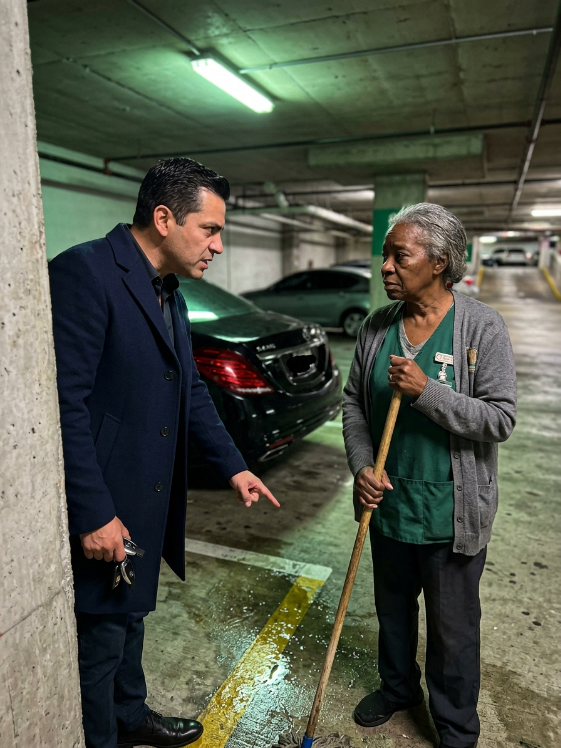
Victor Salazar looked from the old hospital pin to Alma Reed’s face, then pulled out his phone with hands that suddenly would not behave.
The parking garage under Aurelia Tower had gone too quiet. Fluorescent light greened the damp concrete beside Victor’s black sedan, and yellow mop water glistened near Alma’s shoes. A minute earlier, he had been pointing at the wet floor like a man whose name on the building gave him ownership of every inconvenience beneath it. Now his luxury keys hung still from one finger.
Alma held the mop handle with both hands. She was seventy, gray cardigan under a cleaning vest, shoulders rounded but steady. The small hospital pin on her sweater had caught the light first. Then came the humming, soft enough to hide inside the garage echo until it folded around Victor and opened a room he had spent thirty-five years keeping locked.
He found his mother’s number and missed the button twice.
‘Why are you calling someone?’ Alma asked.
Victor almost said he was calling management. That would have been easier. Instead he heard the tune again in his head, sung beside a hospital bed while his lungs fought a tube and his mother’s hand shook against his ankle.
‘I know that song,’ he said.
Alma lowered her eyes to the mop bucket. ‘A lot of nurses knew songs.’
‘Not that one.’
The phone rang. His mother answered on the fourth buzz, voice thin with sleep and Miami distance.
‘Victor?’
He turned away from Alma as if privacy could survive in an empty garage. ‘When I was a kid at St. Agnes. After the surgery. There was a nurse who sang to me.’
The line went quiet.
‘Mom?’
Her breath caught once. ‘Alma Reed.’
Behind him, the mop handle clicked softly against the bucket.
Victor turned back. Alma had closed her eyes.
His mother said, ‘Is she there?’
The question carried more than recognition. It carried fear.
Victor had been seven when the asthma attack became cardiac arrest during what hospital paperwork later called a routine procedure. He remembered flashes: a white ceiling, plastic taste, his father shouting somewhere beyond a curtain, and a woman’s voice singing low beside his ear. Years later, his family turned that week into a charity story. Survived child becomes developer. Developer funds clinics. Developer buys towers. The nurse never had a name in the speeches.
Alma had one.
‘Why is she cleaning my garage?’ Victor asked.
His mother did not answer fast enough.
Alma opened her eyes. ‘Because work is work. And because the clinic closed.’
Victor stared at the old pin. It was not decorative. It was from St. Agnes, the private hospital where his father had sat on the board, where a malpractice settlement had never been called a settlement in front of him.
The elevator doors opened. Mr. Harrow stepped out in a linen jacket, carrying a garment bag from the residents’ valet. Seventy-three, silver hair, smiling with the relaxed entitlement of a man who believed every building meeting was already decided before it began. He lived in the penthouse above Victor’s garage and chaired half the charity boards Victor wanted near his name.
‘Victor,’ Harrow said, glancing at the mop water. ‘Problem with staff?’
Alma’s fingers tightened.
Victor had heard that tone all his life: clean, public, destructive.
‘Were you on the St. Agnes board in 1991?’ Victor asked.
Harrow’s smile did not vanish. It adapted. ‘Long time ago. Why?’
Victor’s mother was still on the phone. Her voice came small through the speaker. ‘Victor, don’t do this in a garage.’
‘You mean where nobody important can hear?’ he asked.
Alma whispered, ‘Mr. Salazar.’
He looked at her. She was not asking him to stop because she feared the truth. She was asking because the truth had cost her enough already.
Harrow chuckled. ‘I have a dinner upstairs. If this is about some old hospital appeal, send it to my office.’
Victor stepped between him and the elevator.
The story came in pieces because nobody wanted to tell it whole. Alma had been the night nurse assigned to pediatric recovery. Victor’s chart showed a medication dose changed after rounds. Alma caught the reaction early, started compressions before the code team arrived, and stayed after her shift singing because the boy panicked whenever the machines clicked. Then she wrote an incident report naming the surgeon who changed the dose and the board member who pressured staff to close the complaint before donor weekend.
Harrow had been that board member.
The report disappeared. The surgeon transferred. Alma was dismissed for insubordination. Victor’s parents were told a nurse had become emotionally unstable after the emergency and was no longer with the hospital. A nondisclosure agreement arrived with the settlement check his father never let him see.
Alma said none of this dramatically. She spoke as if reading a grocery list she had carried too long. Harrow interrupted twice. Victor raised one hand both times, and the older man stopped, offended by the unfamiliar experience of being managed in a garage.
‘You let her lose her license?’ Victor asked.
‘I protected an institution,’ Harrow said. ‘Your family benefited from that institution.’
Alma looked at the floor. ‘I kept my license. Barely. But no hospital in that network hired me again.’
Victor’s mother began crying softly on the phone. ‘Your father said it was finished. I believed him because I needed you alive more than I needed the fight.’
Victor’s anger moved strangely. Not hot. Precise.
He ended the call gently and put the phone in his coat pocket. Then he took a photo of Alma’s pin, not her face, and another of Harrow beside the elevator security camera. Harrow’s smile finally broke.
‘Be careful, Victor.’
‘I am being careful,’ Victor said. ‘For the first time tonight.’
By midnight, Aurelia Tower’s lobby office had the old St. Agnes files pulled from Victor’s family storage. By morning, a lawyer had the settlement agreement, the missing incident report Alma had kept in carbon copy, and a list of board signatures. Harrow’s name appeared twice. Victor sent the packet to every board where Harrow still sat and removed him from Aurelia’s medical charity committee before breakfast.
The public announcement was short: Aurelia Foundation would fund the reopening of the neighborhood clinic Alma had run after St. Agnes blacklisted her, with Alma Reed as director emeritus and paid patient advocate. It also called for an independent review of St. Agnes legacy settlements. Harrow resigned from three boards in one week. He moved out of the penthouse before the month ended, leaving forwarding labels on boxes he did not carry himself.
Alma did not want a ribbon ceremony. Victor compromised badly and gave her one anyway, but without speeches from donors. The first day the clinic reopened, she stood in the doorway wearing her gray cardigan and the old pin, polished now but still dull at the edges.
Victor arrived with his mother. She had brought a photograph of him at seven, thin and scared in a hospital bed, one small hand curled around a nurse’s finger. Alma took the photo and touched the corner as if checking whether time could bruise.
‘I used to hum so you would breathe slower,’ she said.
Victor looked at the exam rooms behind her, at parents filling forms, at a little boy swinging his sneakers from a chair.
‘Would you sing it once?’ he asked.
Alma smiled, almost embarrassed, and hummed the first line. The clinic noise softened around it.
Victor put his keys in his pocket and listened until the last note faded.