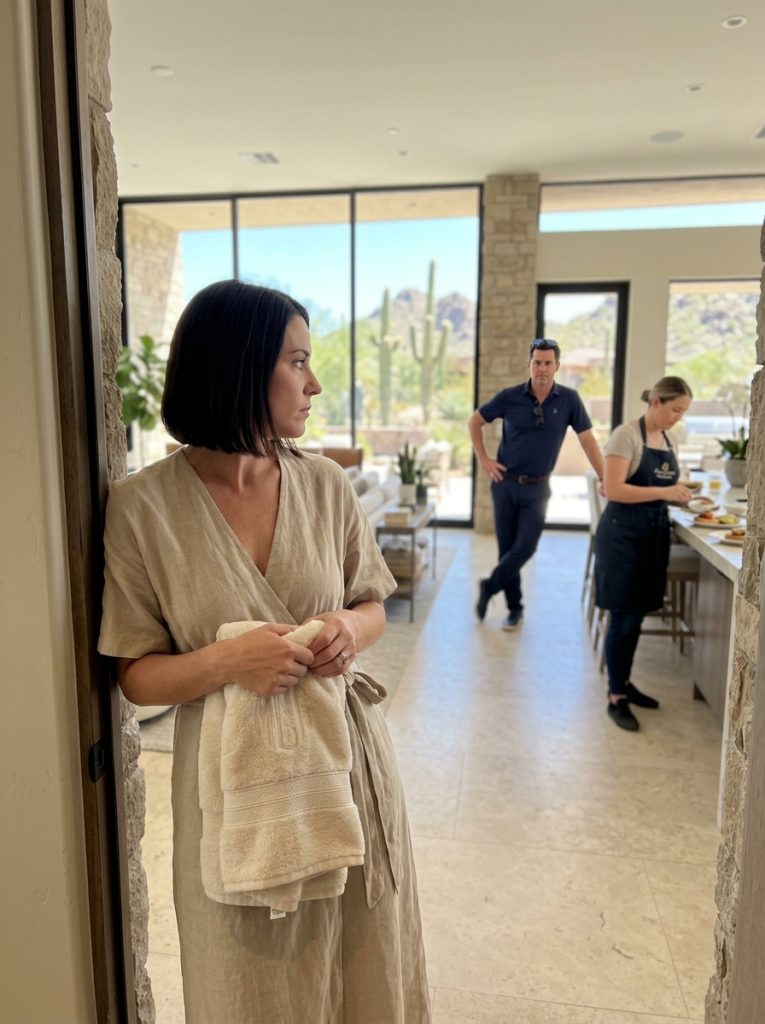
I got through that brunch. I want to be proud of that and I’m not sure I should be, but I did. I ate the eggs the other woman cooked in my kitchen and I made small talk with my husband and I watched the two of them not-quite-look at each other, and I saw it now that I was looking — the ease between them, the way she knew where the good glasses were, the way Lon’s hand drifted toward the small of her back once before he caught himself.
She’d been in my house before. Many times. You don’t move that comfortably through a kitchen you catered once.
When she left, I told Lon I had a headache and was going to lie down. He was solicitous, sweet even, and that was the worst part, the performance of a caring husband layered over whatever he’d built in my own home.
Then I started paying attention.
I’m in real estate. I read documents for a living. And the first thing I did, lying in our room while Lon golfed that afternoon, was something I should have done a year earlier when the “attentiveness” started: I looked.
The guest suite told the story first. It wasn’t a room nobody used. It was a room I didn’t use. There were her things tucked into drawers I never opened. A second toothbrush. A phone charger. Clothes in her size. A nightstand book with a receipt as a bookmark, dated across the last several months — the same months Lon had been traveling for “work” so often, the same months he’d started hiring “help” whenever I’d be home, so that her presence in the house would have a cover if I ever crossed paths with her.
He’d been keeping her. Partly here, in the wing I avoided, hidden behind a story so mundane I’d never questioned it. The audacity of it took my breath away even more than the betrayal. He hadn’t even rented an apartment. He’d hidden the other woman in the blind spot of my own trust.
The second thing I looked at was the house itself. The deed.
And this is where Lon made his mistake, the way these men always do — he forgot the paperwork.
The house was in my name. Not both of ours. Mine. I’d bought it before we married, with money from my own career, and we’d never retitled it, because Lon “didn’t want to deal with the hassle” back when dealing with it would have given him a claim. His arrogance had assumed the house was his the way he’d assumed everything was his, including the right to install a girlfriend in it.
It was my house. He was, legally, my guest. So was she.
I didn’t confront him in a screaming match. That’s not how you win against a man who’s charming and careful and has been planning around your blind spots for a year. I did it the way I do a difficult closing. Quietly, with documentation, with the right people lined up before the other side knows the deal has changed.
I photographed the guest suite — her things, the robes, the monogram, the dated receipt. I called a lawyer, a sharp one, who confirmed what I already knew about the deed and walked me through exactly how to protect myself. I gathered the financial records, because the “work travel” and the “catering” and the gifts had all been flowing somewhere, and it turned out a fair amount of our shared money had been quietly furnishing a double life.
I gave it three days. Three days of being the oblivious wife while I got everything in order. It was the hardest acting I’ve ever done, and I’ll admit there were moments I wanted to throw the monogrammed robe in his face over dinner. I didn’t. Calm was the whole strategy.
Those three days were the longest of my life. I’d wake up next to a man I’d loved for six years and have to remember, all over again, what he’d done — and then arrange my face into the soft, oblivious expression of a wife who suspected nothing. I made his coffee. I asked about his golf. I let him kiss my cheek on his way out the door, and the second the door closed I was on the phone with my lawyer.
I documented everything before I changed a single thing. I photographed the guest suite — her clothes in the drawers, the second toothbrush, the book with the dated receipt as a bookmark, the matching robes with the monogram. I pulled financial records and traced the “work travel” and the “catering” to the places they’d actually gone. The picture that came together was a man running a second household in the blind spot of his first, funded quietly out of accounts he assumed I never checked, hidden behind a parade of “help” he’d hired specifically so another woman’s presence in our home would never seem strange.
On the third evening, when everything was filed and protected and a locksmith was scheduled for the next morning, I sat Lon down at the long counter where his girlfriend had plated brunch, and I laid it out.
The photos. The robes. The monogram on the apron that matched the monogram on the robe. The dated receipt. The financial trail. And, on top of the stack, a copy of the deed with one name on it.
Mine.
I watched my husband try every move in his playbook. Denial first — “you’re misreading this, she really is a caterer.” Then, when the photos made that impossible, the pivot to anger — how dare I go through “his” things, how dare I invade “his” privacy. I almost laughed at that one. His privacy. In my house. With his mistress’s robe hanging in my closet.
When anger didn’t work, he tried the tears, the “I lost my way,” the “we can fix this.” And for a moment, I’ll be honest, the years we’d shared pulled at me.
Then I thought about the perfume in the guest room, and the easy way her hand knew my kitchen, and the year he’d spent betting on me being too trusting to look. And the pull let go.
“Here’s what’s happening,” I said, in my closing voice, the calm one. “This is my house. You’re going to pack a bag tonight, and you’re going to stay somewhere else, and we’re going to do the rest through lawyers. The locks change in the morning. Your friend’s robes will be in a box on the porch. I’ve already protected the accounts.”
He sputtered about being thrown out of his home.
“It was never your home, Lon,” I said. “You just lived in it comfortably enough to forget whose name was on it. Same as the marriage, I think.”
The divorce is settled now. The house is still mine, all glass and stone and desert light, and I finally use the guest suite — I turned it into an office, a bright room with a view, a room for the life I actually live now. I had it repainted first. New everything. The perfume took a while to leave, but it left.
Lon and the woman with the monogram didn’t last, which surprised no one but them. A man who’ll hide a girlfriend in his wife’s blind spot isn’t building a future with anybody. He’s just collecting.
People ask if I feel foolish for not noticing sooner. I used to. Now I think about it differently. I didn’t fail to notice because I’m stupid. I failed to notice because I trusted my husband, and trust means you don’t search your own house. That’s not a flaw. That’s what love is supposed to be allowed to be.
He’s the one who turned my trust into a hiding place.
And the monogram he was too careless to hide turned it right back into the truth.