The nurse held the envelope out, but it was me she spoke to, not the son in the camel coat.
“He gave me this six months ago,” she said. “When he updated his directives. He told me, ‘If I ever can’t speak for myself, the woman who drives the bus speaks for me. Not my son. Her.’ He made me write it down.”
Dennis Mead’s face went through several colors.
“That’s absurd. I’m his son. I have power of attorney—”
“You had power of attorney,” the nurse said gently. “He revoked it in the spring. It’s all filed.”
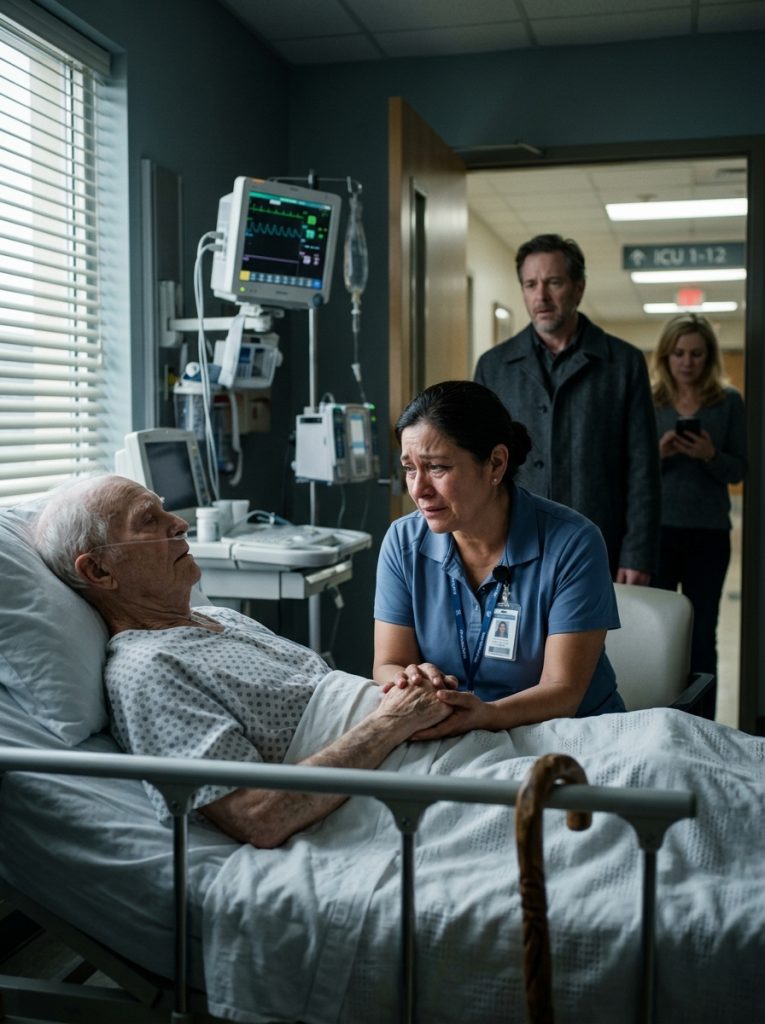
I didn’t open the envelope right then. It didn’t feel like the time. Arthur was still breathing, slow and shallow, and I went back to his side and took his hand again, because that was the only thing in the room I understood how to do.
He passed a little after nine that morning.
I was holding his hand. I told him the shuttle was warm and the route was clear and he didn’t have to hurry, not anymore. I told him he could rest. And he did, the way you blow out a candle — there, and then just the smoke of him, and the quiet.
Dennis and Sharon were in the hallway on their phones. They didn’t see it. I’ll never understand people who drive all that way and still can’t make it the last ten feet to the bed.
The funeral was small, but not the way Dennis expected.
He’d booked the big chapel, picturing colleagues and old friends. Almost nobody from Arthur’s past came — he’d outlived most of them, and the rest had drifted off during the long lonely years nobody witnessed.
But the back of that chapel filled up with people Dennis didn’t recognize.
Senior-shuttle riders leaning on walkers. Three other drivers in their transit blues. The lady from the credit union. The pharmacist who knew Arthur’s prescriptions by heart. The quiet daily life of a man the world had decided to forget, all of it standing up in the back rows in its good clothes.
They came for Arthur.
And, I think, they came for me.
I opened the envelope that night, alone, at my kitchen table.
It wasn’t a long letter. Arthur was a shop teacher; he believed in saying the thing and stopping. But I have it memorized now, the way you memorize the few things that turn out to be load-bearing.
Rosa — If you’re reading this, I’ve caught my last ride. Don’t be sad too long; sad doesn’t suit you. You waited for me nine years when nobody else would cross the street. A man notices who waits. I had more than people thought. I want you to have it. The house is paid for. There’s money in the credit union. And there’s the workshop. Do something good with it, the way you did something good with four minutes a day. Your friend, Arthur Mead.
Folded behind the letter was a second sheet of paper, and that was the one that stopped my heart.
It was a list. In his careful block print. Dates going back years.
Dec 24 — alone. Birthday, March 3 — no call. Easter — no call. Father’s Day — Dennis came 40 min, took the recliner, left. Thanksgiving — alone, Rosa brought a plate.
He’d written it all down. Every missed holiday. Every visit that wasn’t. Not out of bitterness, I think. Out of the shop teacher’s habit of keeping an honest record. A man who measured twice his whole life, measuring the exact size of how alone he’d been.
And next to a few of the dates, in the margin, just one word, over and over.
Rosa. Rosa. Rosa.
The lawyer called the next week.
Arthur Mead had owned his house outright, in a neighborhood that had quietly gotten expensive while he wasn’t looking. He had a veteran’s pension he’d barely touched in twenty years and a credit-union account fat with the patience of a man who never wanted much. And he had a workshop full of furniture he’d built by hand — tables, cradles, rocking chairs — that a dealer later valued at more than I made in three years of driving.
He’d left all of it to me.
Dennis contested it, of course. Hired a lawyer from Houston. The word they used was “undue influence” — the idea that I’d somehow tricked a lonely old man, worked my way into his will, manipulated him for his house.
I won’t pretend that didn’t hurt. To grieve a man and be called a thief in the same season is a particular kind of cruelty.
But Arthur, God love him, had built his case the way he built his cradles. To last.
There was the revoked power of attorney, filed properly in the spring. There was the nurse’s signed note. There was a letter from his doctor swearing he was sharp as a tack to the end. There was the list — that terrible, honest list — which the judge read in open court while Dennis stared at the table.
And there was one more thing I didn’t know about. Arthur had recorded a video at the credit union the day he changed everything. Just him, in his good cardigan, looking into a phone a teller held for him.
“My name is Arthur Mead, and I am of perfectly sound mind,” he said. “My son will tell you I’m not, because that’s easier than telling you he didn’t come. Rosa Delgado held the bus for me every morning for nine years. She read me my mail. She brought me Christmas. She is not my blood, but she is my family, and a man gets to choose where his life’s work goes. I choose her. Stop bothering her.”
The courtroom was very quiet when that finished playing.
The judge ruled for me in under a day.
Dennis didn’t appeal. I think the video took the fight out of him.
He came to my house once, after it was all over. Stood on the porch in that camel coat and wouldn’t come inside. “Did he suffer?” he asked. “At the end?”
I told him the truth. That his father went easy, holding a hand, hearing that he could rest.
Dennis looked at his shoes for a long moment. “It should have been my hand,” he said.
I didn’t argue. Some things are just true, and letting a man say them out loud is the only mercy left to give him.
Here is the part I most want you to know, because it’s the part Arthur would have cared about.
I didn’t keep it for myself. Not most of it.
I sold the furniture to people who’d cherish it, and I kept his rocking chair, which sits in my front room. I took the money and I did something good with it, the way he asked.
I started a fund. It’s small, but it’s growing. It pays the city transit authority to do one simple thing: to let the senior-shuttle drivers wait. The extra minutes. The four minutes that used to get a driver written up. Now there’s money behind those minutes, and a little brass plate on the dashboard of every senior shuttle in San Antonio.
It reads: Wait for them. — In memory of Arthur Mead, who was worth the wait.
I still drive Route 4. I’m at the corner of Calloway and Fern every morning at the same time, even though the seat Arthur used to fall into, breathing hard, is empty now.
Sometimes a new rider takes that seat. An old woman with a walker. A man who’s slow with his cane. And I watch them in the big mirror, working so hard to get to me, and I hold the bus, and I think about a shop teacher who taught me the last thing I ever expected a bus route to teach me.
That love isn’t the grand gesture. Love is just who’s willing to wait.
I was willing to wait for Arthur Mead.
And it turned out, all those years, he’d been keeping a record of exactly that — proof, in his own careful hand, that somebody had finally, faithfully, stopped for him.