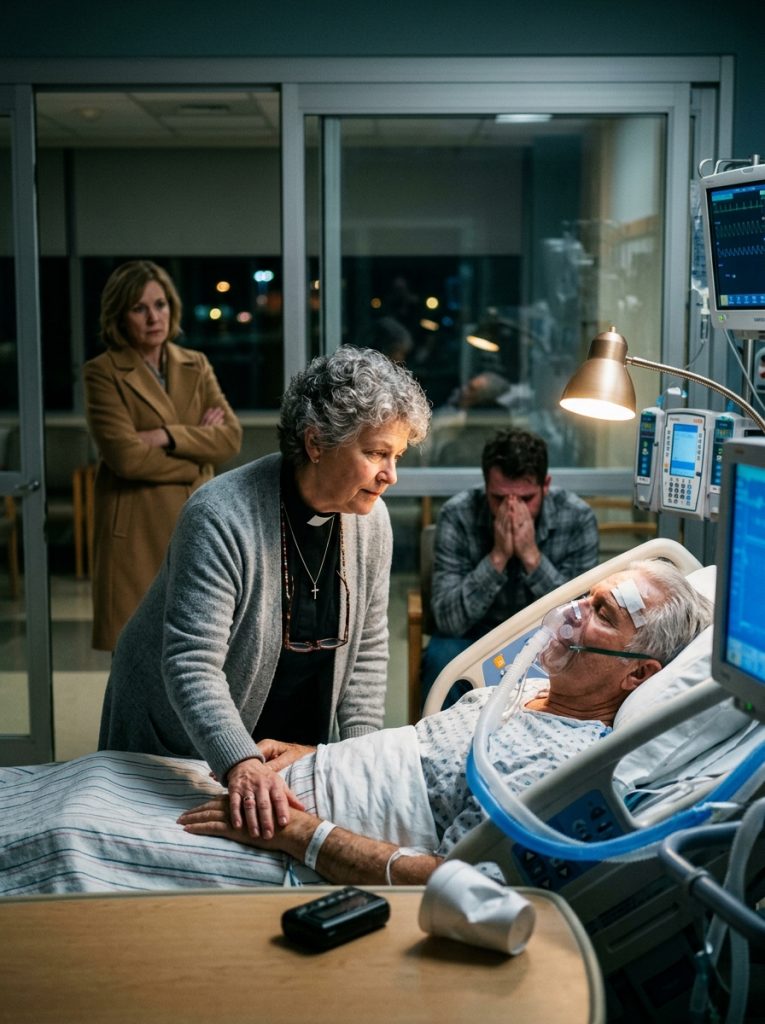
I have been a hospital chaplain for twenty-six years, and the thing nobody tells you about the job is how much of it is just watching. You sit in the dark. You keep your hands still. You let people forget you’re there, because that’s when the truth comes out.
The Lindqvist family forgot I was there a lot.
Frank had been on the ventilator three nights when I started keeping his vigil. Seventy-one years old, silver hair, hands like a man who’d built things. His pickup had gone off Route 9 into a guardrail on a clear, dry night, and his youngest son Danny had been behind the wheel.
That was the only fact the family needed.
Through the glass wall of the ICU I watched them arrange themselves against him. The oldest, Diane, in her camel coat, ran the room like a board meeting. “He was always reckless,” she said. “Dad never should’ve let him drive.” Her brothers nodded. And Danny — thirty-four, in a flannel shirt he’d worn for three days, eyes scrubbed raw — sat in the far corner with his back to the wall, taking every word like it was owed.
He never defended himself. Not once. That was the part that snagged on me.
Innocent people argue. Guilty people argue louder. But Danny just absorbed it, the way you carry something heavy because setting it down would cost more than holding it.
On the third night, Diane started talking about decisions. About whether Danny should have any say in his father’s care, “considering.” She’d brought a folder. She was building a case, even here, with the machines breathing for the man they were fighting over.
I didn’t take a side. A chaplain doesn’t. I just kept watch.
And near four in the morning, when the family had gone to find coffee and it was only the soft tick and sigh of the ventilator, Frank opened his eyes.
Clear. All the way clear. I’ve seen it before — that strange, gathered lucidity that sometimes comes right at the end, like the body lends out everything it has left for one last errand.
He couldn’t speak over the tube, not really, but he could mouth words and push a thread of air behind them. I leaned in until my ear was almost against his lips.
“Not Danny,” he said. “My fault. The wheel.”
I held very still.
It came out in pieces, with long rests between. He’d been having chest pains for a year. Bad ones. He’d hidden them from everybody because his own father had died slow in a hospital and Frank swore he’d never be a burden like that. Danny was the only one who’d suspected. Danny had begged him — for months — to see a cardiologist. Frank had refused every time. He’d even made an appointment once, under pressure, and torn up the card.
That night on Route 9, Frank’s chest had locked. The pain doubled him over in the passenger seat and his arm shot out and grabbed the wheel — a reflex, a drowning man clutching anything — and he wrenched it hard before Danny could fight it back.
The truck hit the guardrail because of Frank. Not because of Danny.
“He kept his promise,” Frank mouthed. The promise being the secret. Danny had spent three nights letting his family call him a killer rather than break his word to his father about the heart he’d been hiding.
“Tell them,” Frank said. “I’m too proud. You tell them.”
I promised I would.
He asked me to hold his hand. I did. And sometime before the sky went gray over the parking lot, with the coffee not yet back, Frank Lindqvist slipped out between one breath of the machine and the next.
He never got to say a word of it himself.
So at six in the morning I walked into that waiting room, where Diane had her folder open on her knees and was mid-sentence about guardianship, and I asked them to sit down.
I told them everything. The chest pains. The year of hiding. Danny begging him to go to a doctor. The hand on the wheel.
Diane said I must have misunderstood. Frail people get confused, she said.
So I asked Danny one question. I asked if his father had ever made a cardiology appointment.
Danny went white. Then he reached into his wallet — that same wallet that had been in that same flannel for three days — and took out a small, creased appointment card. Torn almost in half and taped back together. His father had ripped it up; Danny had fished it out of the trash and kept it, and kept calling to reschedule, and kept getting refused.
He’d been carrying the proof the whole time. He just wouldn’t use it. Because using it meant telling them about the heart, and he’d promised.
The room went silent in a way I’ve only heard a few times in twenty-six years.
Diane’s face came apart slowly, like a wall losing its mortar. The folder slid off her knees. One of the brothers put his head in his hands. And Danny — Danny, who had taken three days of being hated without a word — finally started to cry, not because he’d been cleared, but because the only man who could have said sorry to him was already gone.
That’s the part that stays with me.
They got the truth. They got it at six in the morning, standing up, an hour too late to give it to the man who deserved to hear his children take it back. Danny was free. And there was no one left to be free in front of.
I’ve sat with a lot of families at 3 a.m. I’ve learned you can clear a name and still not heal a thing. Some apologies only ever get to be offered to a grave.
I keep watch anyway. It’s the only thing I know how to do that helps.