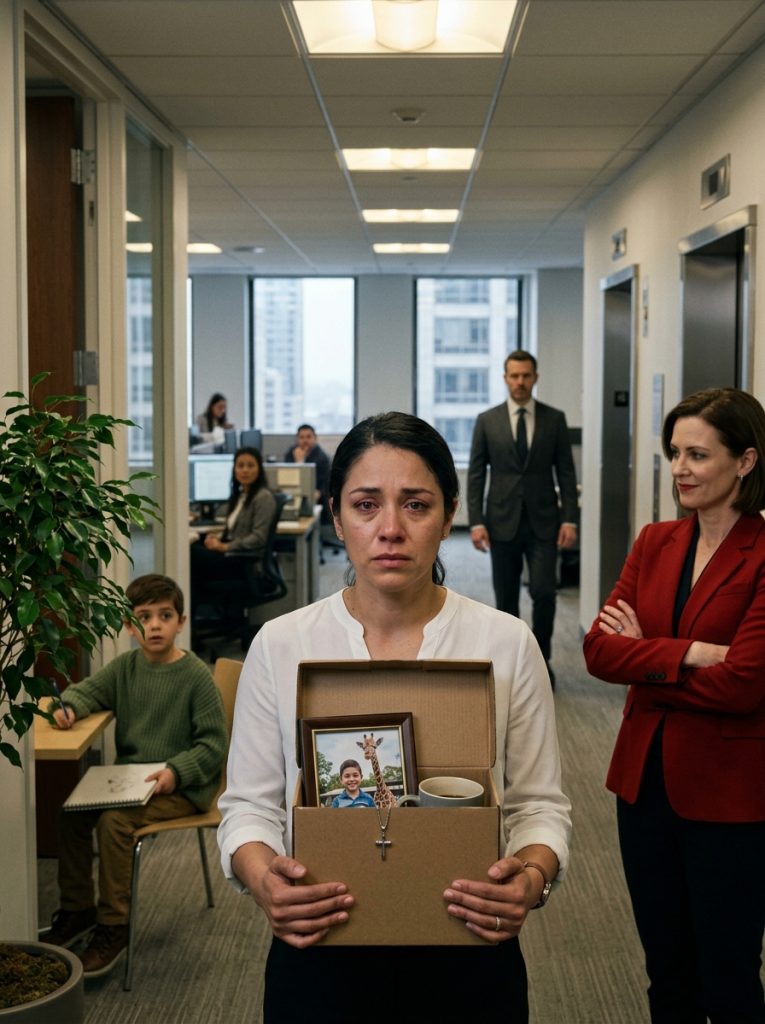
I walked Nathan Cross to the break room with my heart hammering so hard I thought I might pass out.
The cardboard box was still in my arms. My son’s zoo photo — the one I’d cracked looking at — was pressed against my chest. The silver cross necklace my mother gave me was tangled in the corner. Every step toward that break room door felt like walking toward my own execution.
Nathan Cross didn’t say a word. He walked beside me in his charcoal Brioni suit, hands in his pockets, his expression unreadable. The entire twelfth floor had gone silent. I could feel every pair of eyes on my back.
When I pushed open the break room door, Leo was exactly where I’d left him.
Behind the potted plant. Sketchbook open. Crayons arranged by color beside him. His library book about planets propped against the wall. He’d been so quiet that no one — not even the employees who used the coffee machine three feet away — had noticed him.
He looked up when we entered. His big brown eyes moved from me to Mr. Cross and back again. And in that voice — the too-calm voice of a seven-year-old who had learned that panicking only made things worse — he said, “Is Mom in trouble?”
Nathan Cross crouched down.
I don’t know what I expected. Maybe a lecture about workplace policies. Maybe a cold dismissal. Maybe the kind of corporate cruelty I’d come to expect from people in expensive suits.
Instead, he looked at Leo’s sketchbook.
“What are you drawing?”
Leo hesitated. Then he turned the sketchbook around.
The drawing was of the office. But not the office as adults see it. Leo had drawn every person on floor twelve. He’d drawn the woman at the front desk with her coffee mug. He’d drawn the man in accounting who always wore the same tie. He’d drawn Lauren — and in his drawing, she was tiny, in the corner, with a red scribble around her like she was behind bars.
And he’d drawn me. At my desk. With a smile.
Nathan Cross stared at that drawing for a long time.
“Your son is very observant,” he said quietly.
“He’s been here three hours,” I whispered. “He didn’t bother anyone. He didn’t make a sound. He just… drew.”
Nathan stood up. He looked at the potted plant — the one Leo had hidden behind. He looked at the crackers I’d packed in a plastic bag. The water bottle. The headphones. The careful arrangement of a child who had learned to make himself small.
“Wait here,” he said.
He walked out of the break room.
Through the glass walls, I watched him cross the office floor. Every employee pretended to be working. Every monitor was suddenly fascinating. Nathan Cross walked directly to Lauren Whitmore’s office and opened the door without knocking.
I couldn’t hear what he said. But I saw Lauren’s face.
It went through four expressions in ten seconds: surprise, indignation, fear, and then something that looked a lot like a woman realizing her career had just ended.
Nathan walked back to the break room. Behind him, Lauren was packing her desk. Her red blazer was draped over her chair. Her sharp blonde bob was slightly disheveled — the first time I’d ever seen her look anything less than perfect.
“Mrs. Torres,” Nathan said, returning to the break room. “You are not fired.”
I couldn’t speak.
“You are being reinstated with back pay for the time you’ve missed.” He paused. “And effective immediately, Bennett & Rowe Consulting will be implementing a remote-work policy for parents with childcare emergencies. No employee will ever be disciplined for being a parent.”
Tears spilled down my cheeks. I had been holding them back for hours. Years, maybe. I couldn’t hold them anymore.
“Mr. Cross,” I managed. “Why?”
He looked at Leo’s drawing again.
“Twenty-five years ago,” he said, “my mother was a single mother. She was fired from three jobs because she couldn’t afford childcare. She died when I was nineteen — of exhaustion, the doctors said. Stress on her heart. She worked herself to death trying to keep me fed.”
He turned to look at me.
“I built this company so no one would have to go through what she went through. And somewhere along the way, I stopped paying attention to what was happening on my own floors.”
He reached into his pocket and pulled out a business card. He wrote something on the back and handed it to me.
“That’s my personal number. If anyone — anyone — gives you trouble about your son, you call me directly.”
I took the card with trembling hands.
Lauren Whitmore was escorted out of the building ten minutes later. Not by security — by Nathan Cross himself. He walked her to the elevator, held the door, and waited until it closed. The entire floor watched in silence.
Word spread through the company within hours. By the end of the week, Bennett & Rowe had announced a comprehensive family support policy: emergency childcare subsidies, flexible hours for parents, and a dedicated family room on every floor. The break room where Leo had hidden was converted into a small play area with books, toys, and a sign that read: “Children are always welcome here.”
Leo’s drawing ended up framed in Nathan Cross’s office. The one showing Lauren in the corner with red scribbles. Nathan said it reminded him to pay attention.
A month later, I was promoted. Not out of charity — I had the experience, the skills, and the performance record to earn it. Lauren had been blocking my advancement for two years. Nathan personally signed the promotion paperwork.
Leo started second grade that fall. He still draws. He still arranges his crayons by color. But he doesn’t have to be invisible anymore.
And neither do I.
The last thing I did before leaving Bennett & Rowe every evening was walk past that play area sign. I’d touch the silver cross around my neck — the one my mother gave me — and I’d think about what Nathan Cross had said.
No one should have to apologize for being a mother.
He was right.