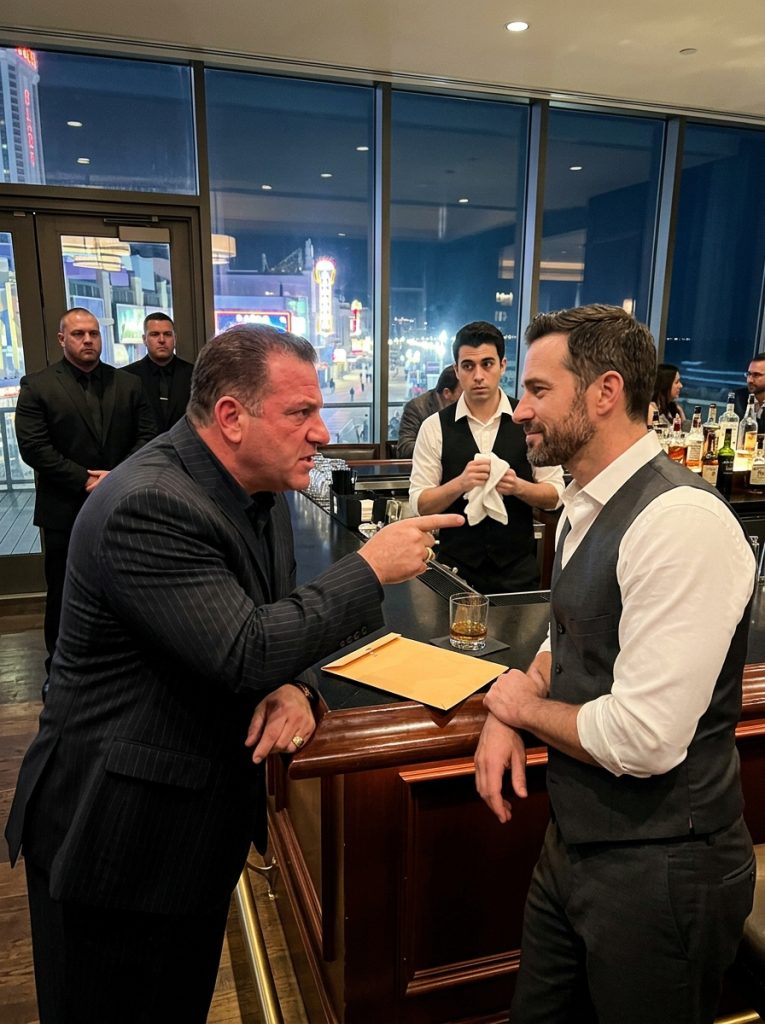
Vincent opened the envelope and the gold pinky ring stopped tapping.
I watched his face go through stages. Confusion first — the legal language, the corporate headers, the LLC names that meant nothing to him. Then recognition — Aurelius Gaming Group, the parent company name he’d seen on his own paychecks for fifteen years. Then the specific line that made his shoulders drop.
Sole member: Nathan Cross.
He looked up.
The bartender behind me had stopped polishing. The two bodyguards by the door exchanged a glance. The boardwalk lights glittered through the penthouse windows like they were holding their breath.
“This is bullshit,” Vincent said. But his voice had lost its edge.
“Call your legal department,” I said. “They’ll confirm.”
He pulled out his phone. Dialed. I watched his face while he listened.
Someone on the other end talked for about forty-five seconds. Vincent didn’t speak. His jaw got tighter. His hand holding the envelope trembled — just slightly, just enough.
He hung up.
He put the phone back in his pocket.
And then he stood there — Vincent Morretti, the man who’d thrown me out of this building three years ago, the man who’d promised to end me, the man who’d spent fifteen years being the most feared person in this casino — and he waited.
For what I would do next.
I remember what it felt like to be in his position. Not with him specifically — but with the disease. The helplessness. The certainty that someone else holds your fate and they’re going to use it the way you would. The way you’ve always seen power used.
I took another sip of bourbon.
“Sit down, Vincent.”
He didn’t move.
“I’m not going to do what you think.”
His eyes narrowed. Calculating. Testing.
“Three years ago,” I said, “you put me in a service elevator and told me my life was over. And you were right — that version of my life was over. The gambling. The desperation. The debt I’d buried in shame.”
I set the glass down.
“You did me a favor. Not intentionally. But you did.”
Vincent said nothing.
“I’m not here for revenge. I’m here because I own this place now and there are changes coming. The private credit operation — the high-interest markers, the predatory lending to people with addiction problems — that ends tonight.”
His face twitched.
“The collections department will be restructured into a responsible gaming program. Anyone currently in debt to this casino will be offered a payment plan at zero interest. And the people who work in collections — including you — will be offered retraining and reassignment.”
I paused.
“Or severance. Your choice.”
Vincent stared at me.
The bodyguards behind him shifted again. They didn’t know who they worked for anymore.
“You’re serious,” Vincent said.
“I’ve been sober for three years, Vincent. I built this acquisition from nothing. Every dollar clean. Every deal legitimate. I didn’t do all of that to become the thing I used to be afraid of.”
I pulled a business card from my vest pocket. Set it on the bar beside the bourbon.
“Call that number Monday. It’s the new GM. Her name is Sarah. She’ll walk you through your options.”
Vincent looked at the card. Looked at me.
“Why?” he said.
The word hung in the air.
“Because somebody gave me grace when I didn’t deserve it,” I said. “My sponsor. A man who found me sleeping in my car outside a gas station in Newark and didn’t judge me. He drove me to a meeting. He checked on me every day for a year. He never asked for anything back.”
I put my hands in my pockets.
“I can’t be that man if I fire you for being what you were when nobody was watching.”
Vincent’s jaw worked. His gold pinky ring caught the bar light as his hand finally unclenched.
He didn’t say thank you.
I didn’t expect him to.
He picked up the business card. He put it in his breast pocket. He turned around. He walked to the door. The bodyguards looked at him, looked at me, and then followed him out.
The penthouse was quiet.
Just me and the bartender and the boardwalk lights.
“Another bourbon?” the bartender asked.
“No,” I said. “I’m done.”
I picked up the envelope — the deed of acquisition that had taken eighteen months to assemble, the document that represented every rice-and-beans dinner, every fourteen-hour shift at the freight company, every meeting in church basements where I said my name and my problem out loud.
I folded it. Put it inside my vest.
Then I walked to the floor-to-ceiling windows.
Atlantic City spread below me. The boardwalk. The ocean. The casino floor thirty stories down where thousands of people were feeding machines with money they couldn’t afford to lose.
Tomorrow I’d begin changing that.
Tonight I just wanted to stand here.
Not as a gambler. Not as a debtor. Not as a man who once owed 2.3 million dollars and thought his life was over in a service elevator.
As the owner.
Who chose grace.
I pressed my palm against the cold glass. The boardwalk lights reflected back at me — orange and white and blue.
Three years ago I left this building with eleven dollars.
Tonight I own it.
Advertisement
And the strangest part — the part that keeps me sober, keeps me humble, keeps me standing at this window instead of celebrating downstairs — is that owning it doesn’t feel like winning.
It feels like responsibility.
And that’s enough.
Vincent called Sarah on Monday. I know because she told me.
He chose to stay. He chose the retraining. He chose to become a floor manager for the new responsible gaming initiative — greeting guests, flagging concerning behavior, connecting people with resources instead of threats.
I don’t know if he’s doing it because he believes in it or because he needs the paycheck. I don’t think it matters. He’s showing up. He’s learning. Sarah says he’s surprisingly good with people when he’s not trying to intimidate them.
The predatory lending program was dismantled within sixty days. Every outstanding marker was restructured. We lost revenue — significant revenue — in the first quarter. The board was nervous. I sat in the meetings and I showed them the long-term projections. Responsible gaming increases customer retention by forty-three percent. People who don’t lose everything come back. People who feel safe spend freely.
It’s not charity. It’s math. But it’s also the right thing to do.
My sponsor, Ray, drove down from Newark for the first quarterly review. Sixty-seven years old. Drives a 2004 Civic with a “One Day at a Time” bumper sticker that’s fading in the sun. He’d never been to a casino before. He walked through the lobby looking up at the chandeliers like a kid in a museum.
“You own this?” he said.
“Technically Tideline Capital owns it. I own Tideline.”
He shook his head. “Three years ago you were sleeping in your car.”
“You woke me up,” I said.
He put his hand on my shoulder. Squeezed.
“No. You woke yourself up. I just held the coffee.”
We had dinner in the restaurant downstairs. Steak. Sparkling water. The bartender — the same one from the penthouse that night — sent over dessert on the house.
Ray looked at the chocolate cake.
“This is good,” he said.
“The cake?”
“All of it.” He gestured around. “The not-revenge part. The grace. Most people in your position would have made Vincent grovel.”
“Most people in my position would still be gambling.”
Ray smiled.
“True.”
We finished dinner. He drove back to Newark that night. Wouldn’t stay. Said casinos make him nervous even when his sponsee owns them.
I walked back through the lobby alone. Past the slot machines. Past the tables. Past the people laughing and losing and winning and hoping.
I took the service elevator up to the penthouse.
The same one.
I stood in it for the full thirty-story ride. Remembering the last time I’d been inside it. Vincent’s hand on my arm. The smell of his cologne. The whispered threat.
The doors opened.
The penthouse was empty. The bar was clean. The windows showed the same boardwalk lights.
I walked to the glass.
I pressed my palm against it.
And I said — out loud, to nobody — “You made it, Nathan.”
Then I went home.
Sober.
Clean.
Whole.