I had just finished printing a stack of paperwork when the old man walked into the recruiting station.
He moved slowly, like every step cost him something. His boots were old and heavily worn, the leather cracked and stained with dirt that looked years old. He didn’t look around. He just came straight to my desk and sat down in the chair across from me.
I smiled the way I had been trained to smile.
“Good afternoon, sir. How can I help you today?”
He studied my face for a long moment. His eyes were pale and tired, but there was something sharp behind them.
“You’re about fifty years late,” he said.
I blinked. “I’m sorry?”
“I’m not here to enlist,” he said, almost gently. “I’m too old for that now.”
Before I could figure out what to say next, the side door opened and Sergeant Carson stepped out of his office. The old man immediately pushed himself up from the chair. He stood a little straighter than before. With both hands, he slowly removed his faded cap and held it against his chest.
Sergeant Carson stopped mid-step.
The old man’s voice was quiet but clear.
“He paid for this building.”
The words landed heavy in the room.
Sergeant Carson’s face went still. He looked at the old man like he was seeing a ghost.
“My father…” Sergeant Carson started, then stopped.
The old man nodded once.
“Me and your father served in the same unit. When we got back, he said if he ever had the money, he would build a place where young men could walk in and be treated like they mattered. He didn’t want his name on it. Said the building itself was enough.”
I looked around the recruiting station — the clean desks, the posters on the wall, the American flag in the corner. I had never thought about who paid for any of it.
The old man turned his eyes back to me.
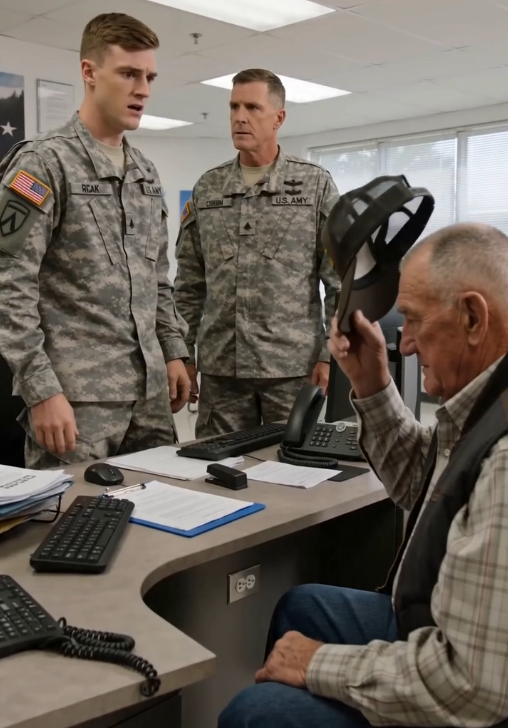
“I came here today because I wanted to see if the boy sitting at this desk was still worth what your father gave,” he said. “I wanted to see if someone was still sitting here listening.”
He reached across the desk and placed his hand over mine. His palm was rough and warm.
“You have his eyes,” he said softly. “And you sit the same way he used to when he was listening to someone talk.”
I felt my throat tighten.
Sergeant Carson walked over and stood beside the old man. For a moment, neither of them spoke.
Then Sergeant Carson said, very quietly, “He never told me he built this place.”
The old man smiled, small and sad.
“He didn’t do it for you to know. He did it because he believed the next boy who walked through that door deserved a chance.”
He looked at me one last time.
“Keep sitting with them,” he said. “Even the ones who come in with dirty boots and nothing left to give. Especially those ones.”
Then he put his cap back on, turned around, and walked out of the building he had helped build fifty years too late for himself — but right on time for someone else.