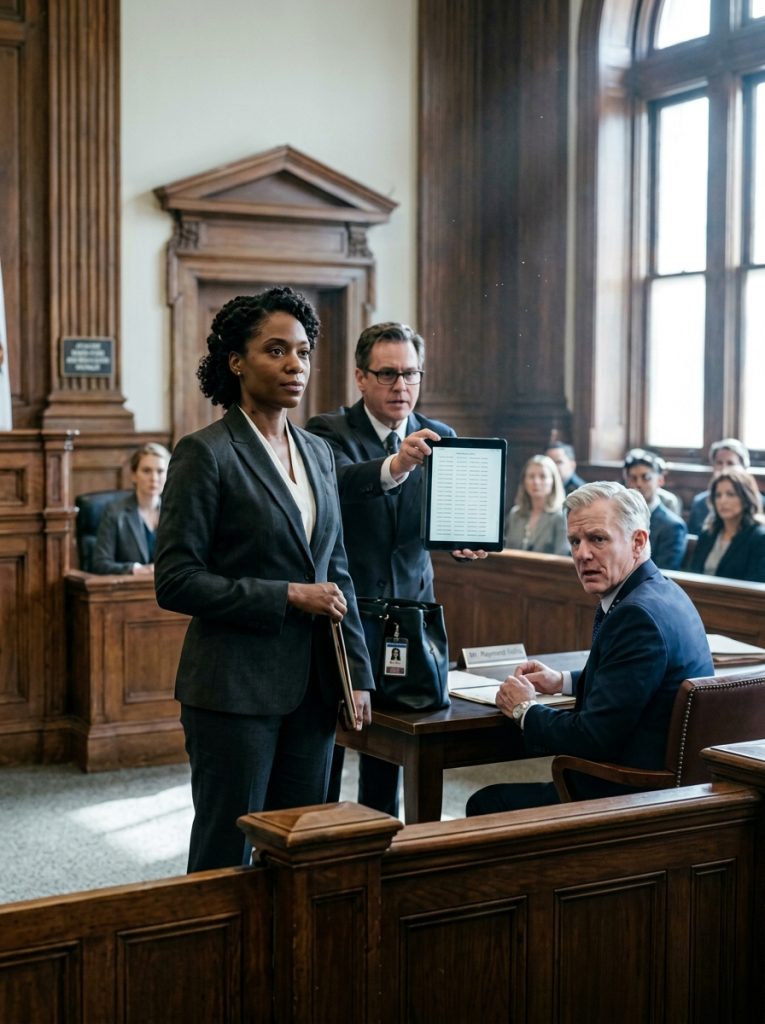
The hospital’s attorney objected, of course. He objected to the audit trail the way a man objects to a window being opened in a room he’s been filling with smoke. He called it “out of scope.” He called it “prejudicial.” He suggested the printed chart already in evidence was “the complete and authoritative record.”
That was the word that finished him. Complete.
My attorney, a quiet woman named Priya who had spent four months being underestimated right alongside me, stood up and said, “Your Honor, the defense has repeatedly characterized the printed chart as complete. We intend to show the jury that it is not — and that the difference between what is in the chart and what is in the underlying system is the entire case.”
The judge let it in.
It took the better part of a day. A forensic analyst from the EMR vendor walked the jury through what an audit trail actually is — that every action in a modern medical record leaves a fingerprint: who, what, and when, down to the second, in a log that ordinary users can’t edit and most of them don’t even know exists. He pulled up the night of Mr. Alvarez’s care on a screen the whole courtroom could see.
There was my login at 11:02 p.m., starting my shift.
There were my routine entries, all night, steady as a metronome.
There was the medication administration at 2:09 a.m.
And there, at 2:07 a.m. — two minutes before — was my variance note. Time-stamped. Unaltered. My words, exactly as I’d typed them in the dark while my stomach turned: Verbal order received from Dr. Hollis by telephone. Dose questioned given current regimen and patient’s renal status. Concern communicated. Order reaffirmed by physician. Administering per direct order. Will continue to monitor.
The analyst read it out loud. Then he read the next part, and the room changed temperature.
Because the printed chart the hospital had handed over — the “complete and authoritative record” — did not contain Dr. Hollis’s order at all. There was no order from him in the chart. On paper, it looked as though a nurse had simply administered a dangerous dose on her own initiative and then, suspiciously, written a note covering herself.
But the audit trail remembers what paper forgets.
At 6:48 the next morning — hours after Mr. Alvarez died, after the sun was up, after someone had clearly had time to think — there was an entry. An order, entered retroactively and then deleted within the same session. Entered and deleted from a single login.
Dr. Raymond Hollis.
He hadn’t just given a verbal order over the phone and let me take the fall. He had come in the next morning, opened the chart, and tried to scrub his own footprint out of it — not realizing, because men like him never learn the boring parts, that the system keeps a record of the deletion itself. You cannot un-ring that particular bell. The deletion was its own confession, signed and time-stamped in his name.
The vendor’s analyst put it in language even I could follow, and even the jury could feel. “A verbal order isn’t in the chart until somebody types it,” he said. “Dr. Hollis never typed it the night of. He gave it by phone and left the nurse holding it. Then, the next morning, he typed it in, saw what it was going to look like sitting next to her written objection, and deleted it within the same minute. The system logged all three actions — the entry, the view, the deletion.” He turned to face the jury. “The record didn’t lose the doctor’s order. The doctor did. The system simply refused to help him do it.”
I watched it land on the jury. I watched it land on the grieving son in the front row, whose face did something I will never forget — because he had spent four months hating the wrong person, and grief that has been pointed in the wrong direction for that long does not turn easily. He looked at me. I looked back. I didn’t smile. There was nothing to smile about. His father was still gone, and no log was going to change that.
He found me in the hallway during the recess. The son. He came up to me with his hands shaking and he could barely get the words out. He said he’d spent four months telling anyone who would listen that I was a monster who’d killed his father. He said he’d written things online, under my name, that he couldn’t take back. He asked how I could even stand to look at him. I told him the truth: that grief has to land somewhere, and the hospital had handed him a convenient place to put it, and that he’d been lied to every bit as much as I had — only his lie cost him his peace, and mine cost me my career, and the same man caused both. We didn’t hug. It wasn’t that kind of moment. But he nodded, and something in his shoulders came down an inch, and I think that was the first honest breath either of us had taken in a season.
The case against me did not so much collapse as evaporate. The plaintiff’s attorney asked for a recess and did not come back with the same theory. Within two weeks the suit against me was withdrawn. Within a month it had been refiled — against the hospital and against Dr. Hollis, this time, with my variance note as Exhibit A and that 6:48 a.m. deletion as Exhibit B.
The state board reinstated my license with a letter that I keep in the same folder I carried up those courthouse steps. St. Brigid offered me my job back, along with a number with a lot of zeros and a non-disclosure agreement stapled to it. I took neither. I’d given that place eleven years of nights, and when the moment came, it weighed a decade of my care against one physician’s reputation and decided I was the cheaper thing to lose. You don’t go back to a building that did that math. You just don’t.
I work nights again now, at a smaller hospital across the river, where the charge nurse read about my case and called me herself to ask if I’d consider coming. On my first shift there, a young nurse — couldn’t have been a year out of school — got a verbal order that didn’t sit right with her, and she froze, the way we all freeze the first time. I watched her do it. Then I walked over and said the only thing that matters: “Write it down. Time it. Your words. Then we’ll go talk to the doctor together.” She looked at me like I’d handed her a life raft. Maybe I had. It’s the same one I built myself, plank by plank, in a courtroom in Sacramento.
Dr. Hollis is no longer practicing. I’ll leave the rest of his story to the boards and the courts that have it now. I take no joy in it, which surprised me. I thought I would. What I feel instead is closer to the thing I feel at the end of a long shift when a patient who was circling the drain at 3 a.m. is stable by dawn — not triumph, just the bone-deep quiet of having held the line where it needed holding.
Here is what I want you to take from this, because it’s the only reason I told it.
Write it down. Whatever it is. When the order makes the hair stand up on your arms, when you’re overruled by someone with more letters after their name, when the easy thing is to assume you must be the one who’s wrong — write it down, with the time, in your own words, where the system can’t pretend later that you didn’t. Not because you’re planning to go to war. Because the truth is fragile, and memory is worse, and paper can be made to forget. But somewhere underneath the paper, in most of the places that matter now, there is a log that remembers exactly who did what, and when.
For four months they treated me as the weakest person in the room. The one who’d sign the NDA, take the money, and disappear.
They forgot that the quietest person in the room is usually the one who’s been keeping receipts.
I came back up those courthouse steps with my whole career in a thin folder under my arm.
I walked back down them with my name.