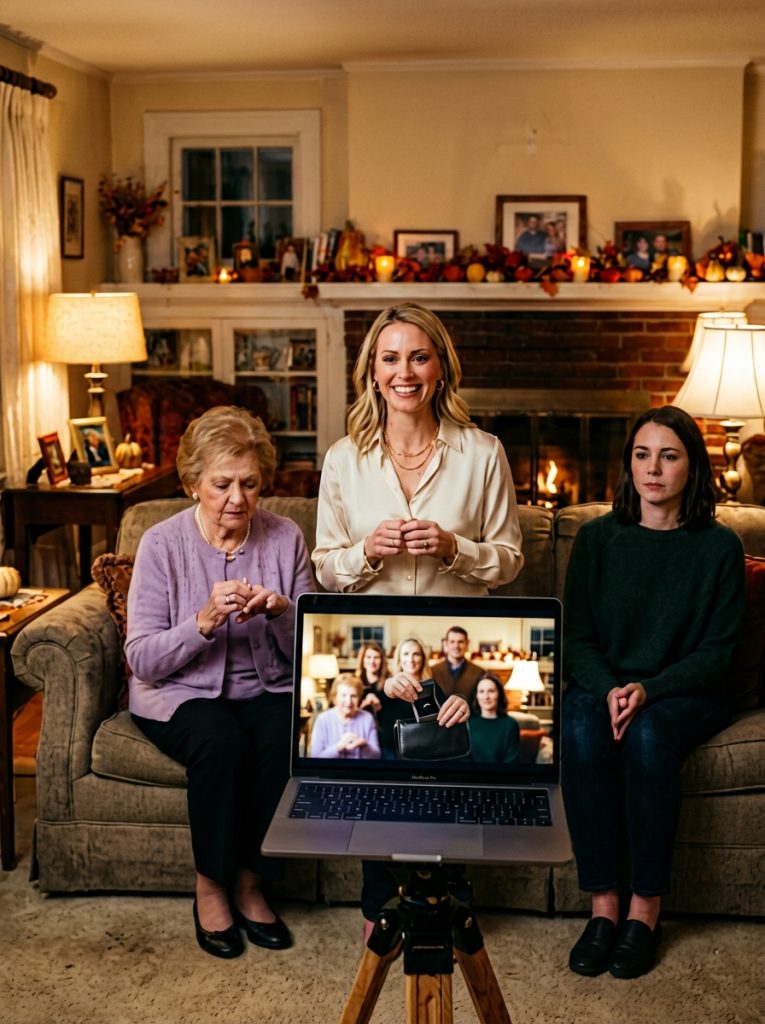
“Hannah, what are you doing?” Megan’s voice had an edge I recognized. It was the same edge from a year ago, the one that came out right before she cried prettily and the room turned against me. “We’re trying to take a picture. Sit down.”
“In a second,” I said. “I want everyone to see something first.”
I’d spun the photographer’s laptop to face the family. Last year’s portrait filled the screen, ten times life-size in the lamplight. For a moment everyone just looked at it — at themselves, a year younger, before the ring, before the accusation, before they’d decided which granddaughter to keep.
“Megan picked the photographer,” I said. “She booked the same one as last year. So his laptop still had last year’s session loaded. Look at the back of the frame. Behind all of us. By the buffet table.”
The photographer — a kind, baffled man named Doug who had not signed up for any of this — leaned in and, because he was a professional and the moment called for it, did the thing professionals do. He pinched the image and zoomed.
The blurred figure at the back sharpened.
Cream blouse. Gold bracelet. One hand in an open purse on the buffet, the other tucking a small square box into it. The box that Grandma’s mother’s ring lived in. The ring that had gone “missing” three days later. The ring I had supposedly taken.
You could have heard a pin drop on the carpet.
“That’s — that doesn’t mean anything,” Megan said, but her voice had climbed half an octave. “I was probably putting my own jewelry away. You can’t even tell what that is.”
“You’re right that the photo alone is just a blurry shape,” I said. “I thought so too, when I noticed it ten minutes ago. So here’s the part that isn’t blurry.”
I took the folded paper out of my back pocket. I’d carried it for two months, not knowing what I’d ever do with it. A photocopy.
“After everyone decided it was me,” I said, “I did the only thing I could think to do. I called every pawnshop and every estate buyer within fifty miles, and I gave them the description and the appraisal photo from Grandma’s insurance. It took weeks. I called on my lunch breaks, from my car, my voice shaking, describing a ring I’d been accused of stealing to strangers who mostly assumed I was the thief trying to find out where it had ended up. Most of them hung up on me. A few were kind. One man told me, not unkindly, that people call about “grandma’s ring” all the time and it’s almost always a family pretending a sale was a theft — and I sat in my car after that call and cried, because I’d started to wonder whether I’d ever be able to prove a negative to anyone, ever again. But one shop in Framingham had a record. An antique platinum ring, old-mine diamond, sold to them eleven months ago. They keep copies of the seller’s ID, by law.”
I unfolded the paper and set it on the coffee table, face up, next to the glowing screen.
“It’s not my face on this ID, Megan. It’s yours.”
I have replayed the next thirty seconds more times than I can count, and I still don’t have language for my grandmother’s face. Eleanor had spent a year letting me be the villain because the alternative was unthinkable. She had looked away from me at this very gathering. And now she was looking at a pawn-shop ID with her favorite granddaughter’s name on it, holding her own bare ring finger with the other hand, and something was breaking behind her eyes that I’m not sure ever fully healed.
Megan did what people do when the floor gives way. She reached for the old script. The tears came up right on cue.
“You have no idea what my life has been like,” she said. “Do you know what I owed? Do you know what it’s like to watch everyone hand you everything”—she pointed at me—”the perfect one, the one who drives Grandma everywhere, while I’m drowning? I was going to buy it back. I was. I just needed time.”
“So you let them throw me out,” I said. “For a year. To buy yourself time.”
“You were fine!” she screamed. “You’re always fine!”
And there it was — the whole thing, finally in the open. Not a missing ring. A sister who had decided, somewhere along the way, that the easiest place to hide a theft was behind the person everyone already trusted least to defend herself. I’d been the perfect mark precisely because I was the reliable one. The one who showed up. People don’t suspect the daughter who shows up; they just quietly resent her, and resentment, it turns out, is extremely easy to convert into belief.
My uncle stood up. My cousin put down her phone. The relatives who had whispered about me at barbecues I wasn’t invited to suddenly found the carpet very interesting.
Grandma Eleanor spoke for the first time. Her voice was small, the same small voice she’d used on the phone to ask me to come.
“Hannah,” she said. “Come here, baby.”
I crossed the room and knelt down by her chair, and she took my face in both of her hands — those hands I’d driven to a hundred appointments — and she said, “I am so sorry. I am so ashamed. I knew you. I have known you your whole life, and I let them tell me a story about you, because believing the story hurt less than believing it about her.” She looked at Megan. “I will spend whatever time I have left being sorry for that.”
“You don’t have to,” I started.
“I do,” she said. “That’s exactly the point. I do.”
We did not take the family photo that night. Doug packed up his gear very quietly and only charged us for the travel. Megan left before dessert. The ring, it turned out, was recoverable — the Framingham shop still had it in a case, and Grandma bought back her own mother’s ring with her own money, which is a particular kind of sad I hope you never have to see.
What happened with Megan after that is a longer and more complicated story than a post can hold. There were no police, in the end; Grandma wouldn’t allow it. There was a reckoning instead — a slow, painful, family kind, the sort that doesn’t tie up neatly. Some doors closed. Some are still cracked open. I’ve made a kind of peace with the fact that being proven innocent is not the same as getting the year back.
Eleven months. That’s what it cost me. Eleven months of birthdays and Sunday dinners and my grandmother’s appointments that someone else drove her to. Eleven months of a small ugly voice in the dark asking whether I was the kind of person who could have done it. You can hand someone back their good name in a single evening, with a blurry photo and a pawn ticket. You cannot hand them back the months they spent learning to doubt themselves. I want to be honest about that, because the clean version of this story isn’t the true one. The truth is that I won — and it still cost me something I will never completely get back.
But here is the part I hold onto.
This Thanksgiving, we took the photo. A new photographer, a new living room — mine, actually. And when everyone arranged themselves, my grandmother reached out and took my hand and pulled me down into the center of the couch, right next to her, her hand on my knee exactly like the picture from two years ago. The one from before.
“There,” she said, settling in, fierce as anything. “That’s where she goes.”
Nobody argued.
The truth had been sitting on a screen in that room the whole time, glowing, waiting for somebody to turn it around and look.
I just had to be the one brave enough to look back.