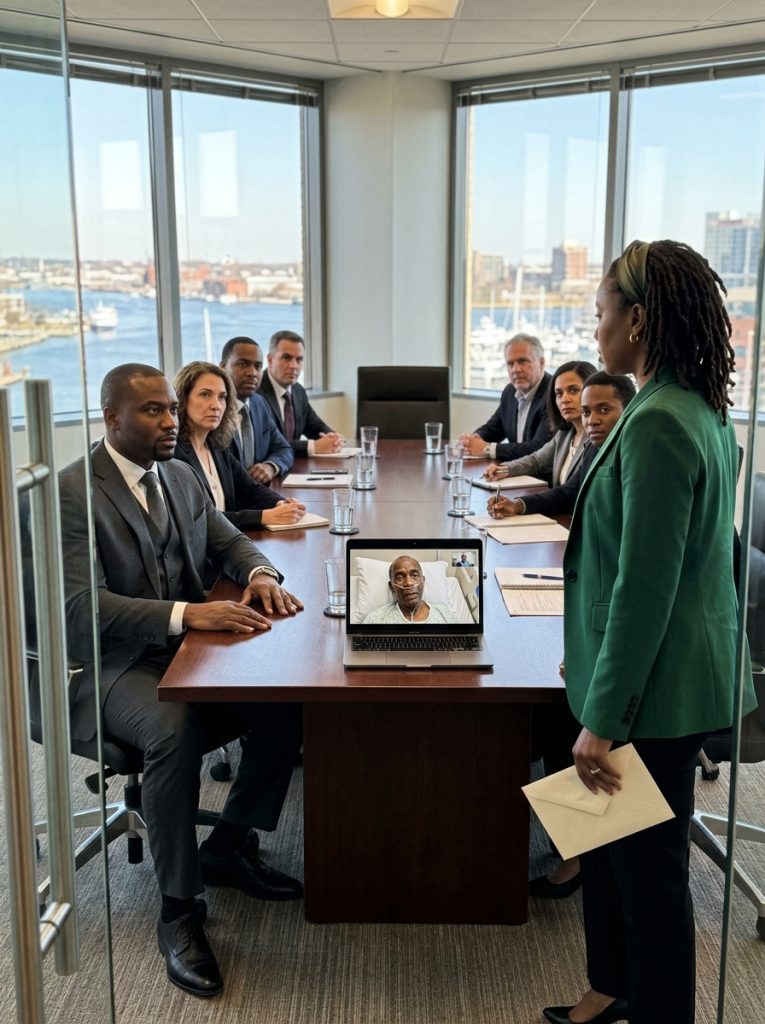
I broke the seal and the boardroom went silent.
Eight board members. The Baltimore harbor glittering through the glass wall. Desmond at the head of the table in his three-piece suit, his hands no longer flat and confident but curling slowly into fists.
And on the laptop screen at the center of the mahogany table, our father — thin, oxygen cannula, watching from his hospital recliner — leaned forward as far as his body would let him.
Inside the envelope was a document. Notarized. Witnessed. Signed in our father’s careful hand, the same hand that had signed every Okafor Foods contract for thirty years.
A proxy assignment and share transfer.
I read it aloud, because I wanted every person at that table to hear it in our father’s words.
“I, Adewale Okafor, founder and majority shareholder of Okafor Foods, being of sound mind, hereby transfer my controlling interest — fifty-one percent of all voting shares — to my daughter, Nadine Okafor, effective immediately and irrevocably.”
Desmond stood up.
“That’s not — Dad, you can’t—”
“I can,” our father said from the screen. His voice was thin but it filled the room. “And I did. Six weeks ago. With two lawyers and a notary present. It’s done, Desmond.”
“Why?” My brother’s voice cracked. “Why would you—”
“Because when I was dying,” our father said, “your sister was the one holding the basin.”
The room went very still.
“For eight months,” our father continued, “I went through chemotherapy. I lost forty pounds. I couldn’t keep food down. I couldn’t sleep. There were nights I was certain I wouldn’t see morning.” He paused to breathe. The oxygen hissed. “Nadine was there every night. She read me the newspaper. She changed my sheets. She held the basin when I was sick and she held my hand when I was scared.”
He looked at Desmond through the camera.
“You came once a month. In a suit. For fifteen minutes. Checking your watch.”
Desmond’s face was the color of ash.
“I am not punishing you, son,” our father said, and his voice softened. “I am telling you the truth about who you became when you thought no one was watching. The company needs a leader who knows that the people who hold the basin matter more than the people who hold the meetings. That’s your sister. That’s always been your sister.”
I stood at the far end of the table with the document in my hands and fifty-one percent of our family’s company suddenly, legally mine.
I had every right to do to Desmond what he’d done to me. Six months earlier he’d blindsided me at a quarterly meeting, used proxy votes from board members he’d taken to dinner, and voted me off the board before I finished my coffee. I’d walked out humiliated while he smiled.
I held the same power now. More. I could remove him with a single motion. I could humiliate him in front of the same board that watched him remove me. The symmetry was right there, gift-wrapped, irresistible.
The board was waiting. Watching me. Some of them had voted with Desmond six months ago. They knew what I could do. A few of them looked frightened.
I looked at my brother.
Forty-one years old. Clean-shaven. Three-piece suit. The big brother who taught me to ride a bike and then, somewhere along the way, decided the company was a kingdom and I was a threat to it.
He was waiting for the blow. Bracing for it. I could see him preparing to lose everything the way he’d made me lose everything.
I set the document down on the mahogany table.
“Desmond,” I said. “Sit down.”
He sat.
“Six months ago you voted me off this board. You used dinner-table proxies and a procedural ambush and you smiled while you did it.” I let that sit. “I’m not going to do that to you.”
His head came up.
“I now hold controlling interest in Okafor Foods. That’s not in dispute. Dad’s signature is notarized and witnessed and it’s final.” I looked around the table. “But I didn’t spend eight months learning how to hold a dying man’s hand so I could come in here and learn how to twist a knife.”
I walked the length of the table — past the board members, past the laptop where our father watched — and I stopped beside my brother’s chair.
“I’m appointing myself chair,” I said. “That’s not negotiable. But I want you as co-president. Operations and growth — the things you’re genuinely good at. We split the leadership. We rebuild this company together. Not because you’ve earned it yet, but because Dad built this so his children would have something to share, not something to fight over.”
Desmond stared at me.
“Why?” he said. The same question he’d asked our father. But quieter.
“Because somebody has to break the cycle,” I said. “And I’d rather it be me, on purpose, than nobody, forever.”
On the screen, our father was crying. I’d never seen him cry. Not once in thirty-six years.
Desmond put his face in his hands.
When he looked up, something had changed. Not fixed — you don’t fix a lifetime of rivalry in one boardroom. But changed. Cracked open.
“I don’t deserve that,” he said.
“No,” I agreed. “But that’s what grace is. You give it to people who don’t deserve it. Otherwise it’s just a transaction.”
The board sat in stunned silence as I explained the new structure. The members who’d voted with Desmond six months earlier — the ones who’d taken his dinners and cast their proxies against me — shifted uncomfortably in their leather chairs. They’d expected a purge. They’d expected me to clean house, to punish the disloyal, to consolidate power the way Desmond had.
Instead I told them they kept their seats. All of them.
“I don’t need loyalty bought with fear,” I said. “I need a board that does the right thing because it’s right. If any of you can’t do that, the door is there. But I’m not forcing anyone out for a vote they cast before they knew the whole story.”
One of them — Edward, the eldest, who’d been with my father since the warehouse days — took off his glasses and said, “Young lady, in forty years I have never seen anyone hold power that lightly.”
“My father taught me,” I said. “He just had to nearly die for me to learn it.”
We rebuilt the company. It wasn’t smooth. There were fights — real ones, about strategy and money and old wounds that took years to close. There were months Desmond and I barely spoke except through assistants. There were quarters where the old resentment flared and we had to sit down with a mediator and a pot of our father’s favorite coffee and untangle it. But we did it side by side, and Okafor Foods is bigger now than it’s ever been.
Our father lived another two years. Long enough to see us share a stage at the company’s thirtieth anniversary. Long enough to see Desmond become the kind of leader who shows up — really shows up — for the people who hold the basin.
At the anniversary, Dad gave a short speech from his wheelchair. He said one thing I’ll never forget.
“I gave my daughter the company,” he said. “But she gave my son back to me. That was the better gift.”
When our father passed, he did it at home, not in a hospital. Both of us were there. Desmond held the basin that last week. He told me later it was the most important thing he’d ever done — that he finally understood what I’d been doing for eight months, and what it had meant, and why our father had seen what he’d seen.
“You could have let me lose everything,” Desmond said at the funeral. “I would have deserved it.”
“That’s exactly why I didn’t,” I told him.
Desmond and I run Okafor Foods together to this day.
My brother called it a courtesy invite, that Tuesday morning.
It turned out to be the morning I chose who I wanted to be.
And I chose grace.
Every time, I’d choose it again.