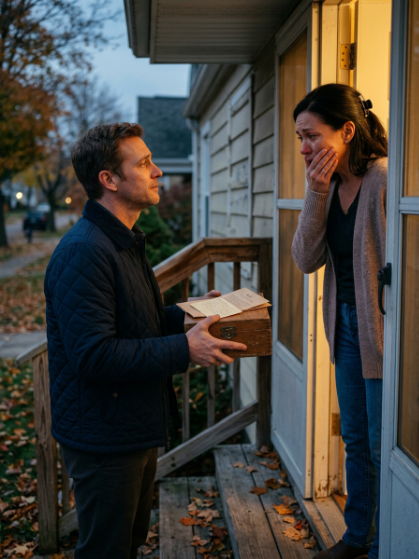
“You brought it,” Lena said. Not a question. Her hand was still pressed to her mouth.
“I don’t really know what ‘it’ is,” I admitted. “I was hoping you might.”
She stepped back to let me in.
The house was small and warm and full of photographs, and on the wall by the door, in a simple frame, was a picture of two young firefighters in turnout gear, arms slung over each other’s shoulders, grinning like men who believed they were immortal.
One of them was my father, forty years younger.
I had never seen the other man in my life.
“That’s my dad,” Lena said, following my eyes. “Tommy Marsh. And that’s yours. Ray.” She said my father’s name like she’d been saying it for decades. “They came up together. Station 19. Best friends since the academy.”
“My father never mentioned a Tommy,” I said. “Not once.”
“No,” Lena said quietly. “He wouldn’t have.”
She made coffee neither of us drank, and she told me the story my father carried for forty years and never set down where his own sons could see it.
There was a fire. A textile warehouse, the winter Lena was four. The roof was going. Tommy Marsh went back in for a man they thought was still inside — a man who, it turned out, had already gotten out the back.
The roof came down.
My father was the one who’d cleared that man. My father was the one who’d radioed that the building was empty. The information was wrong — not his fault, the chaos of a bad night — but Tommy went in on it, and Tommy didn’t come out.
“Your dad always believed his call sent mine back in,” Lena said. “The review cleared him. Everyone cleared him. He never cleared himself.”
Tommy left a wife who was already sick and a four-year-old girl.
And my father — twenty-six years old, gutted, certain he’d killed his best friend — made a decision he kept for the rest of his life.
He took care of us.
“The checks started the month after the funeral,” Lena said. “My mom never knew where they came from. A money order, every month, no name. They paid our rent when she got too sick to work. When she passed, I went to my grandmother, and the checks followed me there. They put me through nursing school. Mine, not your father’s name on a single one of them. Anonymous, for forty years.”
“Forty years,” I repeated.
“He came to see me twice,” she said. “Once when I graduated — he stood at the back, I didn’t know who he was, just a kind old man who shook my hand and left. And once, three years ago, he knocked on this door and finally told me his name. We had one afternoon. He apologized for a fire that wasn’t his fault until I thought I’d cry. I told him Tommy wouldn’t have wanted him to carry it.” She smiled, sad. “He carried it anyway. Some men are built that way.”
I thought about my brother and me in that hospital hallway, fighting over the house, certain we knew exactly who our father was.
We hadn’t known him at all.
I set the wooden box on her table.
She opened it with the care of someone defusing something. Inside: a stack of letters my father had written and never sent, one a year, every year, addressed to Tommy. Photographs of Lena at every age — graduations, a wedding, a baby — that someone had been quietly mailing him for decades. And at the bottom, Tommy Marsh’s old fire helmet, the leather cracked, the number 19 still legible.
“He kept all of it,” Lena breathed.
Then I gave her the deed.
The lake cabin. The one my father took us to twice a summer, the place Russell and I had been quietly valuing in our heads while the monitors beeped.
He’d left it to her. Signed, notarized, eight months before he died.
“He wrote a line on the card the nurse copied for you,” I said. “She told me what he said at the end. ‘Find Lena. Give her the box, and the deed. Tell her I never stopped.’ “
Lena cried then, the way you cry for a grief you didn’t know you were allowed to claim.
“Never stopped what?” she whispered.
“Being your father’s friend, I think,” I said. “Being yours.”
I drove home and I told Russell everything.
We did not fight about the cabin again. It’s hard to fight over a lake house when you’ve just learned it was never the most valuable thing your father owned. The most valuable thing was forty years of quiet penance he never once asked anyone to applaud.
We split the house. We gave Lena the cabin without a word of objection, and we meant it, and it felt like the first honest thing either of us had done since he got sick.
Lena and I talk now. She’s my father’s daughter in every way that the law doesn’t recognize and the heart does. My kids call her Aunt Lena. She hung Tommy’s helmet and Dad’s old photo side by side over her mantel, the two young men grinning, immortal again in the only place it counts.
People say the measure of a man is what he leaves behind.
My father left two sons a house and a misunderstanding, and a stranger forty years of rent, a nursing degree, a lake, and the truth — delivered, finally, six months too late for any of us to thank him.
I used to wish he’d told us while he was alive.
Now I think I understand why he couldn’t.
Some men don’t want you to know how heavy the load was.
They just want to make sure, before they go, that they finally set it down in the right hands.