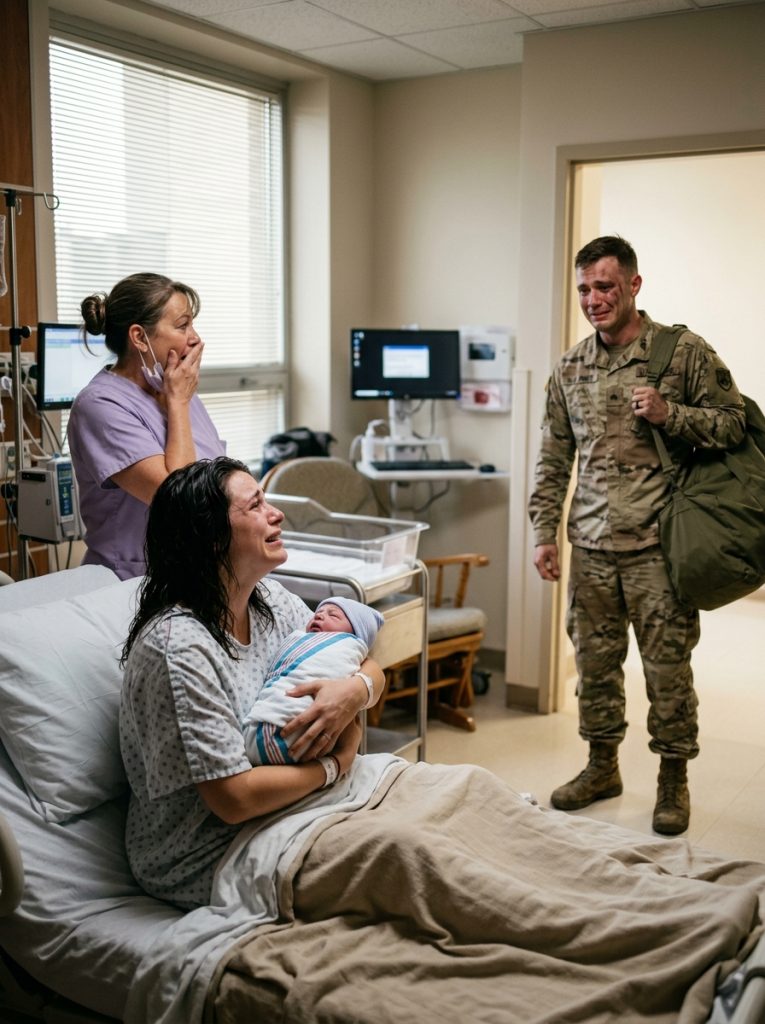
Gloria, my nurse, made a sound I’ll never forget — half a sob, half a laugh — and stepped back from the bed to let him cross the room.
Mike didn’t run. He walked, slow, like a man afraid the whole scene would vanish if he moved too fast. The duffel slid off his shoulder and hit the floor. He looked at me, and then he looked at the small howling bundle on my chest, and I watched the math happen behind his eyes — the math of a man realizing, in a single second, that he is a father and didn’t know it until right now.
“Is that—” He couldn’t finish.
“She,” I said. “It’s a girl, Mike. It’s a girl.”
He folded down onto his knees beside the bed and pressed his forehead to the rail and shook.
It took us days to fit the whole story together, in pieces, between feedings and tears. This is what had actually happened in the seven months I spent believing he’d abandoned us.
The week I found out I was pregnant — the week I wrote him the letter that would change everything — Mike’s unit got an emergency, no-notice deployment. A remote posting, the kind with a communications blackout for operational security. No calls. No internet. Mail in, sometimes; mail out, rarely, and screened, and slow.
My letter telling him about the baby went into the military mail system and, as far as anyone can tell, simply never reached that outpost. Things get lost. A bag, a route, a clerk. One envelope against a war’s worth of logistics.
He wrote me. He swears he wrote me every week. But here’s the part that undid me: when he’d married me, eight months before, he never updated his official records. His emergency contact, his notification paperwork — all of it still listed his estranged father, from before we met. Mike meant to fix it. You always mean to fix the paperwork.
So when I went into a panic in my third month and tried to reach him through the Red Cross — the official channel, the one that’s supposed to find a soldier anywhere on earth — the notification routed to his father’s old address. His father, who Mike hadn’t spoken to in years, who never forwarded a thing.
Two people, both reaching for each other across the same dark, and a misfiled form swallowing every hand.
He thought my silence meant I’d given up on the marriage. I thought his silence meant he’d run from the baby. We spent seven months grieving each other while we were both, the entire time, still writing letters into a void.
The blackout lifted three weeks before my due date. The first batch of held mail finally caught up to him — months of my letters at once, the whole story in the wrong order, the pregnancy and the panic and the due date all landing in his hands in a single afternoon halfway around the world.
He went to his commanding officer with the stack of letters and a due date and, by his own account, did not so much request leave as beg for it. They got him on a transport, then a commercial flight, then a stranger’s offered ride from the airport, and he ran through the doors of a hospital in Killeen, Texas, following the sound of a baby crying down a hallway, and arrived at 3:17 in the afternoon.
There was no villain in any of it. That’s what I keep telling people who want one. No cruel ex, no other woman, no man who didn’t want his child. Just a deployment, a lost envelope, and a form a young husband forgot to update — the smallest, dumbest, most human kind of catastrophe.
It cost us seven months. It cost me a labor I went into believing I was alone. It cost him every milestone of a pregnancy he never got to feel, his hand never once on the kicks.
But it did not cost us the thing it almost did.
He was there for 3:17. He has been there for every 3 a.m. since. He updated his paperwork the first week home — I watched him do it at the kitchen table, and we both laughed in a way that had crying underneath it, because of all the things that nearly broke us, it was a blank line on a form.
Our daughter is asleep on his chest as I write this. He still flinches a little at how close we came to a different ending, the one where he walks into an empty room.
I thought he left me pregnant and alone.
He’d been fighting the whole world’s worth of red tape just to make it to a doorway by 3:17.
And he made it. He made it.