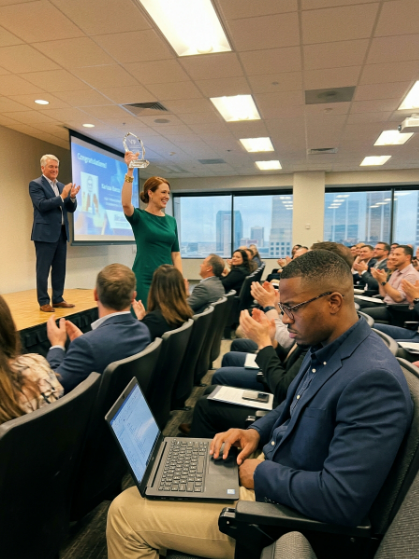
The sunrise slide dissolved, and for one breath the screen behind Karissa Vance was just blue.
Then the first line appeared.
I’d built the deck to auto-advance. No clicker, no second key. Once it started, it would walk through all eighteen months on its own, four seconds a slide, whether I wanted it to or not. That was the point. I didn’t want to be standing there controlling it like a magician. I wanted it to be a machine doing what machines do: reporting.
Vendor name. Invoice date. Amount. Approver.
Vendor name. Invoice date. Amount. Approver.
The same three contractors. The same round numbers. The same signature at the bottom of every authorization, rendered in the looping blue of our corporate template so nobody could pretend it was some outsider’s hit job.
Karissa was still facing us. Still smiling. Still holding the crystal over her shoulder. She felt the room change before she understood it — you could see it hit her in stages. The applause thinned. Then it stopped. Then three hundred people went so quiet I could hear the HVAC.
She turned around.
I watched the back of her neck as she read her own name on the wall, twelve feet tall.
Roger Callahan, our CEO, stepped forward first. He’s a careful man. He didn’t shout. He put one hand up toward the AV booth — toward me, though he didn’t know it was me yet — and said, “Kill the screen.”
I didn’t kill the screen.
I know how that sounds. But I’d thought about this moment for six months, and I’d decided that if I was going to do it, I wasn’t going to do it halfway and let them bury it in a conference room by Tuesday. The deck would finish. All of it. The ghost vendors with no warehouses. The P.O. box addresses. The $1.4 million reconciled, line by line, against the operational budgets it had been bled from — including the marketing budget that got “reallocated” while six people lost their jobs.
“Roger,” Karissa said. Her voice had gone thin. “This is — somebody hacked the system. This is fabricated. I want security in here right now.”
That part almost made me laugh.
Because security did come in. Two of them, through the side doors. And Karissa actually pointed at the screen and told them to find who was responsible.
Roger held up his hand again. “Karissa. Are these your approvals?”
“They’re fabricated.”
“That’s not what I asked.” He took the crystal award out of her hands — gently, almost absentmindedly, the way you take scissors from a child. “Is that your authorization code on the screen.”
She didn’t answer. The deck kept advancing behind her. The numbers kept climbing in the running total at the corner — a number I’d added because numbers in aggregate hit harder than numbers one at a time.
$340,000. $710,000. $1.1 million. $1.4 million.
The total stopped. The screen held on a single final slide. Not an accusation. Just a question, in plain text, the only words I’d written myself: WHO APPROVED THIS?
The room knew the answer. It was printed on every slide that came before.
Karissa walked off the stage on her own. I’ll give her that. She didn’t wait to be escorted. She went out the side door with one security officer trailing her, heels loud on the polished floor, and she didn’t look at anyone, and the auditorium stayed dead silent until the door clicked shut behind her.
Then Roger turned to the room with the crystal award still in his hand and said, “Everybody go back to your desks. We’ll communicate this afternoon.”
Nobody moved for a second. Then three hundred people stood up at once and the noise came rushing back — that low electric hum of a building that just watched its golden child fall through the floor.
Marcus, next to me, leaned over. “Dev,” he whispered. “Was that you?”
I closed my laptop. “The AV system glitched,” I said. “I’ll file a ticket.”
He stared at me. Then he started laughing, quietly, into his hand, and he didn’t stop for a while.
They found out it was me by the end of the day. Of course they did. The deck had to be uploaded by someone with access to the AV network, and that someone signs in, and I hadn’t tried very hard to hide it. I wasn’t ashamed of it. When you decide to do a thing like that, you decide to own it too, or you don’t do it at all.
At 4:30 I got called up to the fourteenth floor. Roger’s office. I’d never been higher than the server room.
He had my original report on his desk. The clean one. The one I’d written six months ago — numbers and dates, no accusations — and handed to Karissa, who slid it back across her desk and told me to stay in my lane.
Except it wasn’t the copy I’d given Karissa. Mine had died when she revoked my access. This was a forwarded version. Karissa had emailed it to my manager with a note telling him to “manage the situation,” and my manager had — instead of deleting it like she wanted — quietly saved it. For six months. In case.
“You flagged this in the spring,” Roger said.
“Yes, sir.”
“And you were told to drop it.”
“Yes, sir.”
“And then you waited until the worst possible moment for her and the most public possible moment for everyone, and you put it on a forty-foot screen instead of bringing it to me.” He wasn’t smiling. “Why didn’t you just come to my office?”
I’d thought about how to answer that, too.
“Because I came to an office once already,” I said. “And the office is where it died. The office is where the laptop kid gets told he’s reaching above his pay grade. I didn’t need another office. I needed witnesses.”
Roger was quiet for a long moment. Then he nodded, like I’d confirmed something he already suspected about his own company.
“The board’s opening a forensic audit Monday,” he said. “Outside firm. Everything she touched. I want you to sit with them.”
“I’m IT,” I said.
“You were IT.” He slid a single sheet across the desk. “As of Monday you’re leading internal controls. You’ll build the system that makes sure the next Karissa trips a wire in week one instead of month eighteen. The role reports to me. Not to operations. Never again to operations.”
I looked at the paper. My name was on it. Spelled right.
The first time anyone in that building had bothered.
It’s been a few months now. The audit found more than my deck showed — it always does, once people stop being afraid to talk. Karissa’s facing more than unemployment; the lawyers handle that now, and I don’t follow it closely. The forty people whose budgets got “reallocated” got made whole. The six who were let go in that round were offered their jobs back. Four came.
My old manager — the one who told me to drop it but quietly saved the report — works on my team now. He apologized once, awkwardly, by the coffee machine. I told him the truth: that the save mattered more than the order. That he could’ve deleted it and didn’t, and that’s the version of him I decided to keep.
I still fix the projector when it glitches. People still call me the laptop kid sometimes, out of habit. I don’t correct them.
Let them think I just plug in cables.
You learn the most about a company from the people it decides aren’t worth talking to. I spent three years being one of them. Now I sit in the room where they decide who matters.
And the first thing I did with that chair was make sure the next quiet kid in the third row gets read the first time he raises his hand.