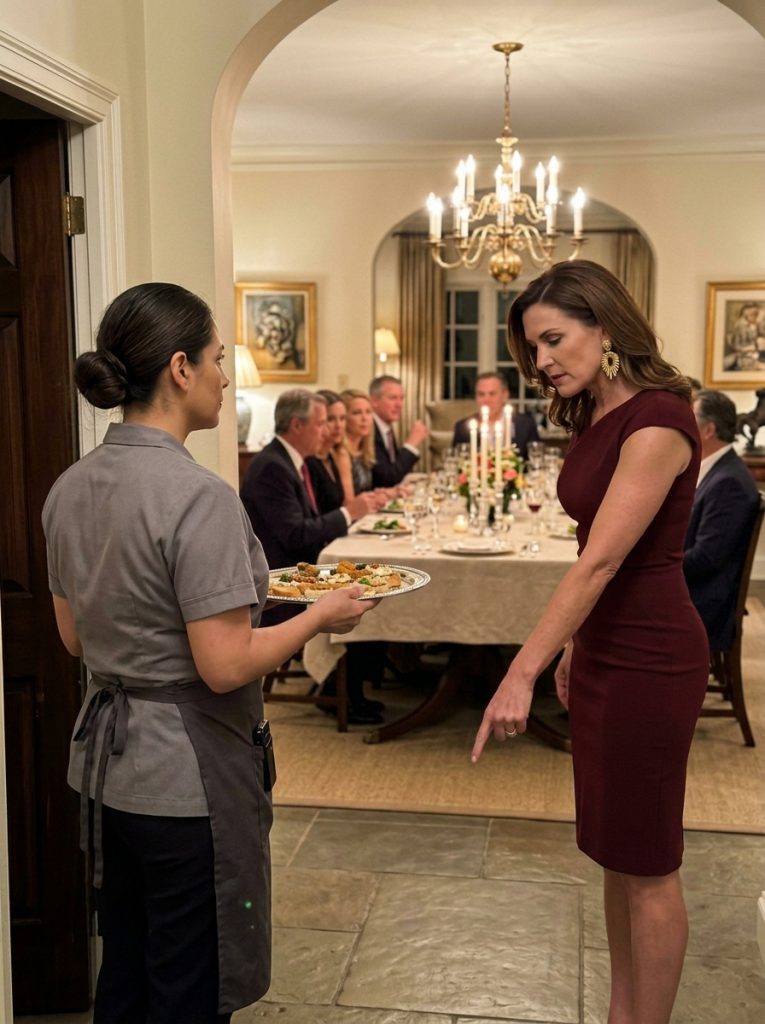
Richard’s flight landed at 6:40 the next morning. By eight, he was home, expecting coffee and his fiancée and a quiet Sunday.
What he got was his sister at the kitchen island, out of the gray uniform, in her own clothes, with a recorder and a folder of notes between us.
Let me tell you how I told him, because the how mattered.
I did not ambush him. I did not play the worst clip first. I poured him coffee — I knew where everything was by then, I’d been cleaning that kitchen for three weeks — and I sat him down and I said, “Richard. I need you to listen to your sister before you talk to your fiancée. I did something you’re going to be angry about, and I’d do it again.”
He went very still when he realized the housekeeper Vivian had been ordering around for three weeks was me.
“You were here,” he said. “The whole time. As the maid.”
“As Rosa,” I said. “Yes.”
He was angry. Of course he was. He stood up, paced, told me I’d gone too far, that I didn’t trust him, that I’d humiliated us both. I let him say all of it. He’s my little brother; I’ve let him be angry at me for forty years.
When he ran out of words, I asked him one question.
“Do you want to know what she said when she didn’t know an Ashford was in the room?”
He sat back down.
I played him three things.
The first was a phone call from the study, two weeks in. Vivian, to someone named Marcus, talking about “the timeline.” About getting Richard to sign a revised asset agreement “before the wedding, while he’s still soft about it.” About how the prenup his lawyer drafted “won’t matter once everything’s commingled.”
The second was Vivian with the jewelry. Walter — our father — left our mother’s pieces in the house safe. Vivian had gotten the code somehow. On the recording you can hear her trying things on, narrating to herself which pieces she’d “keep” and which she’d “sell once the ring’s on.”
The third was the night before the dinner party. Vivian on the phone again, laughing, saying — and I have it word for word — “The staff are furniture, Marcus. He doesn’t even see them. By the time he figures anything out, my name’s on half of it.”
Richard didn’t say anything for a long time.
Then he asked to hear the first one again.
I want to be fair to my brother. He didn’t make excuses for her. He didn’t tell me I’d doctored it or misunderstood. He sat with it, the way you sit with a diagnosis, and then he put his face in his hands for a minute, and then he sat back up and said, “Okay. Okay. What do I do.”
We did it together.
Vivian came downstairs around ten, in a robe, expecting her fiancé and finding two of us at the island. She looked at me — at “Rosa,” out of uniform — and I watched her try to place me, and I watched the exact moment she couldn’t.
“This is my sister,” Richard said. “Catherine. She’s been staying here while I was away.”
Vivian’s face did something complicated.
“Catherine,” I said, “is also co-trustee of the family trust that owns this house. The one your name was never going to be on, no matter what you got Richard to sign.”
I’m not going to pretend the next hour was clean. There was denial. There was a pivot to tears, then to anger, then to a kind of cold calculation when she realized neither was working. She demanded to know how dare I record her. I told her Connecticut is a one-party-consent state and I was a party to every conversation she’d had with the housekeeper she’d been so cruel to. She had no idea the maid she’d ordered to eat in the basement was the one party who made the recordings legal.
She turned to Richard. She tried the voice — the soft one, the “baby, you know me” one.
And Richard, my soft-hearted brother who’d called me six weeks earlier glowing about the woman who “just gets me,” looked at her and said, “I heard the call about the jewelry, Vivian. I heard what you said about the staff being furniture. I think you should pack.”
She packed.
It took until afternoon, and it was not graceful, and at one point she tried to leave with a piece of our mother’s jewelry “as a gift Richard gave her,” which is when I produced the recording of her planning exactly that, and she put it back.
The man named Marcus, it turned out, was not a friend. He was a sort of partner — Vivian had a history, in two other states, of long-game relationships with wealthy men, of revised agreements signed during the soft early months, of quiet settlements. She was good at it. Richard was not her first. He was just the first who had a sister suspicious enough to put on a gray uniform.
After she left, Richard and I sat on the back steps for a long while.
“I’m still angry,” he said.
“I know.”
“Not at you.” He rubbed his face. “At myself. You saw it in three weeks. I didn’t see it in four months.”
“You weren’t supposed to see it,” I said. “That was the whole design. She picked you because you’re generous and you assume the best. Those aren’t flaws, Richard. They’re just doors, and you have to learn which ones to keep locked.”
He laughed, a little wetly.
We sat with it a while longer. Then he asked me the question I’d been dreading, the one I’d been turning over for three weeks in a gray uniform.
“If she’d been real,” he said. “If I’d put you in that house as a maid for three weeks and she’d just been… a good person. Kind to the staff. Honest. What then?”
“Then I’d have taken off the apron the first morning,” I said, “and hugged her, and welcomed her to the family, and told you your sister is a paranoid old woman who owed you both an apology.”
“You’d have apologized?”
“On my knees. Gladly.” I meant it. “Richard, I didn’t go in there to catch her. I went in there hoping I wouldn’t. The test wasn’t a trap. It was a chance. She failed it on day one, snapping at the kitchen girl when she thought no one who mattered was looking. Everything after that was just me gathering enough proof that you’d believe your sister over the woman you loved.”
He was quiet.
“You’d really have apologized on your knees,” he said.
“The disguise cuts both ways,” I told him. “If you’re willing to find out someone’s cruel, you have to be just as willing to find out they’re kind. Otherwise you’re not testing. You’re just hunting. And I didn’t raise myself to be a hunter.”
Here is the part I’m proudest of, and it isn’t the recordings.
The staff Vivian had abused — the kitchen crew she snapped at, the gardener she ran off, the agency cleaners she belittled — Richard called every one of them. He apologized for what had happened under his roof while he was away. He rehired the gardener at a raise. He wrote references for the agency cleaners. And the monogrammed serving cloths Vivian had loved so much, the fancy ones with the family initials — Richard had new ones made for the kitchen staff, with their own initials, because he said anyone who works in a house should have their name on something in it.
I went back to my own life after that. My own house, my own work, my careful quiet ways.
Richard calls me every Sunday now. Not because he needs rescuing. Just to talk.
And once, a few months later, he said, “If you hadn’t put on that uniform—”
I stopped him. “But I did,” I said. “That’s the thing about being underestimated, Richard. Sometimes it’s the most useful disguise in the world. People hand you the truth when they think you’re no one.”
He was quiet a moment.
“Then I’m glad,” he said, “that my sister knows how to be no one.”
So am I. It saved my brother. And it taught the woman in the red dress that the help she’d ordered into the basement had been holding the deed the entire time.