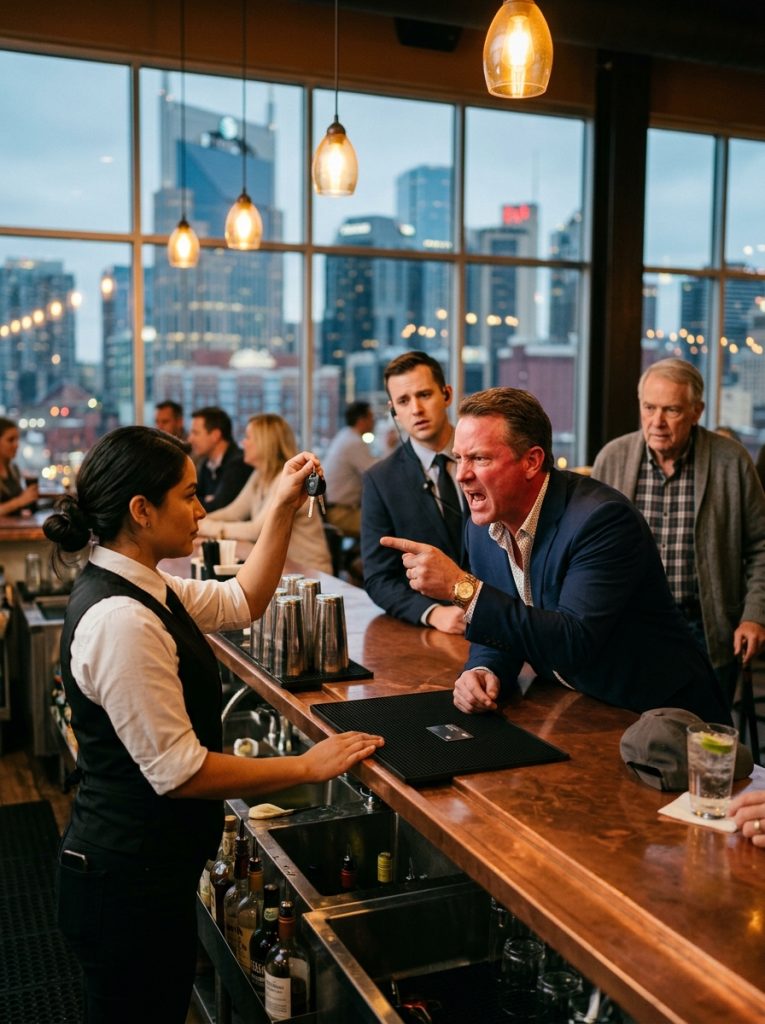
The old man didn’t reach for a wallet or a card. He just walked the length of the bar, unhurried, set his ball cap down next to his club soda, and said, “My name’s Walter Sullivan. Most people who work for me call me Sully.”
Kevin made a small noise, like the air going out of a tire.
Because every one of us who’d ever sat through an orientation knew that name. Sullivan Hospitality owned this hotel. And the next one over. And eleven more across four states.
The man Bryce had been threatening to call — “I know the owner, one phone call and you’re done” — had been sitting twelve feet away the whole time, nursing a lime soda, watching.
Bryce’s face went through about four colors. “Mr. Sullivan. Sir. I— there’s been a misunderstanding, this bartender was—”
“This bartender,” Sully said, “told a drunk man he couldn’t drive, offered to pay for his car, and held the line when her own manager told her to fold. I’ve been in this business fifty-one years. That’s the whole job, son. She did it perfectly. You’re the misunderstanding.”
He turned to me. “You’ll keep those keys. We’ll get him a car. On the house, like you said — you had it right the first time.”
I will be honest: my hands were shaking so hard I had to set the keys down on the mat so nobody would see.
Bryce tried one more time, because men like Bryce always have one more try in them. He started in about how much he spent, how he was a “platinum” guest, how he’d take his business elsewhere.
“I’d be grateful,” Sully said pleasantly. “I don’t want the business of a man who’d put a stranger’s family at risk to save himself a cab fare. Kevin, is it? Pull up Mr. Talbot’s profile.”
Kevin, sweating, pulled it up on the terminal.
“Flag it. He’s done — this property and every Sullivan property. Comp his room tonight so there’s no dispute, put him in a car, and note the reason: refused safe transport, abusive to staff.” Sully looked at Bryce. “You’ll sleep here tonight, sober up, and in the morning you’ll be somebody else’s problem. That’s not a punishment. That’s the cab fare you didn’t want to pay, with interest.”
They walked Bryce to a car twenty minutes later. He went quiet once the audience evaporated. They usually do.
The rooftop exhaled. The bachelorette party actually applauded, which made me want to disappear. The couple by the window flagged me down and tipped on a closed tab just to say they’d never seen anyone hold their ground like that. I poured and smiled and kept my hands busy so I wouldn’t think too hard about how close I’d come to folding.
Then Sully sat back down at the end of the bar like nothing had happened and asked me for one more club soda.
“You really were testing us,” I said, setting it down.
“I test all of them,” he said. “Twice a year I take off the suit, put on this cardigan, and sit at my own bars where nobody knows my face. You learn nothing from the version of your company that knows the boss is watching. You learn everything from the version that thinks no one is.” He squeezed the lime. “Most nights I watch good people get steamrolled by a loud wallet and a scared manager. Tonight I watched somebody hold the line. You have no idea how rare that is.”
“It almost cost me my job,” I said. “Kevin told me to give him the keys.”
I should explain what that job meant to me, so you understand why holding the line was so hard.
I’m the one who keeps things afloat in my family. My mother passed when I was nineteen. My little brother, Mateo, is the smart one — first in our family to go to college — and tuition doesn’t care that our father’s pension is what a cab pension is, which is to say almost nothing. I cover what the loans don’t. I pick up doubles. I count my tips into envelopes labeled by bill.
So when Kevin said give him the keys, what I heard underneath it was the rent, and Mateo’s spring semester, and the specific math of how fast a flagged-as-difficult bartender stops getting the good shifts.
I almost folded for very good reasons. That’s the thing nobody tells you about doing right. The reasons to do wrong are usually excellent.
Sully glanced at Kevin, who looked like he wanted to climb into the ice well.
“Kevin made a mistake,” Sully said. “Kevin’s going to learn from it, because Kevin’s going to spend the next month being trained by you.” He let that land. “That’s not a demotion, Kevin. That’s the most useful thing that’ll ever happen to your career. The day you learn to back the person who’s right over the person who’s loud is the day you become worth promoting.”
Here’s the part that still gets me.
I told him, because he asked, where I’d learned to take a drunk man’s keys without making it a war. I told him about my father. Thirty years driving a cab in this city. The kind, firm no. The night a man he hadn’t argued hard enough with didn’t make it home, and how my dad carried that the rest of his life.
Sully didn’t say anything for a moment. Then he asked my father’s name.
Three weeks later, Sullivan Hospitality rolled out a new policy across all thirteen properties. Any guest who’s been overserved or shouldn’t drive gets a free ride home, no questions, no manager approval needed, charged to the house. Bartenders are explicitly protected for refusing service. It’s printed on a card by every register.
They call it the Tomás Rule.
My father cried when I told him. A retired cab driver, seventy years old, and they named a safety policy across four states after him because his daughter held onto a set of keys on a rooftop in Nashville.
I got promoted, too. I’m the beverage director for the property now — and I help train new bartenders across the group on exactly one thing above all others: the kind, firm no. How to say it. How to hold it. How to mean it when a loud wallet leans over your bar and asks if you know who he is.
Kevin, by the way, turned out fine. He spent that month shadowing me and he took it seriously — really seriously, like a man who’d scared himself. He runs his own property’s front desk now, and last I heard he refused a senator’s aide a late checkout and didn’t blink. People can learn. They mostly just need someone to show them that backing the right person costs less than they’re afraid it will.
The Tomás Rule has been used more times than anyone tracks. But there’s one night I know about.
About a year after Bryce, a young woman came up to my bar after a work party, three drinks past where she should have stopped, fishing her car keys out of her bag and insisting she was fine. New rule, new card, no manager needed. I took the keys, called her a car, and walked her down to it myself. She was furious. Embarrassed. She left me a one-star comment that night calling me condescending.
She came back two weeks later. Sober, mortified, holding a coffee for me as a peace offering. She’d looked up the rule. She’d learned what it was named for and why. “I have a little girl,” she said. “I wasn’t thinking. Thank you for thinking for me.”
That’s the whole thing, right there. Sometimes the person you protect hates you for it in the moment. You do it anyway. My father taught me that, and now a card by every register teaches it too.
I tell my new hires the truth. It doesn’t matter who he is. It matters who you are when no one with power seems to be watching.
Because sometimes someone is. Sometimes it’s a man in a gray cardigan with a club soda and a lime, deciding whether you’re the kind of person worth betting a company on.
But mostly it’s just you. And the keys in your hand. And the road you decide a stranger isn’t going to drive tonight.
I still keep a set of keys on a hook behind the bar. Not anyone’s in particular. Just a reminder.
My father drove people home safe for thirty years and nobody ever knew his name. Now it’s on a card by every register in the company.
Funny how the quiet right thing has a way of getting loud, eventually — if you can just hold the line long enough for the right person to look up.