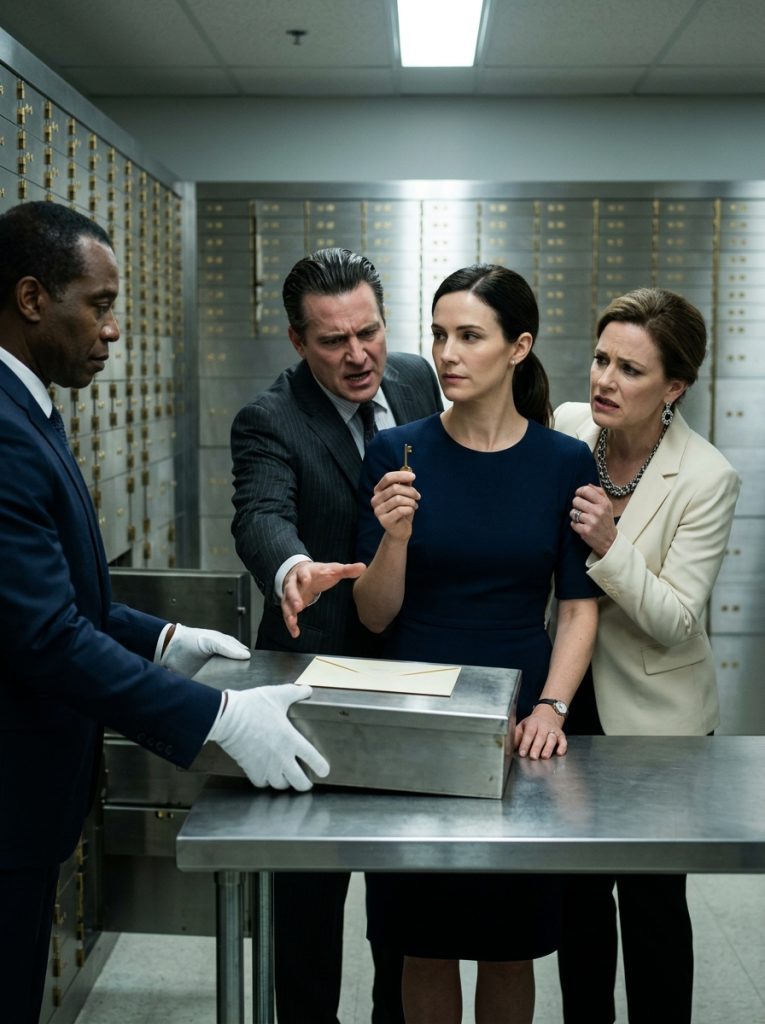
I read it standing in that cold vault with my brother breathing down my neck, and I read it slowly, because I only wanted to do it once.
“Mija,” it began.
“If you are reading this, then I am gone, and you are standing in a bank with a key I sent you and a family that has finally shown you who they are. I am sorry for all of it. I owe you the truth, and this letter is the only way I know how to give it to you clean.”
My father’s handwriting had always been strong. In these pages it shook. He’d written it in his last year, and you could see the year in the letters.
“Eight years ago, you told me you wouldn’t sell your mother’s house. You were right. I want you to know I always knew you were right.
“But that same month, I found something. Money was leaving my accounts. Small at first. Then not small. I traced it, mija. It was Gregory. And Vivian helped him. They had power of attorney for my ‘convenience,’ and they used it the way people like that always do.”
Behind me, Gregory had gone very still.
“I couldn’t prove enough to stop them without warning them. And the moment they knew I was watching, they’d have hidden it, or worse, they’d have had me declared unfit and taken the rest. I have watched it happen to men at my club. The children smile and the children sign the papers and the father ends up in a room he didn’t choose.
“So I did the hardest thing I have ever done. I let them think they had won.
“I let the distance grow between us. I let Gregory believe he had turned me against you. I even let him think it was his idea. Because a man who believes he is winning gets careless. And a careless man leaves a trail.
“For eight years I kept a ledger of every dollar they moved. Every transfer. Every forged signature. It is in this box, notarized, certified, witnessed. It is airtight. My attorney has a sealed copy.
“And everything that actually matters — your mother’s house, the real accounts, the things they think they’re inheriting — I moved years ago into instruments only the holder of the second key can claim.
“I gave you that key, mija, because in forty years, through everything, you are the only one of my children who never once asked me for money. You fought me over a house to honor your mother. You never fought me for a cent for yourself.
“I am ashamed that the safest way I could find to love you was to pretend that I didn’t. I let you grieve a living father so that you would inherit a whole one. I don’t expect you to forgive that. I only ask that you understand it.
“The house is yours. It was always going to be yours. Live in it. Fill it. Forgive me if you can.
“Your father.”
For a long moment, the only sound in that vault was the hum of the lights.
Then Gregory exploded.
“That’s not — he wasn’t competent — that letter could’ve been written by anyone —”
Mr. Osei, the trust officer, spoke without raising his voice.
“The codicil is notarized and witnessed by Mr. Marsh’s physician and his attorney, on the same date, attesting to his capacity. The ledger is certified. I’d advise you to speak with your own counsel before you say anything else in front of witnesses.”
Vivian had stopped pretending to comfort anyone. She’d gone white to the lips, the way you do when you’re recalculating your entire future in real time.
I took the second document out of the box. The ledger. Page after page of my father’s careful hand, dates and amounts in two columns, eight years deep. Beside it, photocopies. Statements. A transfer slip with Gregory’s name signed in a hand that wasn’t Gregory’s.
I understood then what my father had built in that little steel drawer.
Not a fortune. A trap. Patient, quiet, and perfect.
The estate didn’t go to the executor. The executor was the one it closed on.
I closed the box. I slid my father’s letter inside my coat, against my chest, where I could feel it.
“I’d like certified copies of everything,” I told Mr. Osei. “And I’d like my brother to watch me ask for them.”
Gregory didn’t watch. He’d already turned for the door, phone to his ear, calling the first of the lawyers who would spend the next year telling him there was nothing to be done.
Vivian lingered. For one second I thought she might say something true. She’d been my sister once, before she learned to count other people’s money.
“You always were his favorite,” she said. Bitter. Final.
“No,” I said. “I was just the one he didn’t have to watch.”
Then I walked out of that vault into the gray Hartford afternoon, sat in my car, and shook for twenty minutes before I could drive.
The civil suit took the better part of a year. My father’s attorney handled it like a man finishing a job he’d promised a friend. The forged transfers became a separate matter, the kind with the word “criminal” in it. Gregory settled to avoid a courtroom, which is its own kind of confession. Vivian signed a return of “gifts” she swore had been freely given.
I won’t pretend it felt like winning. You don’t win these. You just stop losing.
I moved into my mother’s house in the fall.
It needed work. They’d let it go, of course — taken what they could carry and ignored the rest. The porch sagged. The garden my mother loved had gone to weeds.
I fixed the porch first.
I found things as I cleaned. My mother’s recipe cards. A height chart penciled on a doorframe, my name and Gregory’s and Vivian’s climbing the wood, all of us small once, before any of this.
And in the attic, in a box marked with my name in my father’s writing, every birthday card I had ever mailed him in those eight silent years. I’d sent them anyway. I never knew if he opened them.
He had. Every one. He’d kept them in order.
There was a note on top, in the same shaking hand.
“I read these on the bad nights. — Papá.”
I sat on the attic floor and cried until I couldn’t anymore.
My father’s attorney — a quiet man named Reyes who’d known him forty years — came to the house once the dust settled. He brought a last envelope, one my father had left with him by hand.
Inside was the deed, already transferred, already mine. And a key. The ordinary kind. The front door.
“He gave me this the week before he passed,” Reyes said. “He made me promise to put it in your hand, not mail it. He said you’d had enough things mailed to you.”
I laughed. It came out wet.
“He wanted me to tell you something, too,” Reyes said. “He made me memorize it so I’d get it right.” He cleared his throat. “He said: tell her the silence was the price, and she was always worth it.”
Gregory has tried to call twice since. I don’t pick up. Not out of cruelty. I just don’t have anything to say to a man my father had to outwit from beyond the grave to keep me safe.
But I kept the height chart. I had a contractor build the new hallway around it so it wouldn’t be lost.
My daughter is on it now. A new pencil line, higher than mine ever got.
Some nights I sit on the porch my father told me to fill, in the house my mother told me to keep, and I take out his letter and read the first word again.
Mija.
He never said it out loud in eight years.
He said it in steel, where no one could take it from me.