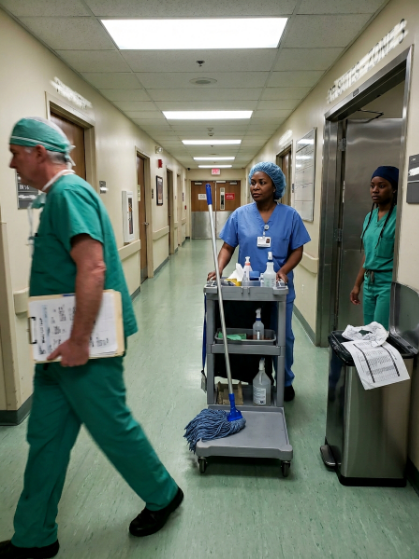
I held Tamika’s hand in that fluorescent hallway at almost midnight, and I felt how cold it was. Fear does that. I’d seen it in a hundred clients. The body goes cold while it decides whether it’s safe to hope.
“You’re not alone anymore,” I told her. “None of you are. Not after tonight.”
“You’re EVS,” she whispered. “You push the cart. How are you going to —”
“Tamika. I push the cart because it lets me go everywhere and no one ever asks me why.” I lowered my voice further. “My name is Denise Kamara. I have a law degree. I’m a medical malpractice attorney, and I have spent three months in this building documenting what Dr. Hale does to patients who never agreed to what he did to them.”
She stared at me. Then her eyes filled, fast, the way they do when someone has been holding something heavy alone for too long and is suddenly told they can set it down.
“You believe me,” she said. Not a question. A thing she needed to hear out loud.
“I have your proof,” I said. “And mine. I just needed to know I wasn’t the only one who’d say it under oath.”
She wasn’t.
That was the thing I’d been gambling on for three months, pushing that cart past the operating rooms, smoothing crumpled schedules from the trash, watching the timestamps that never lined up. I knew the data. Surgery first, consent after — over and over, eighteen months of it. But data doesn’t walk into a courtroom and raise its right hand. People do. And I needed to know there were people on that floor brave enough to.
Tamika took me to them.
Not that night — you don’t move on something like this at midnight. But over the next two weeks, in break rooms and parking garages and one memorable conversation in a supply closet that smelled of bleach, Tamika introduced me to four other nurses. Each of them had been carrying private notes. Each of them had believed, the way the hospital wanted them to believe, that she was the only one who’d noticed, the only one who’d care, the only one foolish enough to risk her job over it.
Five women. Five sets of notes. Five people who’d been made to feel alone in the exact same building, at the exact same time, about the exact same man.
The hospital had counted on that loneliness. It was the whole strategy. Isolate the witnesses and they stay quiet. Make an example of the one who speaks — schedule her off the calendar, let her vanish — and the rest learn the lesson.
What the hospital never planned for was someone whose entire job was to gather the lonely ones into a room and let them see each other.
I’ll tell you why I really took the cart. I owe you that, since I’ve told you everything else.
Eighteen months ago, my younger brother went into one of Dr. Hale’s operating rooms for a procedure he’d been told was routine. He came out different. Permanent nerve damage. A complication, they called it, in the careful language hospitals use. When I asked to see the consent form — the one that was supposed to explain the risks he’d accepted — the timestamp on it was from after the surgery had already started.
My brother never agreed to those risks. He was never given the chance.
His name is Emmanuel. He’s thirty-nine. He was a high school music teacher, and the nerve damage took the fine control in his left hand — the hand a guitarist needs most. He doesn’t play for his students anymore. He still walks into that classroom every day and teaches kids who’ll never know what his hands used to do, and he comes home and he does not complain, and watching him not complain is the hardest thing I have ever done.
When the hospital sent its careful letter calling it a “known complication,” I read it sitting in his kitchen while he made me tea one-handed, slow, refusing help. And I made a decision at that table that I did not tell him about for a long time.
I’m a malpractice attorney. I could have filed one lawsuit for one family and won it, quietly, and Hale would have paid from a fund built exactly for that and gone back to work the next morning.
I didn’t want one quiet settlement. I wanted it to stop.
So I traded my suits for blue scrubs and a hairnet, and I took the eleven-o’clock shift, and I became the woman surgeons step over without seeing. For three months I was furniture. And furniture, it turns out, has the best seat in the house.
The case we built together was not one family’s word against a powerful man’s. It was five nurses, two patients, and a paper trail of consent forms time-stamped against OR schedules that the hospital itself had generated. Denise Kamara the attorney could stand up and say all of it — but it was Denise the EVS worker who’d been there to gather it, and Tamika and her colleagues who’d been brave enough to sign their names to the truth.
Hale’s surgical privileges were suspended within a month of filing. The hospital’s chief medical officer — the one who’d known, who’d protected him because he billed too well to lose — resigned before the board could decide his fate for him.
I want to be honest about how it actually went, because these stories get told as if the truth arrives like a thunderclap and everyone falls to their knees. It doesn’t. There were months of depositions. There were hospital lawyers who tried to paint five experienced nurses as disgruntled and confused, who tried to suggest that an EVS worker reading discarded schedules was some kind of conspiracy rather than a woman with a law degree doing exactly what the law allowed. There was a night Tamika called me crying, certain she was going to lose the job that fed her two kids, ready to recant.
I drove to her apartment at one in the morning. I sat at her kitchen table — I do my best work at kitchen tables, I’ve decided — and I told her the truth: that she might lose the job, that I couldn’t promise she wouldn’t, but that there were now four other women who would lose theirs beside her, and that a thing five people carry together cannot be made to disappear the way one person can.
She didn’t recant. None of them did.
I represented the group. Pro bono. My brother was the fourth unreported complication in Hale’s file, and I was not going to take a fee for finally saying his name in a room that had to listen.
But the verdict isn’t the part I keep.
The part I keep happened three months after, when the five nurses asked me to come back to the hospital — not as an attorney, just as a guest. They’d done something on their own. They’d formed a patient safety committee, the first that floor had ever had. Any staff member who saw something could bring it there, together, instead of carrying it alone in a private notebook in the dark.
They’d named it.
The little brass sign on the conference room door said: The Midnight Committee. Because, Tamika told me, grinning, that was the shift when somebody finally pushed a cart down the hall and saw all of them.
Five women who’d each believed she was the only one.
Now they have a room. And a name. And each other.
People hear this story and think it’s about catching a dangerous surgeon. And it is, a little.
But mostly it’s about loneliness, and how the people in charge use it as a wall.
All I really did was push a cart through that wall, one crumpled schedule at a time, until the people on the other side could finally see they’d been standing together the whole while.
They just needed someone invisible enough to introduce them.