The superintendent waited. The room waited. Sandra Whitmore’s petition lay on the linoleum floor where it had slipped from her lap, and nobody bent to pick it up.
“Ms. Chen,” the superintendent said again. “Would you like to say a few words?”
I stood up. Slowly. The folding chair creaked behind me. My canvas bag was on the floor — heavy with graded papers from sixth-period history, a water bottle, two pens, and the folder I never open in public.
I didn’t bring notes. I didn’t prepare a speech. I’d spent two years in this town saying nothing, and now that the room was finally silent, I realized I didn’t need many words. Just the right ones.
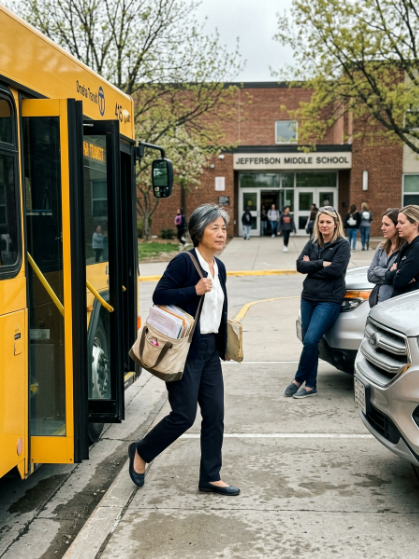
I walked to the front. Forty pairs of eyes tracked me — the substitute teacher in the navy cardigan, flat shoes, no makeup, the woman who rides the Route 15 bus. The woman Sandra Whitmore wanted fired.
I stood beside the podium. Didn’t step behind it. Didn’t touch the microphone.
“My name is Gloria Chen,” I said. My voice was steady. The same voice I use in the classroom when the kids are too loud and I need them to listen — not a shout, just a frequency that cuts through noise. “I’m a substitute teacher at Jefferson Middle School. I’ve been here two years.”
I looked at Sandra. She was staring at me with an expression I couldn’t quite name. Shock, yes. But also something else. Something that might have been the first flicker of shame.
“Before I came to Omaha,” I continued, “I spent thirty-one years in venture capital in San Francisco. I co-founded Chen and Associates in 1993. We managed two-point-four billion in assets at our peak. I retired in 2022.”
The numbers landed like stones dropped into still water. I could see people doing the math in their heads. Two-point-four billion. The woman who rides the bus.
“I moved to Omaha because my parents lived here. My father, Wei Chen, was a custodian at Jefferson Middle School for twenty-three years. He mopped the hallways. He fixed the boiler in winter. He replaced ceiling tiles and unclogged toilets and painted over graffiti on weekends without being asked.” I paused. “He earned eleven dollars and sixty cents an hour. He never missed a day.”
The room was absolutely still.
“My mother, Lin, worked in the cafeteria. She served lunch to fifteen hundred students a week for twelve years. Meatloaf Mondays. Taco Tuesdays. She memorized allergies. She snuck extra portions to the kids she knew weren’t eating at home.”
I could feel the emotion rising in my chest, but I kept my voice even. The same way I keep it even when a student is struggling with a concept and needs patience, not volume.
“They came to this country in 1971 with four hundred dollars and two suitcases. They didn’t speak English. They learned it here — in this school district. And every night at dinner, my father would say the same thing: ‘Those kids matter. That building matters. We keep it standing.'”
I looked at the board members. Then at the superintendent. Then back at the audience.
“My father died four years ago. The last thing he said to me was: ‘Don’t let them close that school, Gloria. Promise me.'”
I let that sentence sit.
“Two years ago, this district was facing consolidation. Budget shortfall. Declining enrollment projections. Three schools were on the closure list. Jefferson Middle was one of them.”
Murmurs. Some people hadn’t known that. The near-miss had been buried in committee meetings and budget documents that most parents never read.
“I contacted the superintendent’s office anonymously. I asked what it would take to keep the district whole. The answer was an eight-million-dollar bond — enough to cover the shortfall, fund deferred maintenance, and stabilize enrollment projections for five years.” I paused. “So I funded it. Through the Chen Family Foundation. Anonymously. Because that’s how my father would have wanted it. Quietly. Without a name on a building.”
Sandra’s face was white. Her hands were gripping the sides of her folding chair.
“I didn’t come here to be thanked,” I said. “I came here to teach. Because that’s what I want to do. Not because I need the salary — but because my parents spent their lives serving this school, and I want to spend mine serving it too. In a different way. In a classroom.”
I looked at Sandra directly.
“I ride the bus because I choose to. I owned three cars in San Francisco. I don’t need one here. The bus takes me where I need to go — the same route my mother took to work for twelve years. I wear the same three outfits because vanity was never something my parents valued, and I see no reason to start now.”
Sandra’s mouth opened. Closed. Her petition was still on the floor.
“I’m not asking anyone to apologize,” I said. “I’m not asking for recognition or special treatment. I’m asking to be left alone to do my job — which is teaching your children history, and geography, and how to write a paragraph that says what they actually mean.”
I stepped back from the podium.
The superintendent stood up. “Ms. Chen — thank you. The board would like to formally—”
“I don’t need anything formal,” I said. “Just let me teach.”
I walked back to my seat. Back row. Folding chair. Canvas bag on the floor.
The applause started somewhere in the middle of the room and spread until every person was standing. Except Sandra. She sat very still, looking at the floor, at the petition beside her shoe.
After the meeting, the superintendent found me by the coffee table.
“The petition is withdrawn,” he said. “Unanimously.”
I nodded. “Thank you.”
“And the board would like to offer you a full-time position. Benefits. Salary increase. Your own classroom.”
I thought about it. For about three seconds.
“I’ll stay as a sub,” I said. “I like moving between classrooms. I like meeting all the kids, not just one group.”
He looked at me like I was the most confusing person he’d ever met. Maybe I am.
I took the bus home that night. Route 15. 9:42 PM. Almost empty. The driver — a young man named Marcus who always waits an extra ten seconds when he sees me walking toward the stop — said, “Evening, Ms. Chen.”
“Evening, Marcus.”
I sat in the third row. My mother’s favorite spot. She always said you could see the whole bus from the third row — everyone getting on, everyone getting off. All the lives passing through.
The next morning, I arrived at school at 7:40. Same bus. Same transfer at 72nd. Same canvas bag.
Sandra Whitmore was in the pickup lane in her silver SUV. She saw me step off the bus. Our eyes met through her windshield.
She didn’t smirk. She didn’t look away.
She nodded. Once. Small.
I nodded back.
Then I walked into the building where my father mopped floors for twenty-three years, and I taught thirty-two sixth-graders about the American Revolution.
Same cardigan. Same flat shoes. Same teacher they’d always had.
The only difference was that now they knew her name.
And two weeks later, when Sandra’s daughter struggled with her history essay — a paper about immigration and the American Dream — Sandra sent me an email.
It was short. Professional. “Ms. Chen, would you be available for extra help after school? Lily is having trouble with her thesis statement.”
I wrote back: “Tomorrow. 3:45. Room 214. Tell her to bring her notes.”
Lily came. We worked on the thesis together. She wrote about her great-grandparents crossing the Atlantic in 1919. About sacrifice. About what it means to build something in a country that wasn’t built for you.
It was a good paper.
I gave it an A.
Some things don’t need a foundation or a wire transfer. Some things just need a teacher who shows up. Every day. Same bus. Same cardigan. Same quiet certainty that the work matters.
My father knew that. My mother knew that.
Now I know it too.