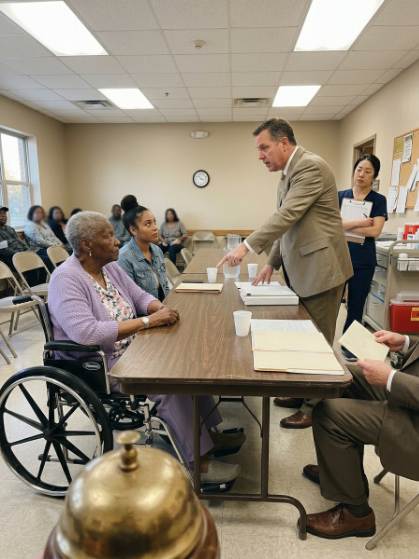
Glen stopped smiling before Joel finished the first paragraph.
That was how I knew Lillian had written the letter correctly.
My wife had never believed in dramatic language. She believed in clauses, dates, signatures, and sentences with teeth.
Joel Mercer stood beside the folding table with the foundation letter in both hands and read in the careful tone lawyers use when every word has already been sharpened.
The Bellamy-Lewis Care Foundation grant, he said, provided annual operating support to Bellamy House for the express purpose of maintaining overnight clinical staffing ratios.
Not lobby furniture.
Not landscaping.
Not a donor wall with names etched in brushed metal.
Overnight clinical staffing ratios.
Glen’s hand moved to the budget folder as if paper could hide behind paper.
Amara stood behind my wheelchair so still I could feel her not breathing.
Keeley Park’s face changed differently.
Not with shock, but with recognition. People who work too hard are rarely surprised by proof.
Glen cleared his throat.
“This is an old grant structure,” he said. “The operational reality of long-term care has changed since Mrs. Bellamy’s wife established the foundation.”
He said my wife as if Lillian were an outdated policy.
I placed one finger on the brass bell.
I did not ring it.
Joel looked over the page.
“The grant was renewed eleven months ago under the same condition. Your signature is on the acceptance letter.”
A low sound moved through the families.
Not outrage yet. The room was finding a floor for it.
Glen’s jaw tightened.
“We accepted funds for staffing support broadly defined.”
“No,” Joel said.
One syllable.
Clean as the bell.
He turned the page.
“The staffing ratio clause defines night coverage by licensed nurse hours per occupied bed between ten p.m. and six a.m. It also prohibits substituting daytime administrative hires or capital improvements for direct overnight care.”
Keeley’s hand tightened around the call-light log.
I looked at her until she looked back, then nodded once.
Permission is not always formal. Sometimes it is an old woman saying, I see the weight you carried here.
Keeley stepped forward.
Glen turned on her before she spoke.
“Nurse Park, this is not a personnel review.”
“No,” Keeley said. Her voice was hoarse from too many night shifts and too little sleep. “It is a resident safety review.”
She placed the call-light log on the table carefully.
Careful people are difficult to dismiss when the paperwork is in order.
Amara leaned over my shoulder.
“Grandma,” she whispered, “did you know about all this?”
I kept my eyes on Glen.
“I knew enough to ask the right person to write things down.”
Keeley read from the log.
Room 214 waited twenty-six minutes. Room 109 had a call light cleared before any nurse reached him. A man in front stood and said, “That was my father.”
Keeley kept reading.
Not every line.
Enough.
Then she reached my name. Ruth Bellamy. Bell rung at 3:14 a.m. after a neighbor could not reach her call button. Response delayed. Neighbor found crying.
Amara made a small, angry sound behind me.
I reached back and touched her wrist.
“Do not spend it all at once,” I whispered.
“What?”
“Your anger. We still need some for the minutes.”
She almost laughed.
It came out broken.
Glen opened another page in his folder.
“Every facility in this state is under pressure,” he said. “I will not have staff weaponize isolated incidents.”
Keeley lifted her chin.
“They are not isolated. They are dated.”
Administrators have folders.
Advertisement
Nurses have time stamps.
I have lived long enough to know which one tells the truth faster.
Joel set the foundation letter beside Keeley’s log.
“The foundation has the right to suspend future disbursements, demand corrective action, and require accounting of prior grant use if conditions were knowingly ignored.”
Glen looked at me then.
Really looked.
Not at the cardigan.
Not at the wheelchair.
At me.
The quiet resident who had listened for months while he spoke around my chair.
“Mrs. Bellamy,” he said, voice lower now, “surely this can be discussed privately.”
There it was.
The private room.
People who do harm in public often discover a sudden affection for privacy when the bill arrives.
I pressed the bell.
One clear ring.
Every head turned.
“No,” I said.
“My wife did not leave money so families could be soothed in meetings while residents waited in the dark. She did not build that foundation so a director could move nurse money into appearances and call it realism.”
Glen paled at the word appearances.
Good.
It had been chosen carefully.
I had seen the new lobby chairs arrive.
I had seen the donor wall installed.
I had seen families admire fresh paint while Keeley worked a double shift with one aide and a vending machine dinner.
Old women notice deliveries, office doors after hours, and when the night hallway sounds less like care and more like waiting.
“You control the foundation?” Amara asked.
There was hurt in her voice because I had hidden it from her.
“Lillian and I built it together,” I said. “After she died, I kept the voting seat. I wanted you to know me before you knew what paperwork could do for me.”
Amara kissed the top of my head. Bellamys cry later when there is work in front of us.
Joel placed another document on the table.
“The foundation board met this morning after reviewing preliminary records. Mrs. Bellamy has instructed us to hold the next disbursement pending immediate restoration of night staffing and an independent audit of grant expenditures.”
Glen’s mouth opened.
Nothing useful came out.
The families began speaking at once.
I rang the bell again, not to silence them, but to gather them.
“One at a time,” I said. “Write your names. Write your rooms. Do not let your worry leave this room without becoming a record.”
Amara pulled a legal pad from Joel’s briefcase and began writing with beautiful furious handwriting.
Within twenty minutes, Glen stopped trying to control the meeting. Within an hour, the board chair arrived. People who could ignore call lights found remarkable speed when a grant froze.
Joel handed over the letter. Keeley handed over the log. Amara handed over family accounts. I only placed my hand on the bell and let everyone understand the woman in the wheelchair was the vote.
By nine that night, two agency nurses had been called in.
Not next quarter.
Not after a committee review.
That night.
Glen was placed on administrative leave pending the audit. He had taken money meant to keep residents safe at night and treated the condition like a suggestion.
I did not need to watch him leave.
I wanted to watch Keeley.
She stood at the nurses station after the meeting, shoulders slumped now that no one was asking her to be braver than exhaustion.
“I should have come forward sooner,” she said.
“You documented,” I said. “That is coming forward in a language management cannot pretend not to understand.”
The next week, Keeley was named interim night-care coordinator.
The foundation resumed funding only after the new staffing schedule was posted, the ratios were written where families could see them, and every call-light delay over ten minutes required review.
At ten p.m., the hall lights dimmed.
I heard footsteps.
More than one set.
Nurses beginning rounds.
Not rushing from crisis to crisis.
Beginning.
There is a difference.
Across the hall, a call light blinked.
For one breath, the old fear moved through me.
Then Keeley’s voice came from the station.
“I’ve got it.”
A nurse answered before I touched the bell.
I rested my hand on the brass dome anyway, because Lillian had been right: if the world insists on pretending quiet people have no power, give them a sound that carries.