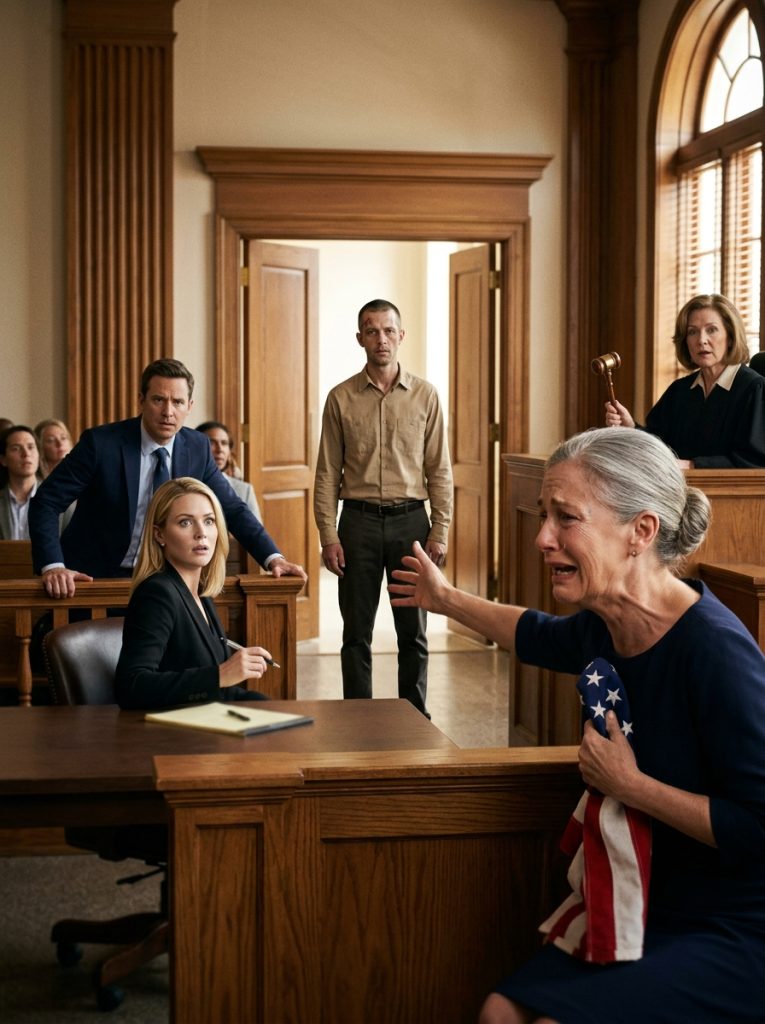
James held his mother for what felt like an hour.
In reality, it was probably ninety seconds. But in that courtroom — where time had just fractured for every person present — ninety seconds was enough to rebuild a world.
Ruth’s shoulders shook against his chest. Her hands gripped the back of his shirt like she was afraid he’d vanish again. The folded flag lay on the bench behind her, forgotten for the first time in four years.
“You’re real,” she kept whispering. “You’re real. You’re real.”
“I’m real, Mom.”
The judge lowered his gavel slowly. He removed his glasses. He looked at the attorney at the petitioner’s table.
“This hearing is suspended pending verification of identity and updated military status.”
Natalie hadn’t moved.
She sat at the table with her pen on the floor and her hands flat on the surface as if the table was the only thing keeping her upright. Her attorney was whispering to her. She wasn’t hearing any of it.
Craig had risen from the gallery and was backing toward the courtroom doors.
A bailiff blocked his path.
“Sir, no one leaves until the judge dismisses.”
Craig sat back down.
James released his mother and walked to the front of the courtroom. His steps were measured. Military. The walk of a man who’d trained himself to move through hostile environments without flinching.
He set a manila envelope on the judge’s bench.
“Your Honor. My name is James Allen Whitfield. Staff Sergeant, United States Army. Service number 4-7-2-5-8-3-9-0-1. I was recovered from captivity eleven weeks ago and have been in military medical care since. This envelope contains my POW recovery documentation, my military ID, and a letter from my commanding officer confirming my identity.”
The judge opened the envelope.
Read in silence.
Looked up.
“Staff Sergeant Whitfield. Welcome home.”
Ruth sobbed.
James nodded.
Then he turned to face the room.
Natalie looked at him for the first time.
Their eyes met across ten feet of courtroom air.
Four years of silence between them.
Four years of whatever she’d built in his absence.
James didn’t look angry. He looked tired. Older than thirty-four. Marked by whatever he’d survived in ways nobody in this room would ever fully understand.
“Natalie,” he said.
Her name sounded strange in his mouth. Like a word he’d said too many times in the dark to remember its weight.
“James.” Her voice was barely audible. “We thought— They told us—”
“I know what they told you.”
Silence.
“I’m not here to blame you,” James said. “I’m not here to undo what happened. Time moved. I understand that.”
He paused.
“But there’s something I need to know.”
Natalie’s face tightened.
“I was told—” His voice broke for the first time. “I was told I have a daughter.”
The courtroom went so quiet you could hear the fluorescent lights humming.
Natalie’s hand moved to her throat.
“Who told you that?”
“The military liaison who debriefed me. Public records. Birth certificate filed sixteen months after my disappearance. Father listed as unknown.”
The last two words hung in the air.
Father listed as unknown.
For a man who was simply missing. Not dead. Not gone by choice. Just missing.
Natalie closed her eyes.
“Her name is Lily,” she whispered. “She’s three.”
James exhaled.
A daughter.
Three years old.
A life he’d missed entirely.
“I’d like to meet her,” he said.
Natalie opened her eyes. Tears streaked mascara down her cheeks.
“James—”
“Not today. Not like this. But I need you to know — I’m not going away again. And I’m not going to pretend she doesn’t exist.”
Craig spoke from the gallery.
“You can’t just walk in here and—”
“Craig.” James didn’t turn. His voice was calm. Devastatingly calm. “I don’t know who you are. I don’t care who you are. This is between me, my wife, and my daughter.”
The word wife made Craig flinch.
Because legally — as of this moment — that’s exactly what Natalie still was. The death certificate was never finalized. The gavel never fell. And every legal step taken in James’s absence was now suspended.
Advertisement
The judge cleared his throat.
“I’m ordering a sixty-day continuance. All estate actions are frozen. Family court will be engaged for custody considerations. Staff Sergeant Whitfield, I recommend you retain counsel.”
“Already have, Your Honor.”
Ruth appeared beside James and took his arm. She was still crying. She might not stop for days.
“Come home,” she said. “Your room is exactly how you left it. I never touched it. I knew.”
James looked at his mother — the woman who refused to let a courtroom declare her son dead. The woman who carried his flag to every hearing. The woman whose faith held when the evidence didn’t.
“I know you did, Mom.”
They walked out together.
Past Natalie’s frozen attorney.
Past Craig’s white knuckles on the bench.
Past the bailiff who stood a little straighter as James passed.
Outside, the Dallas sun was too bright. The parking lot too loud. The world too fast after four years of containment in spaces so dark that daylight itself became theoretical.
James squinted.
Ruth held his arm.
“What happened?” she asked. “Where were you?”
James didn’t answer immediately.
He looked at the sky — wide and blue and free — and breathed.
“I’ll tell you,” he said. “But not today. Today I just need to know — is there a picture of her? Lily?”
Ruth reached into her purse.
She pulled out her phone.
And showed him a photo she’d saved from Natalie’s social media. The only public image of the child.
A little girl with dark hair and blue eyes — James’s hair, Natalie’s eyes — sitting in a patch of grass with a dandelion in her fist.
James stared at the photo.
His hand trembled.
“She looks like Mom,” he whispered.
Ruth smiled through tears.
“She looks like you.”
The road ahead would be long. Custody hearings. Identity restoration. Medical evaluations. The slow, painful work of re-entering a life that closed around his absence.
But the gavel never fell.
The death certificate was never signed.
And somewhere in Dallas, a three-year-old girl had a father who was coming home.
Not as a ghost.
Not as a memory.
As a man.
Broken. Scarred. Alive.
And determined to hold his daughter’s hand before the end of the week.
The custody hearing was scheduled for sixty days later.
James’s attorney — a military legal aid specialist named Captain Rachel Torres — prepared a case built on documentation, not emotion.
Service records. Recovery documentation. Psychological evaluations from Walter Reed. Letters from his commanding officer.
Natalie’s attorney argued that stability mattered more than biology. That Lily had never known her father. That disrupting her routine would cause harm.
The judge listened to both sides.
Then she asked one question that silenced the room:
“Mrs. Whitfield — did you know you were pregnant before you filed for the death certificate the first time?”
Natalie’s attorney objected.
The judge overruled.
Natalie didn’t answer.
Her silence was answer enough.
The judge ordered joint custody to begin immediately — supervised visits escalating to overnights within ninety days, pending a positive psychological evaluation for both James and Lily.
The first visit happened on a Saturday morning in a park near Ruth’s house.
James sat on a bench.
Lily approached holding Ruth’s hand.
She looked at him with eyes that were Natalie’s color but held something else entirely — curiosity without fear. The particular openness of a child who hasn’t yet learned to guard herself.
“Are you my dad?” she asked.
“Yes.”
“Grandma says you were far away.”
“I was. But I’m not anymore.”
Lily considered this.
Then she climbed onto the bench beside him and said: “Can you push me on the swings?”
James could.
And he did.
And for the first time in four years, Staff Sergeant James Whitfield was exactly where he belonged.