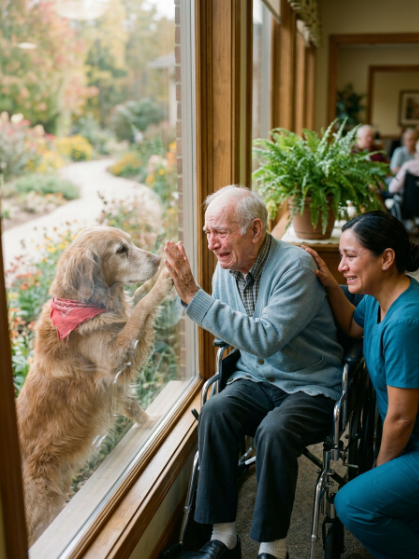
The glass was the only thing between them, and it held for about four seconds.
Buddy got to his feet on the garden side, slow, his old hips trembling. He pressed his gray nose to the window. And Frank Delgado — who had not spoken a full sentence in three weeks — put his shaking hand flat against the cold glass and said, “There’s my boy. There you are.”
Then he wept like I have only seen a few people weep, the kind that comes from a man who’d decided he was done being surprised by anything good.
I went out and brought Buddy around through the side door, against about four facility rules, and I will take that write-up to my grave with pride. The dog walked straight to the wheelchair like no time had passed. Put his chin on Frank’s knee. And Frank just kept saying his name, over and over, “Buddy, Buddy, Buddy,” like a man making sure the world was real.
The director found us like that. I braced for the lecture.
But she’s not a monster, and she had eyes. She watched Frank stroke that dog’s ears, watched the color come back into a face we’d all watched go gray, and she said, very quietly, “We’ll find a way to make this work.”
We did. Buddy became a “registered facility companion animal,” which is paperwork for “the dog stays.” He sleeps in Frank’s room now, on a cushion by the radiator. They sit at the picture window every morning, exactly like before.
I called Sharon, the daughter, to tell her. I thought she’d want to know.
She was quiet a long time. Then she said, “I didn’t think it mattered that much.”
And I understood something about how this happens. It’s not always cruelty. Sometimes it’s just people who stopped looking closely. People who decided what an old man could and couldn’t feel without bothering to ask him.
Here’s what they didn’t know about Frank, because they never sat with him long enough to hear it.
Frank gave those three kids everything. Worked the dawn route and the holiday route. Skipped his own knee surgery for two years so there’d be money for the youngest one’s tuition. When his wife died, he taught himself to braid his daughter’s hair off a library book so she wouldn’t go to school looking, in his words, “like nobody loved her.”
I learned all of this in pieces over those last weeks, sitting with Frank while Buddy snored between us. He talked more with the dog in the room. It was like the old retriever gave him permission to be a person again instead of a patient. He told me about the route. The dogs that chased him. The widow on Sycamore who left him lemonade every July for thirty years. A whole quiet life, narrated to a window with his hand on a gray muzzle.
He never once told them any of that. He thought love you announced wasn’t really love. He just did it, quietly, the way he delivered mail in the rain.
So when his estate came up — and it did, because that’s how these stories always seem to turn — there wasn’t much. A small savings account. The dog. And a letter.
The letter went to all three children. I wasn’t there for the reading, but Sharon told me about it after, on the phone, in a voice that had changed.
He wrote that he wasn’t angry. He wrote that he hoped they’d had it easier than he did, because that was the entire point. He wrote that the only thing he was taking with him that mattered was the memory of the morning light on the dog’s fur.
And he asked one thing of them. Not money. Not apology.
He asked that whoever ended up with Buddy would sit with him at a window in the mornings.
Frank passed in his sleep on a Sunday in October, with the dog on the floor beside the bed and the garden going gold outside. I was on shift. I held his hand for the part of it I was allowed to hold.
It is not a happy ending. I won’t dress it up for you. A good man spent his last years waiting by a door, and the people who owed him everything took the one thing he asked to keep.
But for those last weeks, he had his mornings back. He had his boy. He had the light on the fur.
Sharon adopted Buddy. She sits with him at her own window now, every morning, she says. She says it’s the only way she knows how to talk to her father anymore.
I think Frank would call that mail finally delivered.