Inside the envelope was not a letter.
Not at first.
Attorney Harlan pulled out three pages clipped together, a smaller sealed note, and a copy of something I recognized before my brain could name it.
The Caldwell Family Trust.
Marjorie made a sound in her throat.
It was small.
It was the first honest thing she had done all morning.
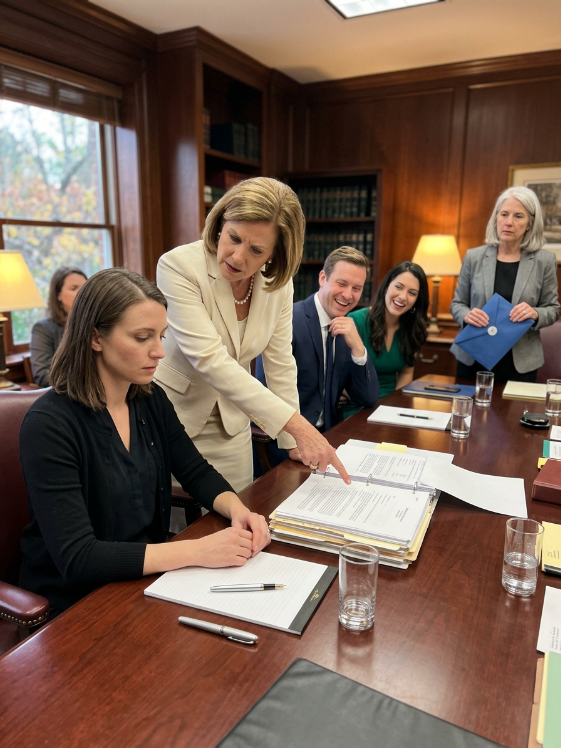
Attorney Harlan placed the pages flat on the table and kept one hand over the bottom half, like she had expected someone to grab them. Grant leaned forward. Whitney stopped smiling at her phone. Marjorie still stood over me with the public will in her hand, but suddenly it looked like a prop.
Attorney Harlan said my father had signed trustee instructions six weeks before his death, with two witnesses, a medical capacity statement, and a video record held by the firm.
Then she said my name.
Not as a daughter.
Not as a beneficiary.
As trustee.
Sole trustee.
The room did not explode.
It tightened.
The public will, Judith explained, handled personal property and cash accounts. The trust held the mill, the factory land, the voting shares, the lake property, the pension reserve, and the family home. My father had separated the performance from the power.
Performance.
Power.
I stared at Dad’s fountain pen on the table and tried to breathe.
Grant said there had to be a mistake. Whitney said Dad would never leave everything to me. Attorney Harlan corrected both of them.
He had not left everything to me.
He had placed it under my control because he believed I was the only person in the room who had protected something without asking what it was worth.
Marjorie sat slowly.
Then she smiled.
That was worse than the fear.
She said grief made old men sentimental. She said my father had been medicated. She said hospice nurses had access to vulnerable patients at odd hours.
There it was.
The accusation she had been saving.
For one second, I was back in Dad’s bedroom at 2:00 a.m., holding a straw to his lips while Marjorie slept in the guest suite because the oxygen machine annoyed her. I remembered his hand searching for mine in the dark. I remembered him apologizing for needing help.
Attorney Harlan opened the smaller sealed note.
She said my father had anticipated that concern.
Of course he had.
The first line was for the room, and Judith read it exactly as written.
If anyone claims Lena influenced me, show them the calendar.
Then she opened another packet.
Visitor logs.
Medication schedules.
Medical capacity letters.
Emails from Marjorie asking the accountant how quickly the mill could be sold after death.
Grant went pale.
Whitney stopped blinking.
Marjorie said those emails were private.
Attorney Harlan said estate planning files often were.
Then came the part that made Grant push his chair back.
My father had created a ninety-day freeze on all major trust assets. No sale of the mill. No eviction from employee housing. No transfer of voting shares. No refinancing of the family home. No removal of long-term staff.
And any beneficiary who interfered with the trustee could have distributions suspended pending court review.
Grant said, “She cannot do that.”
Attorney Harlan said, “Mr. Caldwell already did.”
I finally touched the fountain pen.
It was heavier than I remembered.
Marjorie turned to me then.
Not Judith.
Not Grant.
Me.
Her eyes were wet, but not with grief. She said we did not have to make this ugly.
I almost laughed.
After everything, she still thought ugly began when she stopped winning.
Attorney Harlan handed me the private note.
My name was on the front in Dad’s shaky handwriting.
Advertisement
Lena.
I opened it with both hands.
My sweet girl, you knew when I needed water before I asked. You knew when the mill workers needed keeping before they begged. You knew this family better than they wanted to be known. Do not let them sell what they never loved.
That was when I cried.
Not loudly.
Just one breath breaking in the middle.
For the first time all morning, the silence belonged to me.
Attorney Harlan asked if I wanted a recess.
I shook my head.
My voice came out rough, but it came out.
I asked what had been scheduled for the mill.
Judith opened another tab in her binder. There was a purchase offer from a development group, prepared but unsigned. Closing documents were drafted. Employee termination notices were drafted too.
Terminations.
Already written.
Dad had been dead nine days.
Marjorie lifted her chin and said the mill was failing.
Maybe parts of it were.
But I knew the names of the people who worked there. I knew Carl at loading dock three had sent soup when Dad stopped eating. I knew Denise from payroll had driven an hour to bring him a quilt signed by second shift.
I asked Attorney Harlan what authority I had that day.
She said, “All of it.”
Something in me settled.
I asked Judith to issue written notice freezing the sale, the terminations, and any movement of trust accounts until I completed review. I asked for copies of all pending offers, employee lists, debt schedules, and all communications about the mill after Dad entered hospice.
The words sounded like someone else’s at first.
Then they sounded like mine.
Marjorie said I was being emotional.
That used to work on me.
I looked at her cream suit, her pearls, the public will bent in her hand, and I said emotion was not the same thing as confusion.
The meeting ended with no hugs, no apologies, and no dramatic exit. Grant left first, already on the phone. Whitney followed him, crying now because consequences had finally become personal. Marjorie stayed behind long enough to ask about the house.
There it was.
The real grief.
Judith explained the life-estate limits. Marjorie could remain if she complied with trust rules, preserved the property, and made no attempt to interfere with trust assets or staff. If she violated the terms, the trustee could petition for removal.
The trustee.
Me.
Marjorie looked at me like she wanted to slap the word out of the room. Instead, she picked up her handbag and said my father would be ashamed.
I thought of his note.
I thought of his pen.
I said, “No. He was prepared.”
Three weeks later, I walked through the mill with Judith’s binder under my arm and Dad’s pen clipped inside my cardigan. The machines were loud. The air smelled like oil and cotton dust. People stopped when they saw me because they had expected a developer, a padlock, maybe a notice taped to the door.
I told them the sale was frozen.
Denise from payroll covered her mouth.
Nobody cheered.
Working people do not always trust good news at first.
They wait to see if it survives paper.
It did.
The audit found the development offer had been rushed, undervalued, and tied to a consulting fee Grant had not disclosed. Whitney had already requested advances against distributions she did not control. Marjorie had tried to redirect household staff through an account the trust did not authorize.
Judith handled the court filings.
I handled the mill.
Not perfectly.
Not magically.
We cut waste. We leased unused storage to a local manufacturer. We kept the pension reserve untouched. We rehired two maintenance men Grant had pushed out because they asked too many questions.
Six months later, Marjorie moved out of the house by choice, though she told everyone I forced her.
I did not correct her.
I had learned silence could be a door or a wall.
This time, it was a wall.
On the day the first repaired loom started again, I stood near the factory floor with Dad’s fountain pen in my pocket. It had no reason to be there. There was nothing to sign.
I carried it anyway.
Some inheritances are not money.
Some are instructions.
Mine was simple.
Keep what they never loved.