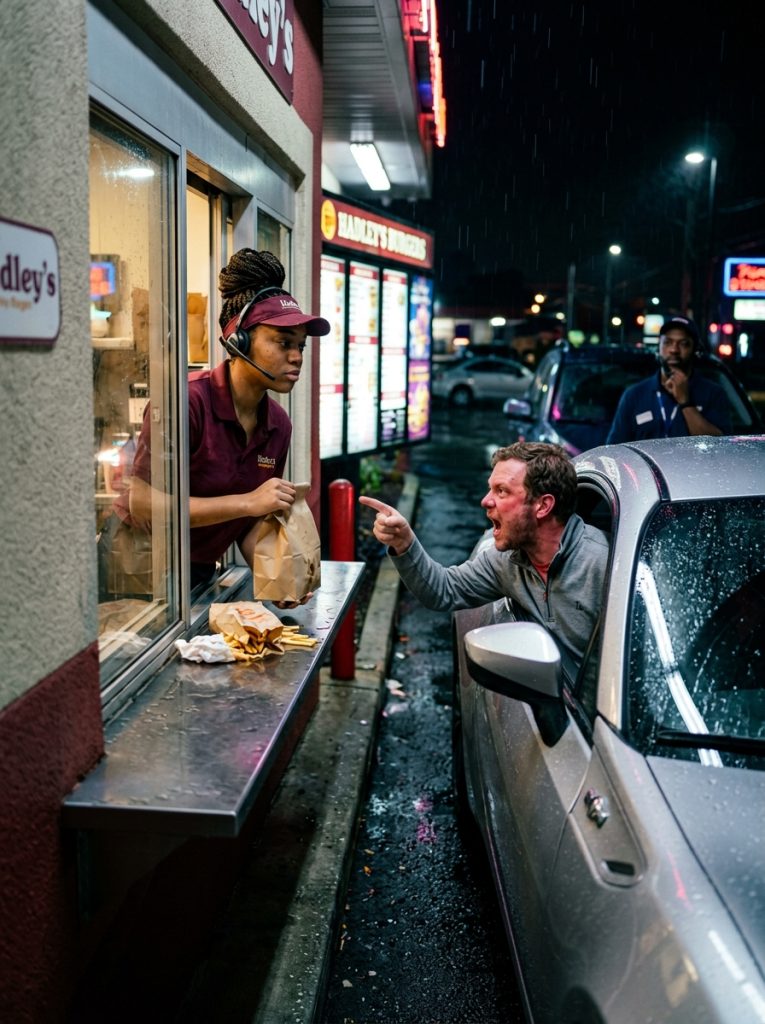
Marcus didn’t raise his voice once. That’s the thing I think about most, looking back. The angry man had done all his business at full volume, and the man who actually had power over the moment spoke so quietly that the guy in the silver coupe had to stop talking just to hear him.
“Pull up to the side and park, please,” Marcus said. “We’re not finished.”
“I’m not parking anywhere. I’m leaving. Get this car out of my way.”
“You can leave,” Marcus said. “I just want to be clear about what leaving means. You spent four minutes on an open headset channel screaming at a teenage employee. I heard every word, because I was sitting in your blind spot doing an overnight service audit. So you can drive off right now — but I already have your plate, your order, and the timestamp. And I’d like to make sure the next part is your choice.”
There was a silence then that I will remember for the rest of my life, because it was the first time all night the man had nothing to say.
“Who even are you?” he finally managed.
“Marcus Webb. District manager. Seven stores, this one included.” He let that sit. “Which means the girl you’ve been telling has no future? She works for me. And from what I just heard, she handled a customer having the worst night of his life with more professionalism than most of my shift leads. So I’m going to ask you not to come back to any of my seven locations. I’ll be flagging the plate. It’s not a threat. It’s just where we are now.”
The man started up again — do you know who I am, I’ll have your job, I’ll call corporate, this is harassment — and Marcus just nodded along like a man waiting out a rain shower. When the guy ran out of steam, Marcus said, “Corporate’s number is on the receipt. Please do call. Ask for the regional line and reference tonight’s incident number.” He slid a little card through the window with a number already written on it. “I wrote it down for you.”
The silver coupe peeled out of the lot so fast it fishtailed in the wet.
And then it was just me and Marcus and the ruin of fries all over my counter and the rain coming down soft on the drive-thru canopy.
“You okay?” he asked. And the way he asked it — not performing, just asking — almost did what the man’s screaming hadn’t. I felt my throat go tight.
“I’m fine,” I said. “I’m sorry about the mess. I’ll have it cleaned before—”
“Jasmine.” He smiled. “I don’t care about the fries. Sit down for a second. Or — you know. Lean. Whatever you can do at a window.”
So I leaned, and he asked me about myself, and somewhere in there the whole night turned.
I told him about the nursing prerequisites. About the late shift paying a dollar more. About studying anatomy flashcards between the dinner rush and the bar rush. About my mom at the airport hotel, and my little brother who thinks I hung the moon. I didn’t mean to tell him all of it. There was just something about a person asking who you are right after a stranger told you that you’re no one. It opens you up.
What I didn’t tell him was the thing the man had actually hit. It wasn’t the insults — I’d been insulted before, by drunks and by tired parents and by people who think a uniform means you can’t hear. It was the certainty. He’d said “no future” like he was reading it off a chart. Like it was already decided. Like the next forty years of my life were a foregone conclusion he could see and I couldn’t. That’s the poison in it. Not that a stranger is cruel, but that for one black second, at one in the morning, you almost believe he can see something about you that you can’t.
Marcus must have known that, because the next thing he said wasn’t comforting. It was practical. And practical, it turns out, is what hope actually looks like when you’re nineteen and soaked through and standing in a pile of someone else’s fries.
Marcus listened to the whole thing. Then he said something I’ve repeated to myself on hard days ever since.
“You know what I heard on that headset?” he said. “I didn’t hear a kid with no future. I heard somebody keep her voice steady while a grown man tried to take her apart. You can’t train that. I can train anybody to run a register. I cannot train somebody to stay decent under pressure. That’s the part that makes a manager. You already have it. The rest is just paperwork.”
Here is what Marcus did, and none of it was a fairy tale — it was just a person with a little power choosing, for once, to use it correctly.
He wrote up the incident with me as the employee who de-escalated, not the one who fumbled an order. He put me forward for the company’s shift-lead training the following month. When I told him I couldn’t take on more hours because of school, he pulled up the company’s tuition-assistance program — the one nobody at my store had ever mentioned, the one buried in the benefits portal behind a login I’d never used because I assumed it couldn’t possibly be for someone like me. It covered a real chunk of my prerequisites. The paperwork had been sitting there the entire time. All anyone had to do was point at it.
I want to be honest about how small the whole thing was, mechanically. Marcus didn’t write me a check or change my life with a speech. He spent maybe forty minutes of administrative time. He filed an incident report correctly. He forwarded a training nomination. He showed me a webpage. That’s it. That is the entire miracle.
But that’s the thing nobody tells you about being looked down on. The people who decide you have no future almost never do it with some grand act of cruelty. They do it by not pointing at the webpage. By not filing the report. By looking through you in the drive-thru lane and quietly deciding you aren’t worth forty minutes. The man in the silver coupe was loud about it. Most people are quiet. Marcus was just the first person with any power over my life who was quiet in the other direction.
By the end of that year I was a shift lead. By the spring after, an assistant manager, running the same overnight shift I used to cry through — except now I was the one training the new kids. And the first thing I teach every single one of them is that the headset is always live, and that how you treat the person at the window says everything about you and absolutely nothing about them.
I’m in nursing school now. Clinicals start in the fall. I still pick up the occasional overnight at Hadley’s, partly because I like the quiet, and partly because every so often someone pulls up to that window having the worst night of their life, and I get to be the calm voice that refuses to match their storm.
I never did find out what happened to the man in the silver coupe. Marcus flagged the plate; he never came back. For a while I used to fantasize about some enormous comeuppance for him — a viral video, a public humiliation to match what he tried to do to me at two in the morning.
I don’t anymore.
Because here’s the truth I finally understand. He told me I’d be standing at that window when I was forty, handing bags to people who matter to people who don’t. And he was wrong in the most specific, satisfying way. I am going to spend my whole life handing things to people on the worst nights of their lives. Medication. A warm blanket. A steady voice at 2 a.m. when everything has gone wrong and they’re sure no one is coming.
Just not through a drive-thru window.
He called me a nobody with no future.
He was the very last person who ever got to define either of those words for me.