The shareholder ethics form asked for the accused account first.
Not the crime.
Not the harm.
The account.
That felt right in the ugliest way.
Platforms do not see a mob at first. They see usernames, timestamps, reports, ratios, flags. You have to translate fear into fields before anyone will admit fear is happening.
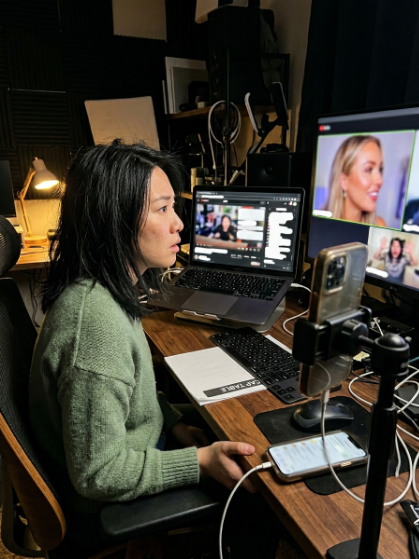
My hands were shaking so badly that I had to use the adaptive mount to steady the phone while I copied Brynn’s livestream link. On the second monitor, her face kept moving through a blur of perfect lighting and practiced outrage. I could not read the comments anymore. They had become motion.
Kit’s tiny video tile blinked off.
Then back on.
Then off again.
A message appeared in the escalation chat.
Do you have standing to file as shareholder?
I looked at the cap table packet tucked under my keyboard.
For three years, I had treated that ownership stake like a locked emergency exit. I had invested early, quietly, after the platform announced creator safety tools it could not afford to build. I had pushed for disability harassment categories, coordinated-report detection, and sponsor disclosure enforcement.
Most creators never knew.
Brynn definitely did not.
I typed yes.
Then I uploaded the filing number.
For the next hour, nothing happened where anyone could see it.
That is the part people never understand about online disasters. The public side moves like fire. The private side moves like paperwork underwater.
My follower count kept falling. Sponsors kept sending careful emails. One brand paused a campaign I had spent four months designing with actual disabled testers. Another asked if I could provide context before Monday.
Context.
I wanted to send them the livestream link and a mirror.
Instead, I saved everything.
Screen recordings.
Sponsor emails.
Bot-like report bursts.
The moment Kit’s moderation panel flashed.
A clip where Brynn told people to “make sure the platform sees who she really is.”
I did not go live.
I did not cry on camera.
I built a folder.
At 12:17 a.m., Kit called me through the secure line.
His voice sounded like he had run up stairs.
He said, “I was not supposed to show you that panel.”
I said, “I know.”
He said, “But you saw enough?”
I looked at the folder on my screen.
I said yes.
There was a pause.
Then he said the reports were not organic. They had come in waves, clustered around private group links, sponsor manager accounts, and a creator agency Slack export someone had already tried to delete.
My mouth went dry.
Creator agency.
Brynn’s agency.
Kit said he could not send me internal logs directly.
I said I was not asking him to.
He said, “Good. Because I would get fired.”
Then he added, quieter, “But the ethics team can request them if the complaint is properly filed.”
I understood what he was doing.
Not leaking.
Pointing to the door that had a handle.
I filed the second attachment at 12:31 a.m.
At 1:06, my account was temporarily restricted pending review.
That was when I finally cried.
Not because I thought I was finished.
Because I had spent years warning the platform that coordinated reporting could silence disabled creators before a human ever saw the context, and now I was watching my own work fail in real time.
The next morning, Brynn posted a story about accountability.
Of course she did.
She sat in a white kitchen, eyes glossy, voice soft, saying she believed all communities deserved honesty. She did not say my name. She did not need to. Her followers filled it in for her.
My mother called.
Advertisement
I did not answer.
Then my lawyer called.
I answered that one.
His name was Owen, and he had the exhausted voice of a man who had spent too many years reading terms of service documents written by people who hoped no one would. He had reviewed the shareholder provisions. Because my stake was small but tied to a safety-fund class, I had the right to request an ethics review if platform enforcement was being used to harm protected safety work.
That phrase sounded ridiculous.
It also saved me.
By Monday, the ethics team had frozen the enforcement action on my account. Not reversed. Frozen. My page was still limited. My sponsors were still silent. Brynn was still posting quotes about grace.
But behind the scenes, the logs were moving.
The first real break came from a sponsorship contract.
Owen found the disclosure clause. Brynn’s deal with the accessibility brand required her to avoid direct harassment of any critic and disclose any paid amplification campaign. The agency had tried to create distance by calling the livestream a personal response.
Then Kit’s logs showed sponsor manager accounts entering the live chat before the report wave began.
Not commenting.
Watching.
Coordinating.
The second break came from the agency Slack export. Someone inside Brynn’s team had used the phrase pressure platform trust team before the live began. Another message listed my sponsors by priority. A third said, if she loses account access before Monday, brand pause becomes permanent.
There it was.
Not outrage.
Strategy.
When the ethics panel met, I attended by video with my camera off for the first ten minutes because my face would not behave. Owen spoke first. Then a platform counsel. Then a safety engineer who sounded furious in the careful way engineers get furious when a system does exactly what they warned it would do.
Brynn joined late.
She had a lawyer and a beige sweater and no ring light this time.
The panel asked whether she had encouraged mass reporting.
She said she could not control her followers.
They played the clip.
Make sure the platform sees who she really is.
She said that was a figure of speech.
They showed the agency messages.
She said she did not manage Slack.
They showed the sponsor clause.
She muted herself.
That was the first time I felt the ground under my feet again.
Not victory.
Ground.
The platform reinstated my account that afternoon with a public enforcement correction. Public. Not the vague private apology creators usually get. The statement said coordinated reporting had been used to trigger an improper restriction. It said sponsor-linked accounts had participated in manipulation. It said the safety workflow would be reviewed by an outside accessibility advisory group.
My name was in the first sentence.
Correctly spelled.
Brynn’s sponsor dropped her within an hour.
Her agency issued a statement using the words misalignment and process failure, which meant everyone was looking for a bus to throw someone under. The brand opened refunds for the customers in my original report. The campaign I had criticized was suspended permanently.
And then came the part that mattered more than Brynn.
The platform adopted the rule I had proposed two years earlier.
Coordinated report waves against creators in protected advocacy categories would no longer auto-restrict without human review. Sponsor-linked accounts had to be disclosed in enforcement disputes. Creator safety investors, including small ones like me, would get quarterly transparency data.
It was not perfect.
Nothing built by a committee ever is.
But it was a door where there had been a wall.
Three weeks later, I went live again.
No dramatic music.
No crying thumbnail.
Just me at my messy desk in the green sweater, adaptive phone mount visible, ring light turned halfway away because I still hated how it made my skin look flat.
I told my audience what had happened.
I told them what I could prove.
I told them what I could not share.
Then I told them the thing I had needed to hear the night my numbers fell.
You are not required to perform pain in order to prove harm.
The chat moved fast again.
This time, not like fire.
Like people coming home with the lights on.
After the stream, I took the cap table packet and put it in a real folder instead of under my keyboard. Not hidden. Not displayed. Just filed where I could reach it.
Power should not have to be secret to protect you.
But if it is, use the door before they lock it.