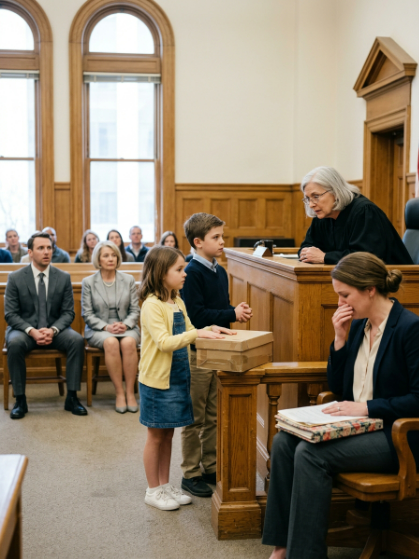
The lid came off, and the whole courtroom leaned in.
Inside that shoebox was not a toy. Not a drawing. It was paper. My daughter’s careful, eight-year-old paper.
Receipts she’d peeled off the fridge. A school lunch card. A pharmacy bag stapled to a note in crayon: MOM GOT MY MEDISIN. A movie ticket. A library card. Three birthday candles in a sandwich bag.
Mason explained it before the judge could ask. Because Mason is ten, and Mason has been the man of a house he was too young to carry.
“We started saving stuff,” he said. “Of who came. Dad said we’d remember it wrong. So we kept it so we wouldn’t.”
Judge Vance asked him, very gently, what he meant.
“When I had the flu, Mom slept on my floor. When Lily’s tooth came out, Mom did the money thing under the pillow. When we had the spring concert, I looked in the seats.” He swallowed. “Dad wasn’t in the seats. He was on a work trip. Mom was in the seats. She’s always in the seats.”
I pressed the binder to my chest and tried not to make a sound.
Grant’s lawyer stood up. “Your Honor, children can be coached—”
“Sit down, counselor,” the judge said. She didn’t raise her voice. She didn’t have to.
Then she did the thing that ended it.
She picked up the therapist’s letter. The one that called me unstable. The one I’d never been able to fight because it had a license number and a signature and I had nothing but a floral binder.
“Mr. Holloway,” she said. “This letter is dated March eleventh. It describes a session with the mother.” She looked over her glasses. “On March eleventh, where was Ms. Brennan?”
I didn’t even have to find it. Lily found it. Lily reached into her shoebox and held up a creased paper plate from a school science fair, dated in a teacher’s handwriting, with a blue ribbon still taped to it.
March eleventh.
I was at Whitman Elementary, second row, watching my son explain a baking-soda volcano.
The judge had the court call the therapist’s office during recess.
The “therapist” had closed that practice four years ago. The letterhead was real. The session was not. Someone had taken an old template and typed a lie onto it.
When we came back in, Diane wasn’t holding her purse like a shield anymore. She was holding it like it might float her out of the room.
Judge Vance spoke slowly, for the record.
“I find the document submitted as Exhibit D to be fabricated. I am referring it to the prosecutor’s office. I am also referring the question of who prepared it.” Her eyes moved to Grant, then to his mother. “Both of you should consult your own attorneys. Separately.”
Grant’s face did something I’d waited fourteen months to see. It stopped performing.
The smirk, the easy money, the borrowed confidence — it all drained out, and underneath was just a man who had bet his children on a forgery and lost.
The ruling came two weeks later, but the courtroom already knew.
Full custody to me. Supervised visitation for Grant — supervised, the word he’d hung around my neck, now hanging around his. The forged-letter referral went forward. Diane’s lawyer started using the word “settlement” in emails before anyone had even filed.
I’d love to tell you I felt triumphant.
Mostly I felt tired, and then I felt the specific, knee-buckling relief of a person who has been holding her breath since the previous spring.
Outside, on the courthouse steps in the pale Columbus light, Lily took my hand.
“Did we do good, Mom?”
I knelt down to her level, the way I’d knelt to tie those shoes a thousand mornings.
“You did perfect,” I said. “But I need to ask you something. Why did you keep all that? Really?”
She thought about it the way kids do, completely honest.
“Because you kept all of us,” she said. “I wanted to keep you back.”
Mason pretended he wasn’t crying. I pretended with him.
That night I tucked them into their own beds, in our own apartment, no clipboard, no clock, nobody watching to grade whether I loved them correctly.
I left the floral binder on the kitchen table. I didn’t need it anymore.
But Lily asked if she could keep her shoebox.
I told her yes. Some things you hold onto, not because you’ll need them again — but because they’re proof that when it counted, you showed up.
She fell asleep with one hand resting on the lid, like a girl guarding treasure she already knew was real.