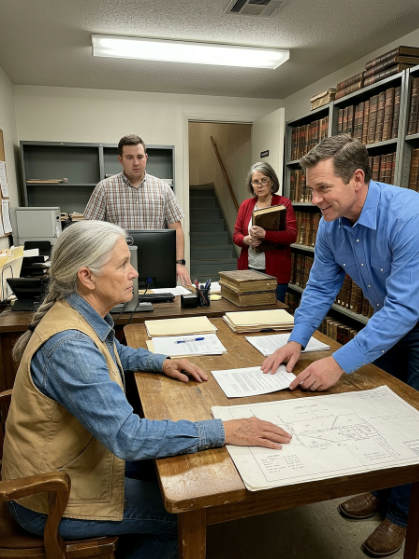
Inez did not answer me right away.
She looked at Beau first.
That told me she remembered.
People who do not remember look confused. Inez looked cautious. Like the memory had sharp edges and she was deciding who in the room deserved to touch it.
Beau’s smile came back too quickly.
“Mrs. McKenna, old books are charming, but the county index is the county index.”
I kept my finger on the blank place in my tract map.
“Then the old book will agree with it.”
Travis Lee swallowed behind the clerk’s desk. Poor boy. He had walked into the room believing the computer made him official. Now every pair of boots in the records room was waiting to see if he would be a clerk or a screen reader.
Inez pushed her glasses higher.
“There was an 1889 volume moved after the basement repair,” she said. “Abstract B through D. It never scanned clean.”
Beau tapped the purchase agreement again.
“This is a delay tactic.”
“No,” I said. “This is a record search.”
The other landmen stopped pretending to browse. One of them leaned against the shelf with his arms crossed. Another took out his phone, then thought better of it when Inez looked at him.
Travis stepped away from the computer.
That was the first brave thing he did.
“I’ll check the basement log,” he said.
Beau’s voice hardened.
“You are going to hold up a transaction because a widow thinks she remembers a flood?”
I looked at him then.
Really looked.
At the boots. The pressed shirt. The folder full of language meant to look helpful while it stripped the future out from under my feet.
“My husband died three years ago,” I said. “Not my memory.”
The room went quiet enough for the fluorescent light to buzz.
Travis returned with a clipboard and a key ring. Inez followed him to the basement door. I stood too, slower than I wanted because my knee had been bad since February, and I refused to let Beau see me wince.
He reached for the purchase agreement as if to gather it.
I put my tract map on top of it.
“Leave it,” I said.
He did.
We went down to the basement in a line that would have been funny in any other story. A widow, a nervous clerk, a title abstractor, a landman, and three men pretending they were not about to watch money change direction.
The basement smelled like dust, cardboard, and the kind of damp stone that never fully dries. Shelves ran along the walls. Some boxes were labeled neatly. Some looked like they had been labeled by people who were running out of time and patience.
Inez went straight to the back.
That is how I knew she had been telling the truth.
She did not search randomly. She counted shelves under her breath, touched one spine, rejected it, then pulled a fat brown volume from the second row with both hands.
The cover was ugly.
Beautifully ugly.
1889.
Travis carried it upstairs like it was heavier than paper. Maybe it was. Maybe all records get heavier when people have ignored them long enough.
Back at the table, Beau tried one last time.
“Even if there is some cross-reference, severance language can be complicated. My office can review it later.”
Inez opened the book.
“Your office can wait.”
I almost smiled.
She turned pages carefully, not with reverence, but with skill. Old paper does not want drama. It wants clean hands and patience.
I watched the columns. Names. Acreage. Transfers. Margins full of clerk notes that looked like tiny arguments with time.
Then I saw Roy’s old kitchen-table mark.
Not his handwriting, of course.
The same abstract number he had circled in pencil thirty years after the clerk wrote it.
My breath caught.
Inez stopped on the page.
Travis leaned over.
Beau leaned too, but from farther away.
“Read the granting language,” I said.
My voice was quieter than I expected.
Travis read the first line. Then the second. Then he stopped.
“Keep going,” Inez said.
He did.
Surface and mineral estate conveyed together.
No reservation.
Advertisement
No severance.
Unity of title.
The words landed one at a time.
Not poetic.
Not dramatic.
Better.
Legal.
Beau reached for the book.
Inez shut it halfway before his fingers touched the page.
“No handling without gloves.”
That was not the real reason.
The real reason was that she did not trust him near a sentence that had just cost him money.
Travis looked pale.
“The digital index cross-referenced the wrong abstract.”
“Yes,” I said.
I did not say I told you so.
At sixty-nine, you learn some victories are too expensive to spend on small words.
Beau tried to recover by talking about market offers and title uncertainty. He said even corrected records took time. He said companies preferred clean chains. He said a lot of things men say when the door they planned to walk through becomes a wall.
Travis picked up the purchase agreement and handed it back to him.
“This office cannot certify severed minerals on this tract. Not with this record.”
Beau stared at him.
Travis’s ears went red, but he did not look away.
That was the second brave thing he did.
By the end of the afternoon, the county supervisor had joined us. Copies were made. Not scans from a phone. Proper archival copies. Inez wrote a correction memo. Travis opened an index correction ticket while I sat at the same scarred table with my map folded beside me and Beau’s agreement no longer touching it.
Beau left without shaking my hand.
I preferred it.
A false courtesy would have dirtied the room.
Two weeks later, the public index was corrected. The mineral chain reflected unity of title from 1889 forward. Three companies that had ignored my calls suddenly wanted meetings. One sent a young man with a basket of muffins and a lease proposal so friendly it might as well have worn perfume.
I made him wait on the porch while I finished feeding the heifers.
Not to be rude.
To remind both of us whose land he was standing on.
Travis called me himself when the correction posted.
He apologized.
Not in the thin way people apologize to get past trouble. He said he had repeated a database result without checking the underlying record, and that his office had started a review of other flood-repair volumes.
I told him embarrassment can be useful if you let it teach you instead of letting it hide you.
He was quiet for a moment.
Then he said, “Mrs. McKenna, would you mind if I asked Ms. Calder to train me on the basement books?”
I looked out my kitchen window at Roy’s old windmill.
“I think she’d like that,” I said.
Inez did like it, though she pretended she did not. For the next month, she marched Travis through the basement with a pencil behind her ear and the patience of a woman who had spent decades waiting for young clerks to learn that records are not old because they stopped mattering.
As for Beau, word traveled faster than he expected. Landmen talk. Ranchers talk slower, but better. By the time he tried to buy under another neighbor’s widow, she had already called me. I told her where to look and what to ask.
She did not sign either.
The royalty checks did not arrive all at once. That is not how oil works, no matter what people in suits imply. First came title confirmation. Then negotiation. Then a lease I understood because I made three different attorneys explain it until their metaphors ran dry.
When the first check finally came, I took it to the cemetery.
Not the whole thing. Just the stub.
I sat beside Roy’s stone with the paper in my hand and told him he had been right about the book.
Then I told him I had been right too.
That would have made him laugh.
I used part of the money to repair the south fence. Part to pay off the equipment loan. Part to set up a scholarship at the county vocational school for kids who wanted to learn surveying, title work, and land management without leaving home.
I named it after my grandfather’s tin box.
People asked why not Roy.
Because Roy already had the ranch.
The tin box had the receipts.
Months later, I went back to the courthouse records room. Same fluorescent lights. Same scarred tables. Same basement door. Travis was helping a young couple trace an easement, and Inez was correcting his pronunciation of a survey term from three shelves away.
He saw me and smiled.
Not like a boy with a database.
Like a clerk.
I signed the visitor log and sat at the table with my tract map, now laminated at the corners because I had finally admitted paper gets tired too.
A new landman I did not know glanced at me, then at the map, then back at me with sudden caution.
I did smile then.
Not big.
Just enough.
The old records had not made me powerful.
They had only reminded the room I already was.