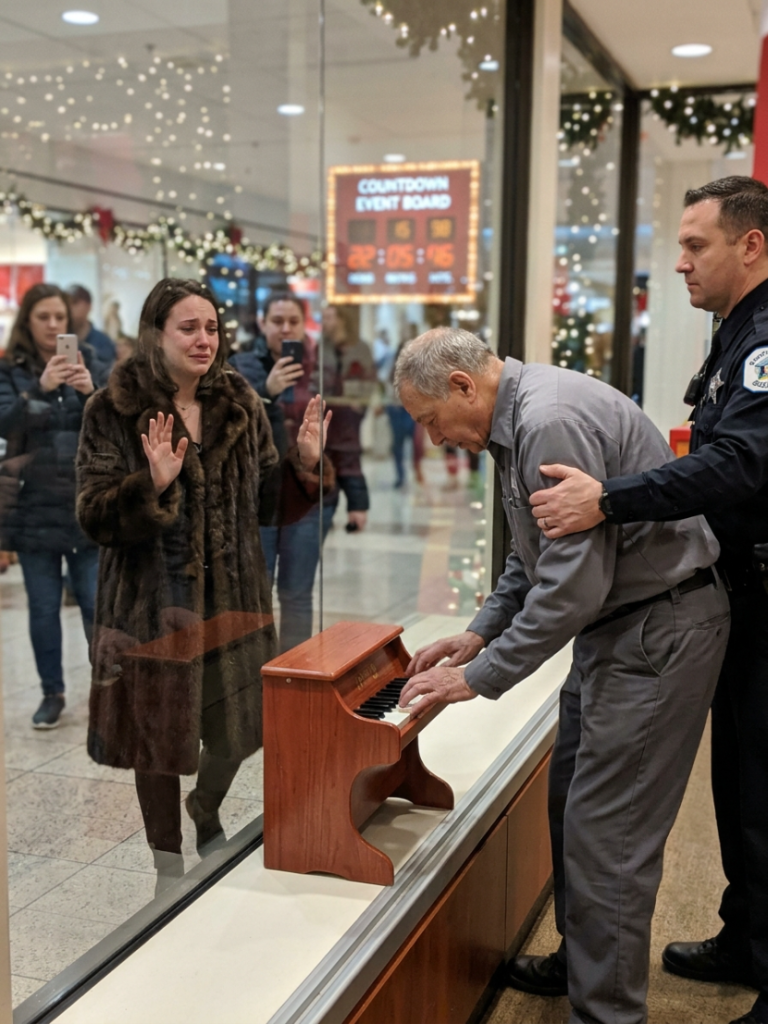
“Let him play,” Clara Harlan said, and the ribbon countdown at Harlan Plaza seemed to stop with her voice.
Twelve minutes had remained on the digital board above the holiday stage — twelve minutes of VIP donors, camera crews, and a toy store window dressed in string lights for the Saturday five o’clock opening. George Pell, seventy, custodial uniform, bent toward the display ledge with a security officer’s grip on his upper arm, fingers still pressing the small plastic keys of a toy piano as if melody outranked uniform policy.
Clara, thirty-two, fur coat, stood frozen ten feet away, tears forming before she understood why. The phrase George tapped was unfinished by design — three notes, pause, two notes — a pattern too specific to be random, too broken to be a store demo loop.
Shoppers behind her raised phones. The mall emcee checked his watch near the stage and lost his smile.
The security officer tugged harder. “Sir, you are not authorized at the display window.”
George did not resist violently. He kept the melody going with one hand, stubborn and gentle, while Clara’s breath caught like she had been struck by memory instead of air.
“Let him play,” she said again, louder.
The officer looked at her — Harlan name on the event banner behind the stage, Harlan Plaza in gold letters on the marble directory, the kind of name security training told you not to argue with. His grip loosened but did not release.
“Ma’am, he was tampering with merchandise—”
“He was finishing my brother’s song,” Clara said.
The walkway went quiet in the way malls go quiet when money hears something money cannot buy.
George’s fingers stilled. He turned his head slightly, eyes wet, still bent toward the cheap piano keys that had cost less than Clara’s earrings.
“You heard it,” he whispered.
Clara crossed the ten feet without running. Running would have made it spectacle. She stopped at the window glass, palm against the pane, breath fogging a small circle.
“Daniel’s bridge,” she said. “He never wrote the last line.”
Two hours earlier, George had been wiping sugar dust from kiosk rails on the third level when the emcee’s rehearsal music bounced off the atrium glass. He heard the countdown tests. He heard Harlan family names. He heard nothing that should have pulled him downstairs until he passed the toy store window and saw the display piano — white plastic, red keys, the kind children punched while parents shopped.
Daniel Harlan had owned one like it at eleven, before the diagnosis, before hospice, before the family stopped saying his name at galas because grief did not photograph well.
George had been Daniel’s music therapist for the final eight months — not because the Harlan trust paid the highest rate, but because Daniel’s fingers still wanted sound when speech failed. They built a phrase together on bad days: three notes up, rest, two notes down, unfinished on purpose because Daniel said endings were for people who believed in tomorrow.
He died on a Tuesday without writing the last line.
Clara had been twenty-four, abroad, unreachable for the final week. She returned to silence and a locked music room. George returned to custodial shifts because hospitals had become too loud.
Now his fingers had found the phrase again in a window where Harlan money hung lights for strangers.
The security officer still held George’s arm. “Ma’am, we have a schedule—”
Clara turned on him with a composure colder than the fur around her shoulders. “Release him or I stop the ribbon event and every camera here records why.”
The officer released.
George finished the phrase — not the ending Daniel never wrote, but the next honest bar they had rehearsed once: a single low note held until it trembled, then silence.
Clara’s tears fell without performance. Shoppers lowered phones out of instinct, not policy.
“Who are you?” she asked through the glass.
“George Pell,” he said. “I cleaned your brother’s room at St. Luke’s. I was the one who wrote the phrase down when he couldn’t hold a pencil.”
Clara’s hand flattened harder against the glass. “You never came to the funeral.”
“You didn’t invite staff,” George said, not accusing — stating weather. “I kept the notebook.”
He reached slowly into his uniform pocket with permission in Clara’s eyes and produced a spiral pad, corners worn, page corner folded to a sketch of notes in a child’s uneven hand. Daniel’s name at the top. Unfinished bar at the bottom.
The emcee approached with a headset and caution. “Clara, donors are waiting—”
“Then wait,” Clara said.
She asked George to play again. He played. The toy piano’s cheap speakers made the melody tinny and true. A woman in the crowd cried without knowing why. A boy tugged his mother’s sleeve and listened.
Clara opened the store door — against protocol, against schedule — and stepped inside the window display without caring about scuff marks on her heels. She knelt beside George on the faux snow matting and looked at the keys his fingers had touched.
“Finish it with me,” she said.
George shook his head once. “That ending is yours. He told me.”
Clara pressed one key — the low note he had held. The note rang small and stubborn in the holiday lights.
“He said you would know it when you were ready,” George said.
Clara stayed on the faux snow while the countdown board hit nine minutes, then eight. She did not stand for donors. She asked George to play the phrase again, slower. She hummed the missing line — not from memory of paper but from memory of a boy humming in a hospital bed while monitors beeped in polite disagreement.
The last line came out simple. Two notes. A step down. A rest. Completion without grandeur.
George wept without hiding it.
The crowd outside the window grew until security stopped pretending they could control it. The emcee killed the intro music. Cameras turned from the ribbon stage to the window where a Harlan heiress knelt beside a custodian and finished a dead boy’s song on a toy piano.
Clara’s public relations director arrived breathless. Clara handed her the notebook and said, “No spin. His name. George’s name too.”
The ribbon event was delayed forty minutes. Donors complained until they heard the melody through the atrium speakers someone patched from a phone recording. Complaints stopped mid-sentence.
Afterward, in a service corridor smelling of mop water and cinnamon pretzels, the security chief who had grabbed George was escorted off property by HR. Clara signed the termination order herself on a clipboard George held steady for her without being asked.
“You didn’t have to do that,” George said.
“He put hands on you for playing my brother’s music,” Clara replied. “Harlan Plaza does not own grief schedules.”
She established the Daniel Harlan Music Scholarship by morning — tuition for pediatric therapy students, preference for hospice music programs. George declined a board seat. He accepted one teaching clinic a month.
On the application form, question seven asked: Describe a melody that changed your life. George wrote three notes, pause, two notes, and left the last line blank for applicants to finish themselves.
Six months later, George played the completed phrase at the first scholarship concert in the atrium where he had once been dragged from a window. Clara turned the page when his hands shook.
When the final note faded, Clara walked to George, put her hand on his shoulder the way Daniel used to lean against him in hospice, and said thank you in a voice too quiet for microphones but loud enough for the man who had kept her brother’s song alive on a custodian’s break.
George nodded, closed the notebook, and slipped it back into his pocket — unfinished no longer, not because endings erase loss, but because someone finally came back to hear the last line.