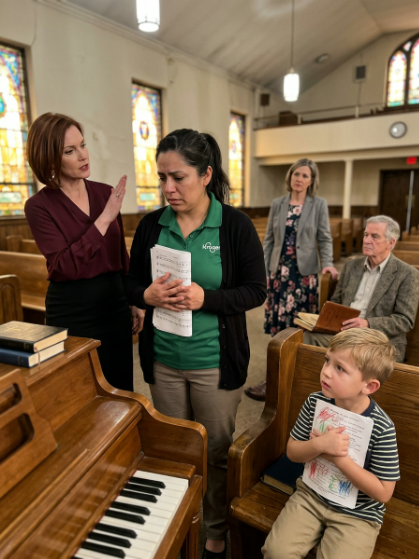
The piano gave me the first note again.
This time, no one stopped it.
Pastor June played softly, like she was building a floor under my feet instead of pushing me onto a stage. My sheet music trembled in my hands. I could feel Celeste beside the piano, stiff and silent, holding her clipboard against her ribs.
Arthur Bell watched from the back pew.
Mateo watched from the front.
That was the harder one.
An old man with a leather notebook could judge my voice.
My son was judging whether the world was allowed to make his mother smaller.
So I looked at him when I sang the first line of the second verse.
Not at Celeste.
Not at the stained glass.
At Mateo.
His sneakers still did not touch the floor. His crayon-marked program was bent in the middle from how tightly he held it. When my voice rose, his mouth opened a little, like he had always known the sound could fill a sanctuary and was only surprised the adults were late to the truth.
By the third line, my shaking stopped.
By the fourth, the room changed.
You can feel it when people stop waiting for you to fail.
The air loosens.
Shoulders drop.
Someone breathes in too sharply.
Pastor June’s left hand softened on the piano. She found me instead of leading me. I followed, then carried, then stopped thinking about whether I belonged there at all.
For one whole verse, I was not a cashier in a green polo.
I was not a tired woman with bills in the glove box.
I was not a mother trying not to cry in front of her child.
I was a voice.
When the final note faded, nobody clapped right away.
That silence scared me for half a second.
Then Arthur closed his notebook.
The sound was small.
But it ended something.
He stood slowly from the back pew.
“Ms. Vega,” he said, “who taught you breath control?”
I almost laughed because the honest answer sounded ridiculous.
“Long shifts,” I said. “And lullabies.”
Pastor June smiled down at the piano keys.
Mateo sat taller.
Celeste cleared her throat.
“Raw ability is not the same as choir readiness.”
Arthur walked down the aisle with the patience of a man who had spent a lifetime letting other people reveal themselves. He was not tall, but the room moved for him anyway.
“No,” he said. “But dismissing raw ability after two lines is not direction. It is gatekeeping.”
Celeste’s face tightened.
“I have standards for this choir.”
“As you should,” Arthur said. “Standards train people. They do not humiliate them for arriving without what money usually buys.”
The sanctuary went still.
I looked at Pastor June because I did not understand why this man had the authority to say what everyone else had swallowed.
Pastor June stood from the piano bench.
“Marisol, this is Arthur Bell. He has advised our music scholarship fund for years.”
Arthur lifted one shoulder.
“Retired music publisher,” he said. “Mostly retired from being useful, apparently.”
Celeste said his name like a warning.
“Arthur.”
He turned to her.
“How many adult applicants received scholarship support last year?”
Celeste looked at Pastor June.
Pastor June looked at the clipboard.
No one answered fast enough.
Arthur opened the leather notebook and flipped to a page with neat handwriting. I could see columns. Dates. Amounts. Names, maybe. He had not been waiting for someone. He had been evaluating something.
“The fund was established for community music development,” he said. “Not only youth choir robes, not only competition travel, not only the families who already know how to ask. Adults count. Working adults count. Parents count.”
My throat burned worse than it had while singing.
Because I had spent years believing the locked door was talent.
It was not always talent.
Advertisement
Sometimes it was access dressed up as taste.
Celeste pressed the clipboard tighter.
“We cannot lower musical expectations because someone has a touching story.”
Arthur looked at Mateo’s program, then at my folded sheet music.
“No one asked you to lower expectations,” he said. “I am asking why you refused to develop a voice worth developing.”
That sentence did not feel like praise.
It felt like a door opening onto work.
Real work.
The kind I could trust.
Pastor June asked if I would wait in the fellowship hall with Mateo for a few minutes while they spoke. I wanted to say no because leaving the sanctuary felt like losing whatever had just happened. But Mateo was already sliding off the pew, program clutched to his chest.
In the hallway, he took my hand.
“You finished it,” he whispered.
I crouched in front of him even though my knees hurt from standing at work all day.
“Was it okay?”
He looked offended.
“Mom.”
That one word did more for me than applause.
We sat at a round table under a bulletin board covered in casserole sign-ups and youth retreat photos. I stared at my grocery polo. The little embroidered logo suddenly seemed less like evidence against me and more like proof I had made it there anyway.
Fifteen minutes later, Pastor June came out first.
Celeste followed.
Arthur came last with his notebook tucked under one arm.
Pastor June’s face was gentle, but serious.
“Marisol, the choir would like to invite you to join the alto section on a provisional training track. Rehearsals, sight-reading support, and vocal coaching.”
Celeste added, “You would still need to meet performance standards.”
The words were stiff.
But they were not cruel.
Arthur looked at her until she continued.
“And auditions will now require a full verse before any decision is made.”
Mateo squeezed my hand.
I could not speak right away.
Arthur did.
“I am also funding six adult music scholarships this year,” he said. “Not charity. Investment. The church has been sitting on a fund while voices walked past the door. That stops now.”
I thought of every woman I had worked beside who hummed in break rooms and every man who sang harmony while stocking shelves after midnight. I thought of people with talent folded small because rent was louder.
“Why me?” I asked.
Arthur’s expression softened.
“Because your son was right to mark that program.”
That was when I cried.
Not the kind of crying that asks to be pitied.
The kind that happens when someone hands back a piece of yourself you had learned to carry quietly.
Celeste did not apologize that night.
I want to be honest about that.
Stories like this do not always end with the person who hurt you suddenly becoming warm. She remained exacting. She corrected my vowels. She stopped me when I drifted flat. She made me learn to read rhythm instead of guessing by ear.
But she never again stopped anyone after two lines.
And she never mentioned checkout-lane confidence in front of my child.
The first adult scholarship class met on a Tuesday evening in the choir room. There was a bus driver, a hospice aide, a warehouse supervisor, a grandmother who had sung only at funerals, a line cook, and me. We sat in metal chairs with borrowed folders and the shy posture of people trying not to want too much.
Arthur came to the first session and said only one thing.
“Training should refine dignity, not decide who gets to have it.”
Then he sat down and let the teacher work.
Three months later, I sang my first Sunday service with the choir.
Mateo wore a button-down shirt he hated and waved at me from the third pew like we had not discussed subtlety in the car. Pastor June tried not to laugh. Arthur sat behind him with the leather notebook closed.
Celeste lifted her hand.
This time, it was not to stop me.
It was to bring us in.
When the first note rose, I found Mateo’s face in the congregation. He was not waiting to see if they would let me finish anymore.
He already knew.
After the service, he ran to me and pressed the old crayon-marked program into my hand. He had kept it all those months, folded and refolded, the star still bright on the choir notice.
“For when you forget,” he said.
I framed it beside my first piece of sheet music.
Not because I needed proof I could sing.
Because my son deserved proof that his mother was heard.