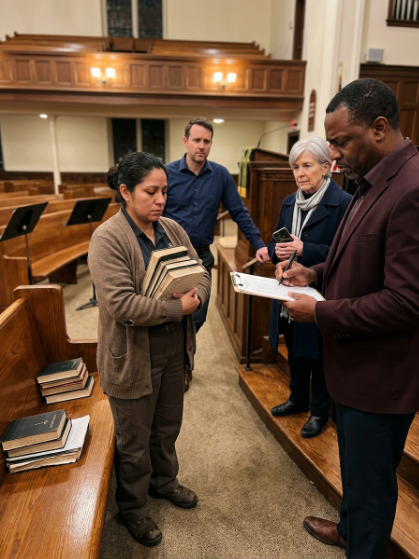
Eleanor did not hand me the phone.
She set it face down on the piano like the recording was not a secret anymore, but evidence the sanctuary had to answer for.
“From the top, Mrs. Vega,” she said. “Take your time.”
My hands were still full of hymnbooks.
That was the foolish thing my mind held onto first. Not Calvin’s insult. Not the heat in my face. Just the fact that I could not sing while holding twenty hymnbooks against my chest like a shield.
I placed them on the front pew one by one. If I dropped them, the sound would tell everyone how badly my hands were shaking.
Calvin Price cleared his throat.
“Eleanor, this is irregular.”
She did not turn around.
“Cutting off an audition before the second verse is irregular,” she said. “I am correcting the process.”
Pastor Reece stepped toward me with the careful face of a man trying to arrive at courage late.
“Marisol,” he said, “would you like a moment?”
I almost said yes.
A moment meant stepping into the hall, calling Mateo, and telling my son I had tried. Adults use that sentence when they are bringing home a broken promise.
Then I looked at the pencil marks in my hymnbook.
Breathe here.
Do not rush.
Let the last note land.
Those marks had been made by a woman who sang freely only when the room was empty. I did not want her to be braver than the woman standing in front of people.
“No,” I said. “I can start now.”
Calvin gave a small laugh under his breath.
It helped, not because it was kind, but because it reminded me he had already decided who I was. If a door is closed, you stop asking it to be polite.
I opened the hymnbook to the page Mateo had dog-eared so neatly it hurt to see it.
Mateo had once told me I sang this one like the room got taller. Now I stood under the sanctuary lights and thought, Make the room taller.
I breathed once.
Then I sang.
The first line came out smaller than I wanted. Fear can sit on your chest like another body.
But the second phrase found the place in me that no one had reached by insulting my cardigan or my job or my tiredness.
By the time I reached the verse Calvin had not let me finish, the room had changed.
No one gasped.
No one clutched a pew.
People simply began listening.
The alto who had adjusted her scarf lowered her hand. A tenor stopped pretending to study his folder. Pastor Reece’s face lost the soft blur of avoidance.
Eleanor stood near the piano with her hands folded, like she was stopping herself from conducting.
The high note arrived.
I did not chase it. I gave it room.
It opened.
Calvin’s pencil stopped moving.
That was the first payoff. Enough.
When I finished, the last note stayed in the rafters for a second before it disappeared.
No one clapped.
I was grateful.
Clapping would have made it a performance.
The silence made it evidence.
Eleanor spoke first.
“Who trained you?”
I looked at the hymnbook.
“Nobody.”
She gave me the look teachers give when a student is telling the truth and still leaving out the important part.
“Someone taught you breath discipline.”
“Warehouse stairs,” I said before I could stop myself. “And singing quietly so I would not wake my son when he was little.”
A soft laugh moved through the room.
Human this time.
Eleanor nodded. “That will do it.”
Calvin stepped forward because silence had started working against him.
“There is no question Mrs. Vega has a pleasant voice,” he said.
Pleasant.
A word you put over a gate.
“But the spring concert is not only about voice. It is about presentation, consistency, donor expectations, rehearsal attendance. We cannot build a program around sentiment.”
He looked at Eleanor when he said donor expectations.
Advertisement
That was his mistake.
Eleanor picked up the cracked phone.
“The donor is expecting excellence,” she said. “Not polish pretending to be excellence.”
Pastor Reece looked from Calvin to Eleanor to me.
“Calvin,” he said, “why was she not allowed to finish?”
Calvin’s jaw tightened.
“I made a judgment call.”
“Based on the singing?”
No answer.
That was an answer.
Deanna, one of the altos, spoke from the risers.
“She should be on the callback list.”
A tenor added, “She should be on the solo list.”
Calvin turned sharply.
“This is not a public vote.”
“It should not be a private dismissal either,” Eleanor said.
The sanctuary went still again, but this silence had a spine in it.
Pastor Reece took the audition sheet from the piano. I did not ask what Calvin had written beside my name. Some humiliations do not need exact language.
He folded the paper once and put it inside his Bible.
“Effective tonight,” he said, “callbacks and scholarship recommendations will be reviewed by a three-person panel. Eleanor, Deanna, and I will serve for this cycle. Calvin, you will remain part of rehearsal planning while we review the audition process.”
Calvin stared at him.
“You cannot be serious.”
Pastor Reece looked tired, but not unclear.
“I am late,” he said. “That is different.”
I wanted to feel triumphant.
Instead I felt shaky.
Relief came with a grief I did not expect, as if my body was asking why it had held the truth alone for so long.
Eleanor handed back the hymnbook.
“Can you return Thursday evening for a proper callback?”
Work, Mateo, the bus schedule, and dinner all lined up between me and a yes.
Eleanor saw my face before I answered.
“The scholarship includes lesson fees and transportation support,” she said. “It was designed for adults with obligations, not for people who already have every road cleared.”
I held the book tighter.
“You do not know if I can keep up.”
“No,” she said. “But I know you have already been keeping up without help. I would like to see what happens when help stops being withheld.”
My phone buzzed in my pocket.
Mateo.
I stepped into the side aisle and answered.
“Mom?” he asked. “Did they let you sing?”
I looked back at the sanctuary and saw Eleanor holding the cracked phone like proof.
“Yes,” I said.
My voice broke on that small word.
Mateo went quiet.
Then he asked, “The whole song?”
I closed my eyes.
“The whole song.”
The callback happened two nights later.
This time there were three chairs behind the table.
This time Calvin sat to the side without a pencil in his hand.
This time I brought Mateo.
He wore the button-down shirt he hated. When I reached the high note, he stared at the carpet so no one would see his eyes fill.
Afterward, Pastor Reece came over with an envelope.
My name was written on it.
Not crossed out.
Written carefully.
Marisol Vega.
“The scholarship is yours,” he said. “And if you accept, we would like you to sing the solo at the spring concert.”
Mateo made a sound beside me.
Half laugh.
Half sob.
I held the envelope, but I looked at him first. A child who believes in you before the room does deserves to see the room catch up.
Calvin lost sole control of auditions the following week.
He did not apologize in any way that required witnesses. That was fine. I had spent too much of my life being asked to treat private regret like public repair.
The repair was the new panel, the transportation support in the scholarship rules, and Pastor Reece saying service in the church did not make a person invisible in the church.
On the night of the spring concert, Mateo sat in the third row holding the program. Beneath the performers list was my name. Not large. Not fancy. Enough.
When I walked to the piano, I saw the front pew where I had stacked hymnbooks the night Calvin cut me off.
One of them was open there now.
My marked page.
Eleanor had left it where I could see it.
I sang the whole piece again.
This time my voice did not have to prove it deserved to exist.
It only had to fill the room.
When the final note landed, Mateo stood first.
Then the rest of the sanctuary followed.
I did not look for Calvin.
I looked at my son.
The scholarship envelope was tucked inside my hymnbook, and the room that had used my labor finally made space for my name.