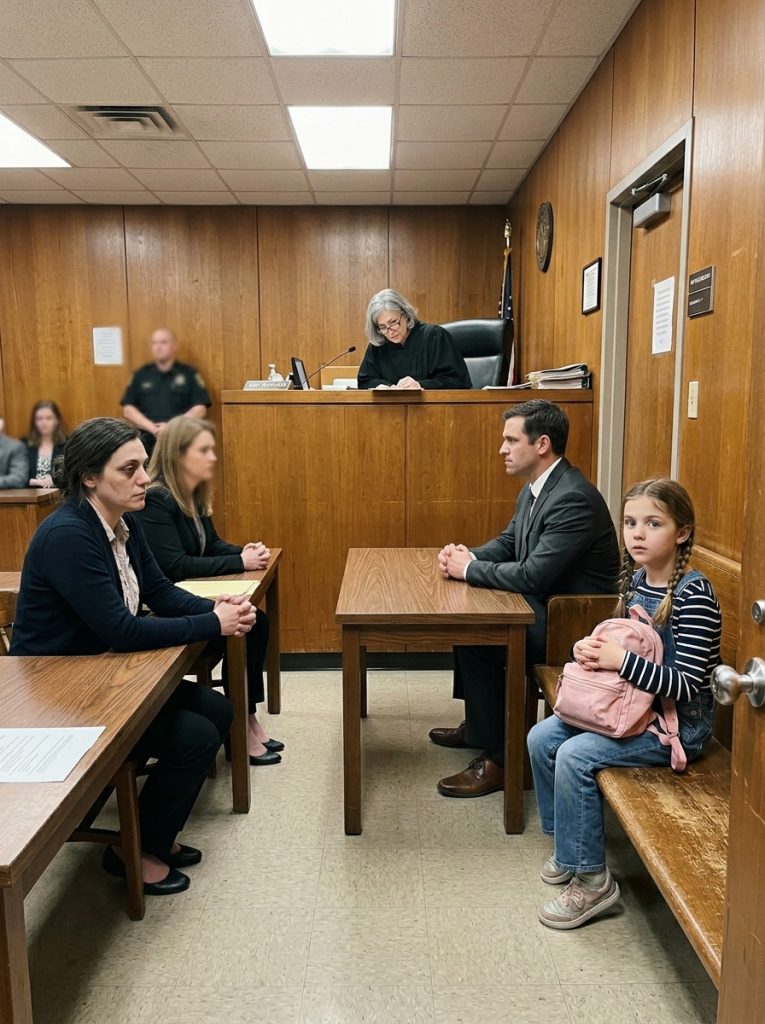
Zoe pressed play, and the courtroom stopped breathing.
The recording was forty-three seconds long. It was muffled at the start — the sound of a child’s phone left on a nightstand, picking up a voice through a closed door. But it cleared as the voice got closer and louder.
It was Frank.
“…I’m telling you right now, if you say one word to that judge — one word about what happens in this house — I will take you somewhere your mother will never find you. You understand me? You’ll never see her again. Is that what you want?”
A pause. A child’s small voice, barely audible: “No, Daddy.”
“Then you keep your mouth shut. We’re a happy family. That’s what you tell them. A happy family.”
The recording ended.
Forty-three seconds.
Nobody in that courtroom moved.
Judge Barker took off her reading glasses. Slowly. She set them on the bench. Her face, which had been neutral and measured for the entire hearing, had changed into something else.
Frank was on his feet. His chair had hit the wall behind him.
“That’s — that’s fabricated. That’s edited. She’s nine, she could have—”
“Mr. Marchetti,” Judge Barker said. “Sit. Down.”
“Your Honor, a child cannot just—”
“SIT DOWN.”
He sat.
The judge turned to Zoe, who was still standing in front of the bench with her phone in her small hands and her two braids and her denim overalls.
“Sweetheart,” the judge said, and her voice was gentle now, “where did this recording come from?”
“My phone,” Zoe said. “The one Mommy gave me for emergencies. I keep it in my backpack. One night at Daddy’s house I heard him being loud so I turned on the voice memo because — because I wanted somebody to believe me. Nobody believes kids.”
The judge was quiet for a moment.
“I believe you,” she said.
I started crying. I couldn’t help it. Six months of being painted as unstable, as a liar, as an unfit mother — and my nine-year-old daughter had quietly carried the truth in a ladybug backpack the whole time, waiting for a moment when an adult would finally let her speak.
Frank’s attorney requested a recess. He was whispering furiously to Frank, who kept shaking his head, his face cycling between rage and panic.
Judge Barker granted a brief recess and ordered the recording preserved as evidence. She instructed the bailiff to secure Zoe’s phone.
During the recess, I held my daughter in the hallway outside the courtroom. She was shaking — not crying, just shaking, the adrenaline of a nine-year-old who’d done the bravest thing of her life leaving her body.
“Did I do the right thing, Mommy?” she asked.
I knelt down to her level. Her two braids. Her denim overalls. The ladybug backpack hanging off one shoulder.
“You did the bravest thing I’ve ever seen anyone do,” I told her. “And no matter what happens, I want you to know that.”
“I was scared,” she said. “He said he’d take me away.”
“I know, baby.”
“But I was more scared of staying quiet.”
I will carry those words for the rest of my life. More scared of staying quiet. A nine-year-old who understood, at a cellular level, that silence was the real danger.
When we went back in, everything had changed. The air in the room was different. The lawyers knew it. The judge knew it. Even Frank knew it, though he kept trying to fight it.
What followed moved fast.
The court ordered a forensic analysis of the recording to confirm it hadn’t been altered. It hadn’t. The metadata confirmed the date — a night Zoe had been in Frank’s custody — and the audio analysis confirmed a single continuous recording, no edits.
The guardian ad litem, who had been leaning toward a shared-custody recommendation, withdrew it immediately and requested an emergency review.
Frank’s “perfect documentation” — the character references, the therapist’s letter, the volunteer logs — suddenly looked like exactly what it was: a carefully constructed performance by a man who knew how to look good on paper and terrify a child behind closed doors.
The preliminary custody arrangement, which had been trending in Frank’s favor, was reversed.
Judge Barker granted me sole physical and legal custody. Frank’s visitation was suspended pending a full investigation and was ultimately restricted to supervised visits only — and even those, Zoe was given the right to decline.
A protective order was issued. Threatening a child with abduction — telling a nine-year-old you’ll take her where her mother will never find her — is not a custody tactic. It’s a crime. The recording was referred to the district attorney’s office.
I won’t pretend the aftermath was simple. Zoe needed therapy. So did I. The thing she said in that courtroom — “nobody believes kids” — became the thing we worked on for over a year. Because she’d carried that recording for a month, alone, certain no adult would take her word, and she’d been right to worry, because the entire legal system had been tilting toward the man who threatened her.
It was a nine-year-old with a voice memo who corrected it.
I think about how close it came. If Zoe hadn’t recorded that night. If she hadn’t kept the phone in her backpack. If she hadn’t found the courage to raise her small hand and ask to speak. The judge had been leaning toward Frank. The documents were on his side. The system, for all its good intentions, was about to hand my daughter to the man who’d threatened to make her disappear.
The margin between justice and catastrophe was forty-three seconds of audio on a cracked phone.
That terrifies me. It should terrify everyone.
Her therapist told me something I think about often: that children in unsafe situations often become extraordinary observers. They learn to read rooms, to document, to wait for safety. Zoe had done all three. She’d watched. She’d recorded. And she’d waited until she was standing in front of a judge — the safest, most powerful adult she could find — to finally hit play.
It made me an advocate. After the case, I started volunteering with a local organization that trains family-court professionals to actually listen to children — to understand that a quiet kid isn’t a content kid, that silence in a custody case can be the loudest evidence of all. I’ve told Zoe’s story (with her permission, and her name changed) to rooms full of judges and guardians and social workers. Every time, I watch them go still the way that courtroom went still.
Because they need to hear it. They need to remember that the smallest person in the room is sometimes the only one telling the whole truth.
Zoe is twelve now. She’s loud these days. Gloriously, wonderfully loud. She argues with me about bedtime and sings off-key in the shower and has opinions about everything.
I never tell her to be quiet.
Not once. Not ever.
Because I know what her quiet cost her. I know what she carried in that backpack, in that silence, for a month.
The ladybug phone is in a drawer now. She doesn’t need it for emergencies anymore.
But she keeps it.
“In case anybody ever needs proof,” she told me once, “that the quiet kid was listening the whole time.”
She was.
Thank God she was.