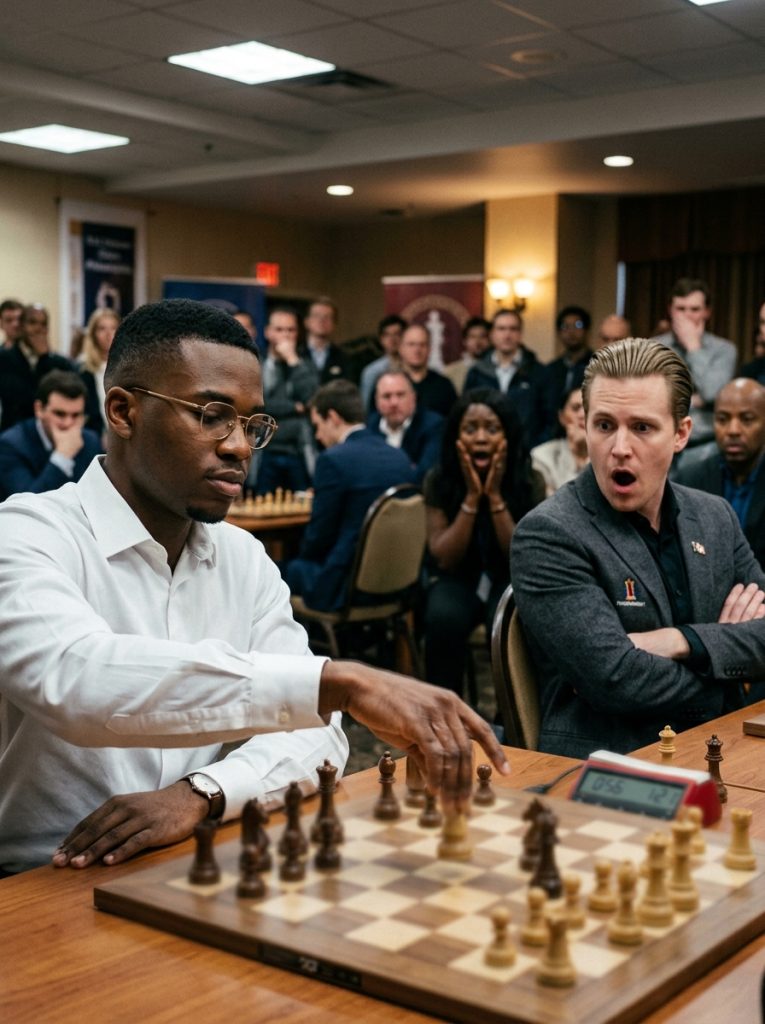
The arbiter caught Marcus Hale in the hallway outside the ballroom.
I did not see this happen.
I learned about it from the USCF rep, a woman named Patricia Voss, who walked over to my table four minutes after Hale walked out and asked me if I had a moment.
She told me the arbiter, a Bulgarian man named Kostas, had pulled Marcus Hale aside and informed him, in a calm and unmistakably final tone, that the federation’s office of fair play had been reviewing his three prior complaints against me.
Each complaint had been dismissed individually.
Together, however, they constituted what Kostas described as “a documented pattern of using disability as a tactical accusation.”
The federation’s bylaws have a quiet provision in section 4.2.f that allows for a one-year suspension of tournament eligibility for any player whose conduct toward another player constitutes “harassment grounded in protected characteristics.”
Kostas told Hale that the federation board would be reviewing his pattern at the next quarterly meeting.
He did not promise an outcome.
He did promise a review.
Hale left the venue without his trophy stipend, without his points, and, most cuttingly for a man whose entire identity was wound around his rating, without the rated draw he had hoped to extract from a bad position.
I did not feel triumph.
I do not feel triumph at chess.
I feel the same quiet I felt when I was nine years old and my mother first explained to me that my hands would always shake and that this would be a fact about my life, not a defect in it.
Patricia Voss sat down across from me at the empty board.
She placed a folded letter on the table.
She slid it across.
The letter was the wildcard offer for the U.S. Junior Championship in Saint Louis the following month.
The federation does not give wildcards lightly.
Patricia told me, with the quiet professionalism of a woman who had clearly drafted similar letters before, that the federation had been preparing the offer for two weeks based on my recent performance.
She had brought it to the venue today expecting to give it to me regardless of the result of the semifinal.
She told me, with a small smile, that the result of the semifinal had simply made her job easier.
I accepted the wildcard.
I shook her hand.
She walked away.
My coach Anatoly was at the back of the ballroom, watching me from a distance, his arms crossed, his eyes wet.
He does not cry at chess matches.
He cried at this one.
He told me, in the lobby twenty minutes later, that he had played in three Soviet championships in the 1970s.
He had watched a Russian grandmaster intentionally drop a piece during a critical match against a Belarusian opponent in 1972 because the Belarusian had been told, before the match, that he was “not allowed to win against a Soviet master.”
The Belarusian had won anyway.
Anatoly told me that match was the reason he became a chess coach.
He told me that match was the reason he had agreed to coach a nine-year-old American boy with essential tremor in 2013, when his other students had told him I was “wasting his time.”
He told me that match was the reason he had refused to retire when his wife had begged him to.
He said, in his clipped Belarusian English, “Daniel. You played that match for him. You did not know it. But you did.”
I did not know what to say.
I hugged him in the hotel lobby.
He smelled like espresso and pipe tobacco and a wool coat from 1989.
That night I went up to my hotel room on the eleventh floor of the Marriott.
I called my mother in Lagos.
I told her about the match.
I told her about the wildcard.
I told her about Anatoly.
She cried on the phone for a long time.
She told me my late father, a high-school physics teacher in Surulere who had died of a heart attack when I was eleven, had once told her in their kitchen that the most powerful thing a man could ever do was not be ashamed of his own hands.
I told her I remembered.
I had been at the kitchen table when he said it.
She did not know I had been listening.
I went to bed at one-thirty in the morning.
At eleven that same night, before I went to sleep, my email pinged.
It was a forwarded message from Anatoly.
The original sender was a man named Wojciech Lewandowski.
I did not recognize the name.
The forward had no subject.
It was three paragraphs long.
The first paragraph identified the sender as the chairman of the board of directors of the Polish Chess Federation.
The second paragraph said the federation had been watching footage from American tournaments for the last eighteen months as part of a broader inclusion initiative they were planning for the 2026 European Cup in Krakow.
The third paragraph contained the offer.
The Polish Federation was inviting me to play, as a special guest of the federation, in a four-board exhibition match against the Polish national team during the European Cup in November.
The exhibition would be paired with a public conversation, in front of the European chess press, about disability and chess.
Advertisement
The federation would cover all expenses.
They were asking, additionally, if I would be willing to give a short address to the youth division of the Polish Chess Federation about playing chess with a tremor.
Anatoly had added one line at the top of his forward, in his terse English.
“Daniel. This is the kind of letter you don’t say no to.”
I did not say no.
I went to Krakow in November.
I played four boards against the Polish national team.
I drew two and lost two.
The losses were honorable.
The draws were against players rated 2480 and 2510.
The Polish chess press, which is more brutal and more attentive to detail than the American press, took photographs of my hand from sixteen different angles.
They printed one of those photographs on the cover of their monthly chess magazine.
The caption was a single Polish word that translates roughly as “steady.”
I did not understand the irony in Polish.
A Polish journalist explained it to me at a coffee shop the day after.
He said, “In our language, steady can mean still. It can also mean reliable. The double meaning is the headline.”
I told him my hand had been doing both since I was nine.
He laughed.
He printed that quote in a follow-up feature.
The youth address went better than the matches.
I stood in front of two hundred Polish kids, ages seven to fifteen, in the auditorium of a chess academy in Krakow.
I did not give them a speech about overcoming.
I do not believe in speeches about overcoming.
I told them about my father in Surulere.
I told them about my mother making me practice on a folding board on the back porch in the rainy season.
I told them about the first time, at age twelve, an opponent had refused to play me because my hand “was distracting.”
I told them about Anatoly walking up to me in 2013 in Philadelphia and saying, in front of my mother, “I will coach this boy if his mother says yes. He has the eyes.”
I told them what my eyes had been doing while my hands were shaking.
A small girl in the third row raised her hand.
She had cerebral palsy.
She was holding a chess piece in a hand that was not entirely cooperating.
She asked me, through the translator, “Mr. Okafor. What do you think about while you move?”
I thought about my answer for a long time.
I told her I thought about whether the next move was the right move.
She nodded.
She said, “That is what I think about too.”
The whole auditorium was very quiet.
Then she added, into the microphone, “It is good. We are not different.”
The translator translated her sentence into English in a voice that broke very slightly on the last word.
I came home from Krakow in late November.
I went back to school.
I finished the semester.
In February, my USCF rating crossed 2500 for the first time.
The American chess press called.
I declined most of the interviews.
I gave one to Patricia Voss, the rep who had walked the wildcard letter across the ballroom in Philadelphia.
She wrote a single profile for the federation’s quarterly magazine.
She used a single quote from the interview as the pull quote.
The quote was something I had not realized I had said until I read it on the page.
“My hand is not the part of me that plays chess. It is the part of me that picks up the piece. The piece would still be on the board without it.”
Marcus Hale was not at any of the next three tournaments.
The federation board’s review concluded with what they called “a procedural reminder,” which is the diplomatic equivalent of a yellow card.
He returned to play in May.
He did not file a complaint that month.
He did not file one the month after.
He has not filed one since.
Last weekend, at a smaller open in Newark, I was paired against him in round three.
We sat down across from each other.
He looked at my hand without comment.
He extended his to me.
I took it.
He said, “Good luck, Okafor.”
I said, “Good luck, Hale.”
We played a Catalan.
I won in thirty-four moves.
He resigned cleanly.
He stood up.
He extended his hand again.
This time he held on for one second longer than the handshake required.
He said, “It was a good game.”
I said, “It was.”
We did not become friends.
We did not need to.
A handshake is sometimes the entire conversation.
That was four months ago.
My hand has shaken every minute of every day since.
The board has not noticed.
The pieces have not noticed.
The rating has not noticed.
Neither, anymore, has the room.