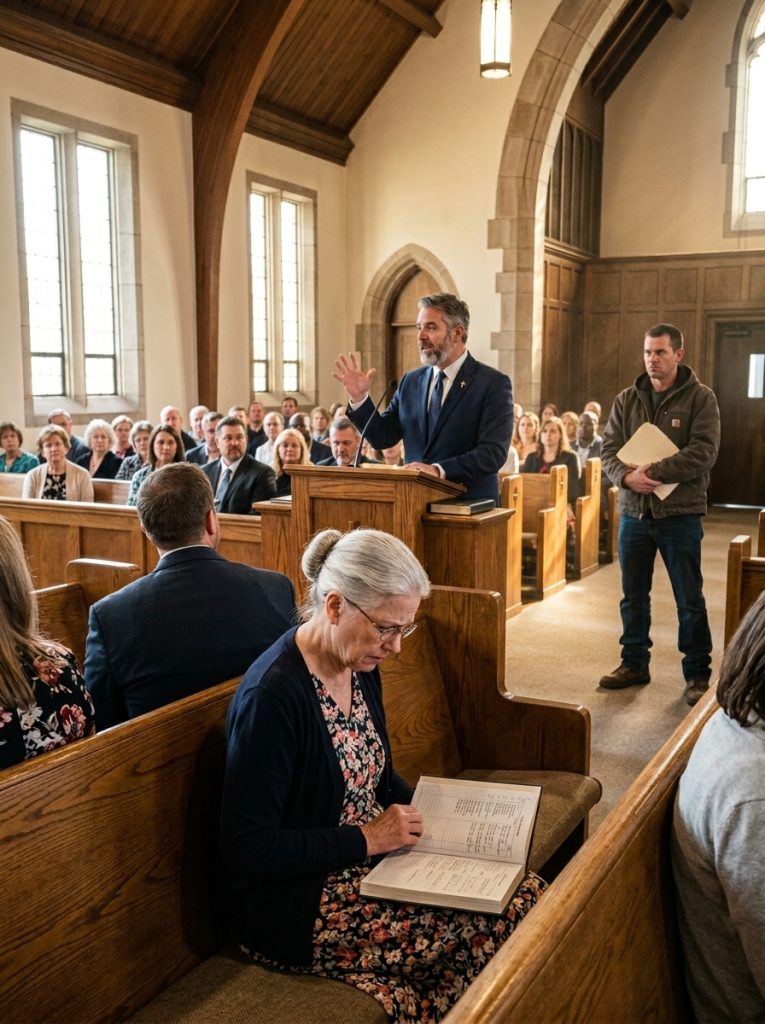
Pastor Garrett Cole did not deny it.
That’s the part I keep coming back to. In all my imaginings of that Sunday — and I’d imagined it a hundred times in the three days I sat on what I’d found — I expected a fight. A denial. An accusation that I’d misread the books, that I was a confused old woman, that the devil had gotten into me.
Instead, he set his Bible down on the pulpit.
And he was quiet for a long, terrible moment while sixty people stared at him in the bright morning light.
Then he said: “It’s true.”
The sanctuary made a sound I’d never heard before. Sixty people inhaling at once.
“Every word Mae read is true,” he said. His voice was steady, which somehow made it worse. “The contractor’s bid was ninety-four thousand. We raised one hundred and eighty. I created Cole Ministry Services and I paid myself the difference. Eighty-six thousand dollars.”
Margaret Thompson — who’d made her grandmother’s maple syrup for the pancake breakfast — started crying in the third row.
“I told myself it was a salary,” Cole continued. “I told myself I’d earned it, that I’d given this church fifteen years and deserved more than the board paid me. I told myself a lot of things.” He looked down at his hands. “They were all lies. I stole from you. From all of you. From the children’s Sunday school fund and the widows’ offering and the maple syrup money. I stole it.”
James Holloway stood by the side door in his Carhartt jacket, manila folder still against his chest. He’d come ready to back up the numbers. He didn’t need to.
I stood in the front pew with the ledger in my hands, and I felt no triumph. None. I’d uncovered the truth and the truth was breaking sixty hearts in real time and there was nothing clean about it.
A deacon named Harold stood up in the back. Harold is a hard man. A retired Marine. He doesn’t suffer foolishness.
“You’ll be arrested for this,” Harold said. “You understand that.”
“I do,” Cole said. “I’ve already called a lawyer. I’ll make full restitution. I’ll cooperate completely. And I’ll resign effective today.”
That should have been the end. The villain confesses, the congregation casts him out, justice is served.
But that’s not what happened.
Because something happened in that sanctuary that I did not expect and have never forgotten.
A woman named Ruth — eighty-one years old, in the second pew, a widow who lives on Social Security and still tithes ten percent — stood up with her cane.
“Garrett,” she said. “Look at me.”
He looked at her.
“My husband stole once,” Ruth said. “From the mill where he worked. Nineteen sixty-one. Forty dollars, which was a lot then. He confessed it to the foreman and he paid it back and he carried the shame of it to his grave forty years later. And do you know what the foreman did when he confessed?”
The room was silent.
“He forgave him. And he kept him on. And my husband became the most honest man in that mill for the next thirty years because somebody gave him a second chance he didn’t deserve.” Ruth’s voice shook but didn’t stop. “I’m not saying there shouldn’t be consequences. There should. You’ll answer to the law and you’ll pay back every dime. But I am not going to stand in this church my husband helped build and watch us pretend we don’t believe the very thing we sing about every Sunday.”
She sat down.
Nobody spoke.
Then Harold — the hard Marine — wiped his eyes with the back of his hand and sat down too.
I want to tell you how I felt, standing there in the front pew with the ledger that had upended everything.
I’d found the truth three days earlier, at my own kitchen table, with James Holloway watching me realize what eighty-six thousand dollars meant. I hadn’t slept since. I’d prayed about how to handle it. Privately confront Cole? Take it to the board first? Go straight to the police?
In the end, I decided the congregation deserved to hear it from one of their own, in the open, in the light. No back rooms. No quiet settlements. The money had been given in faith by sixty families. They had a right to the truth in the same sanctuary where they’d given it.
So I’d stood up during the service. My twenty-two years as a deacon steadied my voice. And I’d read the numbers.
What I hadn’t planned for was what the truth would do to the room.
Margaret Thompson sobbing. Harold’s jaw working. Young families looking at each other in confusion, trying to explain to their children why the adults were upset. The weight of betrayal settling over people who’d trusted this man with their faith and their wallets and their children’s Sunday mornings.
I’d expected anger. I’d braced for it.
I had not expected Ruth.
What happened over the following months was the hardest, most beautiful thing I’ve ever been part of.
Pastor Cole resigned. He was charged with embezzlement. He pleaded guilty, made full restitution by selling his house, and served eight months. The congregation did not protect him from the law, and he didn’t ask them to.
But they didn’t abandon him either.
Ruth visited him. So did Harold, eventually. A rotation of church members drove two hours each way to see him during his sentence, not because they excused what he did, but because they refused to let a man rot in the absence of the grace they claimed to believe in.
I became interim treasurer with full authority and a new rule: every dollar in and out of Grace Fellowship is now public. We post the books in the fellowship hall every month. Anyone can read them. Anyone can question them. The thing that let Cole steal — the assumption that one trusted man should handle the money alone — is gone forever.
We finished raising the funds for the steeple properly. James Holloway did the work at cost. The congregation showed up on Saturdays to help. We dedicated it on a Sunday in spring, and we did it debt-free and clean.
Pastor Cole came to the dedication. He sat in the back. He didn’t speak. After the service, Ruth walked over to him with her cane and took his hand.
I watched them. The eighty-one-year-old widow and the man who’d stolen the widows’ offering, standing together under a steeple built with honest money.
And I understood something about my faith that twenty-two years as a deacon hadn’t taught me:
Justice and mercy are not opposites.
You can demand the truth, insist on consequences, rebuild with transparency — and still refuse to let a fallen man stay fallen.
I exposed the theft. I’d do it again.
But I’m just as proud of what we did after.
The new pastor came eight months later. A young woman named Reverend Diaz, fresh out of seminary, who walked into her first board meeting and found a church that had been burned and rebuilt and was more honest for it. We told her everything. The theft, the confession, the restitution, the visits to the prison. She listened to all of it.
“You went through fire,” she said. “And you came out as a church that actually practices what it preaches. Do you know how rare that is?”
I didn’t, until she said it.
Cole moved away after his release. He found work — manual labor, a fresh start in a place where nobody knew his story. He sends a card to the church every Christmas. Just a card. Signed “with gratitude and shame, G.C.” We read it aloud at the board meeting every year, and every year somebody cries.
I’m seventy now. I don’t keep the books anymore — we have a committee for that, three people, full transparency, the way it should always have been. But I still walk into the fellowship hall on the first of every month to read the posted ledger, just to see the numbers in the light.
I think about the eighty-six thousand dollars sometimes. About how it disappeared in plain sight because we trusted one man and never checked. About how easy it is for good people to enable bad things by looking away.
But mostly I think about Ruth, standing up with her cane, telling the story of her husband and the forty dollars and the foreman who forgave him.
She died two winters ago. The whole church came. We sang the songs she loved. And under the steeple we built with honest money, in the sanctuary where she’d refused to let us abandon a fallen man, we buried the woman who taught us what our faith actually meant.
We didn’t just catch a thief.
We remembered who we said we were.