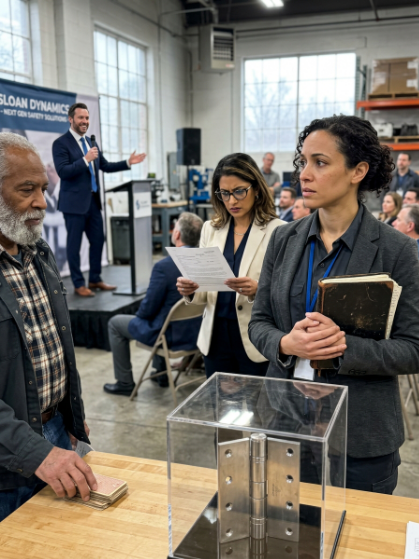
Priya stopped Nolan before he could touch the notebook.
Just one hand.
Flat in the air.
A small gesture, but the whole factory seemed to obey it.
Nolan looked at her as if she had forgotten who paid for the launch, then remembered too late that patent attorneys do not work for applause.
“This is unnecessary,” he said.
Priya did not answer him.
She looked at me.
“Dr. Sloan, are these contemporaneous notes?”
I opened the cover.
My hands were steady until the first page showed.
Then they were not.
Because there it was. The first awful sketch. A hinge that would have failed within ten seconds on the line. My own handwriting in the margin, angry and cramped.
Pin shear risk. Redesign before Nolan sees cost.
A few people leaned forward.
The investors did not understand the drawing yet. Earl did. His mouth tightened like he was seeing a younger version of both of us at the workbench again.
I turned to the next tab.
Load test one.
Failure.
Load test two.
Failure.
Load test three.
Held for twelve minutes.
The dates were there. The times. The little oil stain from the night Earl knocked over a cup beside the press because we were both too tired to care.
Nolan laughed under his breath.
“A notebook proves she took notes.”
That was exactly why I had waited.
If I had opened it in anger, he would have made it look like a diary.
Priya made it evidence.
She asked Earl for the test cards.
He stepped forward and placed them beside the notebook, face-up this time. Each card matched a test number. Each card had the machine stamp, the date, and Earl’s blocky initials beside mine.
Earl said, “She ran every failure herself.”
His voice carried farther than mine might have because Earl was not a person Nolan could easily dismiss. Retired machinists have a different kind of authority in a factory. They know what breaks because they have watched it break with their hands near it.
Priya turned to the patent assignment form.
“Mr. Sloan, when was Dr. Sloan’s system access revoked?”
Nolan’s smile sharpened.
“That is not relevant.”
An investor in the front row said, “It might be.”
There it was again.
Curiosity becoming risk.
I took out my phone and opened the email from IT. I had saved it because losing access to your own work teaches you to keep receipts. Priya read the date from my screen, then read the date on the patent assignment.
The assignment was dated nine days after my badge stopped working.
Nine days after I could no longer access the legal portal.
Nine days after Nolan told everyone I needed rest.
The room changed.
Not dramatically.
Factories do not gasp. They hum. But the hum shifted. Employees who had been looking at the floor looked at Nolan. Investors whispered. Someone near the aisle stopped recording and lowered their phone.
Nolan reached for the microphone again.
“This is a family matter.”
I finally spoke.
“You made it a company matter when you put my work on a stage.”
My voice did not shake.
That surprised me most.
Priya asked whether I had signed the assignment.
“No.”
One word.
The same kind of word a machine makes when it refuses to start because something essential is missing.
Nolan said I had verbally agreed.
Priya asked for documentation.
He said our father knew.
Advertisement
That was when Earl moved.
Slowly. Carefully. Like he was carrying more than test cards.
He pulled one more envelope from inside his shop jacket.
“Her father knew who built it,” he said.
Inside was a copy of a note my father had left in Earl’s tool chest before the stroke took his handwriting from him. Not a will. Not a legal transfer. Just a production note with my name on it.
Keira’s hinge clears line B if test 7 holds. Do not let Nolan rush filing without her.
I had never seen it.
For a second, the factory blurred.
I hated crying in front of Nolan.
Then I realized I was not crying for him.
I was crying because my father had known.
Priya took the note, photographed it, and placed it with the notebook and test cards. She told the investors the launch could continue only if inventorship and assignment were corrected before any licensing representation left the building.
Nolan said she was overstepping.
The lead investor said she was not.
That was the turn.
Not the notebook alone.
The people who had been afraid of losing a smooth launch realizing Nolan was the risk, not me.
The next hour was the longest meeting of my life.
The launch guests were moved to the cafeteria with coffee and stale pastries. Employees pretended not to watch through the glass. Priya called outside counsel. The investors called their board representative. Nolan called everyone who used to answer on the first ring and learned how fast confidence thins when money sees liability.
I sat in a conference room with the prototype hinge on the table between us.
Nolan would not look at it.
He kept looking at me.
“You are going to destroy the company over credit?”
I almost answered too quickly.
Then I heard my own younger voice from all those nights on the floor, saying redesign before Nolan sees cost.
I had been protecting the product from him before I had admitted I was protecting myself.
“No,” I said. “I am saving it from a false filing.”
By sunset, the public launch was paused. Not canceled. Paused. Priya filed a correction notice and a preservation letter. The investors required Nolan to step back from all patent and licensing decisions while the board reviewed the assignment. Earl gave a recorded statement. IT produced the access logs.
The lab notebook did what I could not do alone.
It made time testify.
Two weeks later, the board restored my inventorship and corrected the equity tied to the hinge. Nolan lost signing authority over the patent and was removed as acting CEO after the access logs showed he had approved the assignment routing himself.
He did not go quietly.
People like Nolan rarely do.
He said I had embarrassed the family.
I told him he had confused family with ownership.
The factory kept the product.
That mattered to me more than revenge. The hinge was too good to bury under Nolan’s name, and too many employees had survived too many bad contracts to lose work because my brother wanted a cleaner biography.
The first corrected production run happened on a Thursday morning.
No stage.
No banner.
Just line B running under practical warehouse lights while Earl stood beside me with a paper cup of coffee and pretended not to be emotional.
Priya sent the corrected filing confirmation at 9:17 a.m.
I printed it and put it in the front pocket of the lab notebook.
Not the back.
The front.
A reminder that proof should not always have to wait until damage is done.
Months later, my father’s health had improved enough for him to visit the floor in a wheelchair. I placed his hand on the finished hinge. He could not say much yet, but he tapped the metal twice with one finger.
Approval.
Apology.
Maybe both.
Nolan did not come.
I stopped looking for him in doorways.
The company put my name on the patent wall beside the prototype case. I did not ask for a ceremony. I asked for the old test cards to be framed under the display, because success without failure is just a story someone cleaned for investors.
On the first card, Earl’s initials sit beside mine.
On the last, the machine stamp is faint but readable.
Held.
That is the word I remember.
Not because the hinge held.
Because so did I.