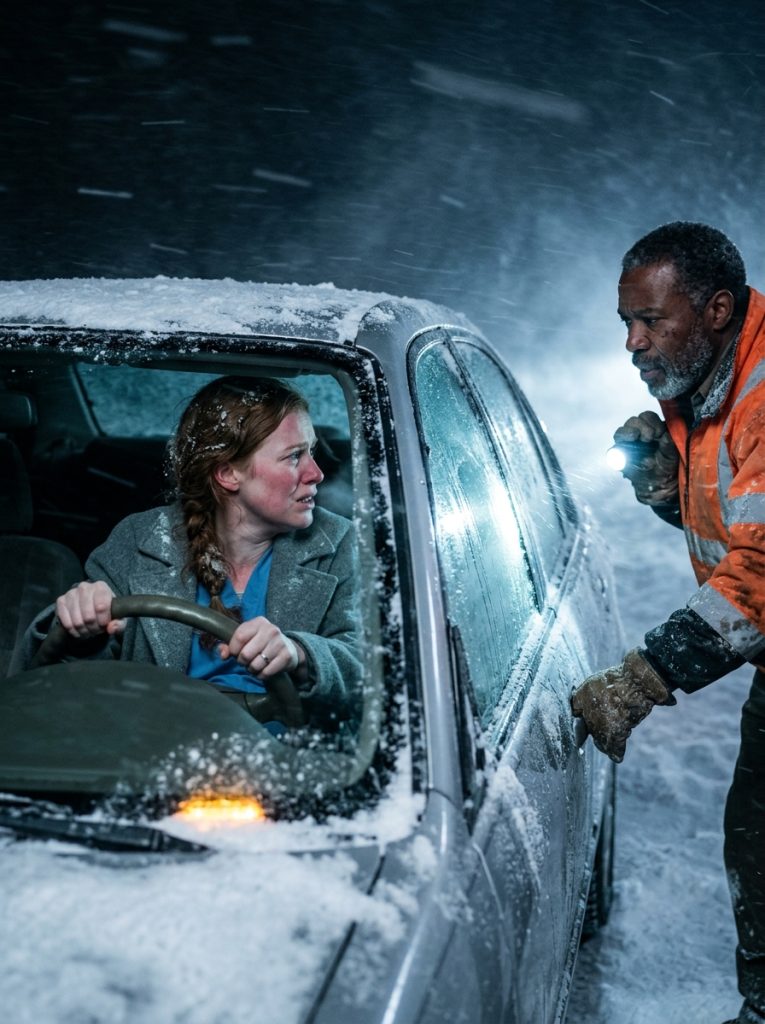
Dale Okonkwo did not answer my question right away.
He held my newborn daughter against my chest with one big hand under her tiny head, and he kept his eyes on her face, and the wind kept screaming against the Subaru, and the doctor on the radio kept asking us to repeat vitals every two minutes.
Then, in the small space between contractions and the rumble of the idling plow on the shoulder, he told me.
“Fifteen years ago, my wife was driving home from her sister’s place in Brainerd. Storm just like this one. She went into labor four weeks early. She slid into a culvert on County 47. Nobody saw her hazards for an hour and twenty minutes.”
He was quiet for a moment.
“By the time the plow got to her, she was gone. So was the baby.”
I started crying so hard I thought I would break my new daughter’s ribs.
He didn’t move.
He just held her steady and let me weep into the top of her head.
“I started driving plow the next winter,” he said. “I have not missed a storm in fifteen years. I told myself if I could just get there in time once. Just once.”
He looked up at me through the snow on his eyelashes.
“This is the once.”
The ambulance reached us forty-six minutes after Dale walked out of the storm.
The EMTs found a fifty-four-year-old DOT plow driver kneeling in the front seat of a Subaru, holding a newborn girl wrapped in his orange jacket against the chest of a hypothermic mother whose blood pressure had dropped twice and stabilized twice on his calm voice alone.
They cut me out of my seatbelt because I could not lift my arms.
They put my daughter in a transport incubator.
They put me on a stretcher under three heated blankets.
Dale would not take his jacket back.
He stood in the snow in a salt-stained DOT t-shirt, no coat, while the EMTs loaded us into the ambulance.
He walked beside the stretcher.
He climbed in with us.
He held my hand the entire forty minutes to St. Cloud Regional, in front of two EMTs who pretended not to notice the way the big man kept whispering “you did good, Mama, you did so good” into the cold air of the ambulance bay.
By the time my husband Caleb made it back from Wisconsin at 4 a.m., my daughter was breathing on her own in the NICU and I was sleeping for the first time in nineteen hours.
Dale was sitting in a plastic chair in the L&D waiting room with his orange jacket back on and a styrofoam cup of black coffee, refusing to leave until he heard from a nurse with his own ears that we were both alive.
He left at 6 a.m. without saying goodbye.
He told the night-shift nurse to please not tell me his last name.
She told him she would not lie to a patient.
She came in at 9 a.m. to check my vitals and put a folded slip of paper on my bedside tray.
Dale Okonkwo. Plow division supervisor, MnDOT District 3.
I named my daughter Hazel Dale Jensen.
Caleb did not argue for one second.
The hospital chaplain came up to my room three days later with a clipboard.
She had not looked Dale up.
She had heard the story from the nurses.
She told me the L&D wing was being renovated in the spring with a private endowment from a state grant, and they were going to name the new triage suite after a person of the family’s choosing.
She asked if I had a name to suggest.
I gave her one.
The hospital sent the proposal up the chain.
A week later it cleared the board unanimously.
The Dale Okonkwo Triage Suite at St. Cloud Regional Medical Center now has a small brass plaque inside the door.
It reads: “For everyone who walks into the storm.”
Six weeks after the night of the blizzard, I was at home with Hazel on a Tuesday afternoon when the phone rang.
The caller ID said STATE OF MINNESOTA.
I almost let it go to voicemail.
The voice on the other end was a woman in her fifties, clipped and warm.
“Mara Jensen?”
“Yes.”
“Please hold for Governor Wexler.”
I sat down on my own kitchen floor.
The governor of Minnesota told me, in a careful and slightly emotional voice, that the Minnesota Department of Transportation had nominated Dale Okonkwo for the Citizen Lifesaving Medal.
The state was going to award it in March at the capitol in St. Paul.
The governor wanted to know if my family would be willing to attend.
I told her yes before she finished asking the question.
I told her Hazel and I would be in the front row.
I asked her one more thing.
I asked her if she had read Dale’s full file.
I asked her if she knew about his wife.
There was a long pause on the other end of the phone.
The governor’s voice came back gentler.
“Yes, Mrs. Jensen. We know.”
Advertisement
The medal ceremony was held on a Saturday in March in the rotunda of the Minnesota State Capitol.
It was sixty-one degrees and clear, the kind of warm spring day Minnesotans remember in a single sharp image for the rest of their lives.
Dale wore a dark gray suit his daughter from his second marriage had bought him for the occasion.
He stood next to the governor at the podium and looked deeply uncomfortable.
The governor read out the citation.
The night of January 14th.
Visibility under fifteen feet.
Wind chill of negative forty.
A pregnant woman trapped in a buried sedan with a 911 dispatcher and forty-two minutes of plow ETA between her and a hospital.
A plow driver who walked the last three hundred yards of his own route on foot, with a flashlight and a salt bag, because he had spotted a single set of hazard lights through a wall of snow.
A baby delivered in the front seat of a Subaru with a doctor on a borrowed radio.
A child named Hazel Dale Jensen.
The governor then did something the press secretary had not warned Dale about.
She turned to me, in the front row, and asked me if I would like to come up to the podium.
I had not prepared remarks.
I had not prepared anything.
I walked up holding Hazel against my shoulder in a small white dress.
I stopped at the microphone.
I looked at Dale.
He was already crying.
I told the rotunda about a woman named Marian Okonkwo and a baby that did not make it home from County 47 in 2011.
I told them that Dale had spent fifteen winters driving plow.
I told them he had not missed a storm.
I told them my daughter was alive because a man we had never met had refused to stop punishing himself by serving everyone else.
I told the governor that the medal in her hand was beautiful and good and necessary, and also not enough.
I told her there was a very small two-line plaque, in the front foyer of the Dale Okonkwo Triage Suite at St. Cloud Regional, that I had been hoping the state of Minnesota might allow us to add a third line to.
The governor smiled.
She nodded.
She said, “Read me the line.”
I read it from a piece of paper in my hand.
“For Marian Okonkwo, and the baby who came home with her son.”
Dale put his face in his hands.
The rotunda did not applaud.
It exhaled.
Three weeks later, in St. Cloud, the third line went up.
Hazel turned five months old that same week.
She has a godfather now.
He drives a plow.
Hazel grabbed at his beard during the photographs.
He laughed for the first time in front of strangers in fifteen years.
The photo of that laugh hangs framed in our front hallway, next to the door we walk Hazel through every morning on the way to her car seat.