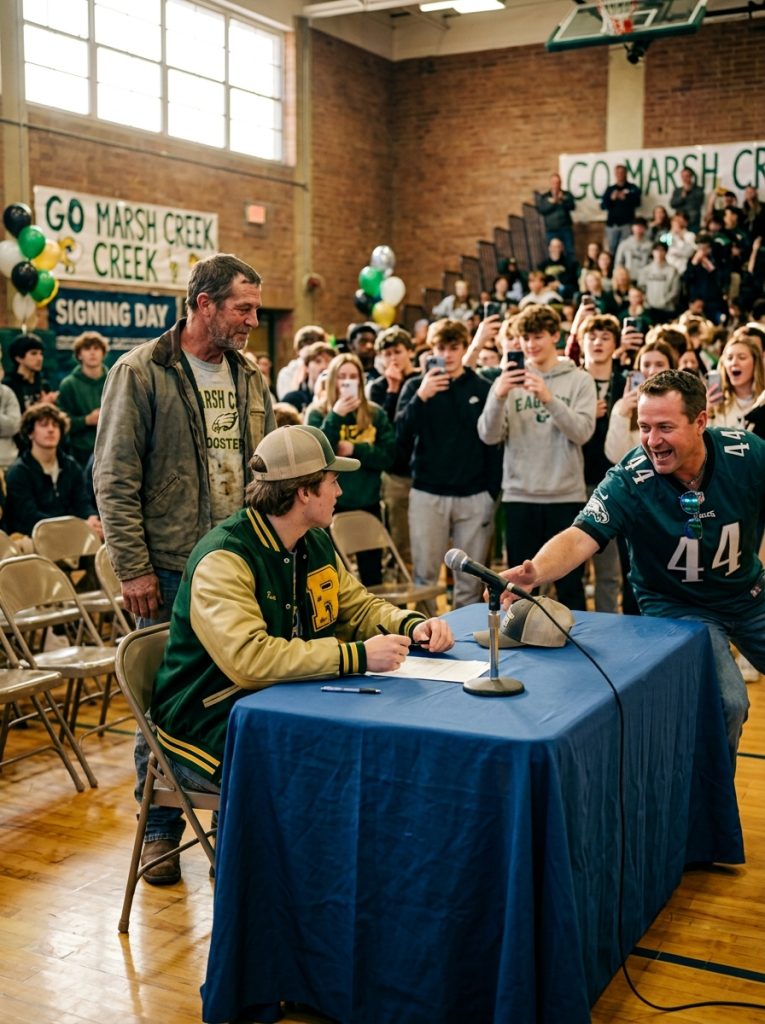
For a second nobody moved. Two hundred people in a high school gym, and the only sound was the air handler and the squeak of Dell’s brand-new sneakers as he stopped mid-stride, his hand still half-raised toward the microphone he’d been so sure was his.
Tyler didn’t look at him. He looked at me, at the back of the room, the way he used to scan the bleachers when he was seven years old and small for his age and needed to know I’d come.
I had come. I always came. That was the whole entire point of the last eleven years.
He picked up the microphone himself.
“A lot of you know my story,” Tyler said. His voice cracked a little on the first word and then steadied, the way it does when he’s about to throw on third down. “And a lot of you think you know who raised me. So I want to say it out loud, today, where it counts.”
He set down the pen.
“When I was seven, my dad left. When I was twelve, my mom passed. And in between and after all of that, there was one man who never missed a single thing. He drove me to two-a-days before his own shift. He learned to braid my hair for picture day off a video, and he was terrible at it, and he did it anyway. He sat in a freezing parking lot through every away game so I’d see his truck when we pulled in. He fixed everybody’s air conditioning in this town except his own, because he was always at one of my practices instead.”
I could not see very well by then.
“His name is Wade Carver,” Tyler said. “He’s my uncle. But that word’s never been big enough, so I just call him Pop.” He found me again at the back. “Pop, the seat next to me at this table is for my family. It always was. Will you come sign it with me?”
I want to tell you I walked up there with dignity. I didn’t. I walked up there like a man wading through water, and when I got to that table Tyler stood and grabbed me and held on, and two hundred people came up out of those folding chairs all at once.
It was the loudest thing I have ever heard. It went on and on. The principal was crying. Tyler’s offensive line — these enormous boys I’d been feeding spaghetti to for four years — were crying. Somewhere in the noise I heard a woman yell, “That’s right!” and a man near the front just kept clapping his big hands together long after everyone else had started to settle, like he couldn’t make himself stop.
I stood there with my arm around a boy who’s four inches taller than me now, and my mind did a strange thing — it played all of it back at once. The driveway where his father’s car pulled away. The first night he woke up screaming for a mother who wasn’t coming back, and how I learned to sit on the floor in the hallway outside his door, because going in made it worse and leaving made it worse too. The volcano for the science fair that ruined the kitchen ceiling. The stitches over his eye in third grade. The college brochures spread across that same kitchen table last fall, and Tyler asking me, quiet, whether I thought his mom would have been proud of him — and me having to get up and pretend to check something on the stove so he wouldn’t see my face while I answered.
You don’t get those years back. You don’t even want them back, exactly. But they all live somewhere inside you, and apparently they all come out at once when a kid puts his hand over a microphone.
And Dell?
Dell stood in the front row in his crisp new jersey, in the spotlight he’d come to steal, and discovered that there is no performance for a moment like that one. There were no cameras pointed at him anymore. Every phone in that gym had swung toward the table — toward Tyler, toward me, toward the empty chair that turned out to have my name on it. He stood there in a costume he’d bought to play a part that had been filled, by somebody else, for eleven years, in front of a town that knew exactly who’d done the filling.
He left before the ceremony ended. I watched the gym doors swing shut behind him. I won’t pretend I didn’t feel something — he’s my brother, and somewhere underneath all of it I will always be the kid who looked up to him. But I have learned the difference between a brother and a father, and I learned it the long way, one 5 a.m. at a time.
I thought about my sister, too — Tyler’s mom — and what she’d say if she could have seen it. Near the end, she made me promise I wouldn’t let him grow up thinking he was a burden. That was her exact word. Burden. I think about that promise more than almost anything in my life. And standing in that gym with the whole town on its feet, I felt like maybe I’d finally kept it — that the boy understood, all the way down, that he had never once been a burden. That he had been the gift. That raising him was the great privilege of my unremarkable life, and I’d have paid twice the price and called it a bargain.
We signed the letter together. Tyler’s signature, big and looping. Mine underneath, in the line for guardian, the same blocky capitals I use to label everything in my garage. The recruiting coordinator slid the cap across the table and Tyler set it on my head instead of his own, and the photographers got that picture, and it ended up in the county paper under a headline I keep in my wallet now.
Here is the part I didn’t expect.
About a month later, a letter came to the house. Not from Dell. From the college — from the head coach who’d recruited Tyler. He’d been at the signing. He’d seen the whole thing. And he wrote, in his own hand, that in twenty-two years of recruiting he’d signed a lot of talented kids, but that he’d never seen a young man stand up and define his own family in front of his whole town, and that whatever Tyler did on the field, he’d already shown the coach the most important thing. “You raised a man, Mr. Carver,” the letter said. “We’ll try not to mess that up.”
I framed that one too. It hangs in the hallway next to the cap.
Tyler started his redshirt year that fall. I drove up for the first home game I could get to — eleven hours, a cooler riding shotgun, the same as it ever was. I sat in a stadium with eighty thousand strangers, not one of whom knew me, which suited me fine. They announced each player’s hometown and major over the loudspeaker. And when they got to Tyler, they added something they don’t usually add. “Raised by his uncle, Wade Carver, of Marsh Creek.” He’d asked them to. Eighty thousand people who’d never met me, and for about four seconds my name went up into the lights of a place I would never have walked into on my own.
I had to pull my hat down low for a good while after that.
People ask me sometimes if I’m bitter — about the years, about the money I never had, about a brother who showed up in a jersey to take a bow for a race he never ran. And the honest answer is no. Bitterness is for people who feel like they got robbed. I didn’t get robbed. I got eleven years of the best thing that ever happened to me. I got to be there. Dell got a photograph of a moment he didn’t earn and the long drive home to think about it.
You don’t become a father on the day a kid is born. You become one in ten thousand small mornings nobody films. And then one day, if you’re very lucky, that kid stands up in a gym in front of everyone, puts his hand over a microphone, and tells the world the thing you already knew but never needed to hear out loud.
“That’s my boy,” Dell had said when he walked in.
He was wrong. But he wasn’t entirely wrong, either.
Tyler is somebody’s boy.
He’s mine.