The man in the dark suit said her name.
“Dorothy Payne.”
And the common room went still.
Marcus — our facility manager, the one with the clipboard permanently tucked under his arm, the one who scrolled his phone in doorways while residents went unattended — turned so fast his facility polo stretched at the collar.
“Dorothy? Room 14 Dorothy?”
The man in the suit nodded. His colleague — the woman in the gray pantsuit — opened her briefcase and produced a single sheet of paper.
“The trust holder of Magnolia Gardens Living LLC has agreed to identify herself for the purpose of this acquisition meeting. She is present in the facility.”
Marcus laughed. A nervous laugh. The kind that sounds like a question.
“Dorothy is a resident. She plays bingo. She wins five dollars every Wednesday.”
“And puts it back in the jar,” I said.
Everyone looked at me. I was still crouching beside Mrs. Patterson’s wheelchair, blanket in my hands. Sunflower scrubs. Nobody important. Just Tasha.
But I’d been watching.
Eleven months of watching.
The suit walked toward the common room. Marcus followed, clipboard clutched to his chest like a shield. I followed too, blanket forgotten on the arm of the wheelchair.
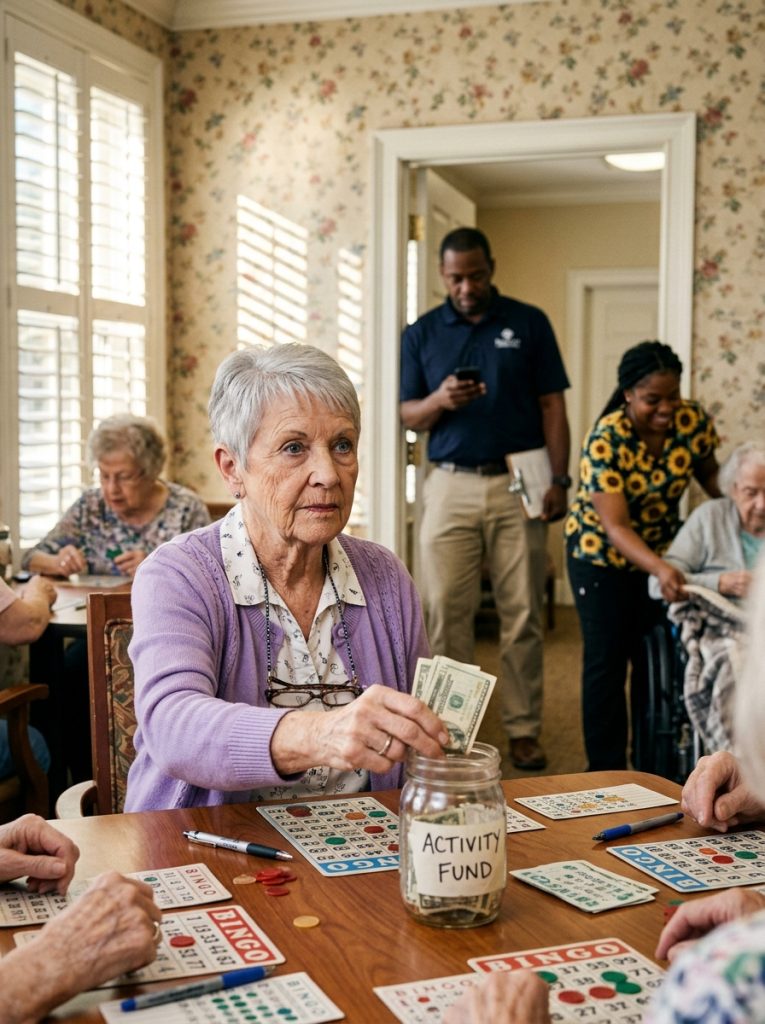
Dorothy was where she always was on a Wednesday afternoon. Bingo table. Lavender cardigan. Reading glasses on the beaded chain. Sharp blue eyes that missed nothing.
She looked up when we entered.
Not surprised. Not confused.
Ready.
“Dorothy,” the suited man said. “Thank you for agreeing to this.”
“Of course, Daniel,” she said. Like she knew him. Because she did.
Marcus’s mouth opened. Closed. Opened.
“You — you’re the owner?”
Dorothy folded her hands on the bingo table.
“I have owned this facility through the Payne Family Trust since 2011. That’s twelve years, Marcus. Twelve years I’ve watched from this chair.”
His clipboard hit the floor.
“You were supposed to be managing this place,” Dorothy said. Her voice wasn’t angry. It was sad. “I put you in charge because your references were good and your resume said you cared about elderly patients.”
“I do — I do care—”
“You skip rooms during rounds. You cut activities to save money you then spend on vendor lunches. You put Mrs. Hale on the wrong medication for three days last August because you were too busy with a personal call to check the pharmacy order.”
Marcus went pale.
“I have notes,” Dorothy said. She reached under her cardigan — the small notebook she always carried. “Dates. Times. Room numbers. Twelve years of notes.”
She set the notebook on the bingo table.
It was thick. Dog-eared. Stuffed with loose papers and sticky tabs.
“The residents here are my people,” she said. “This isn’t an investment to me. This is my responsibility. And I needed to know — without the bias of being recognized as the owner — how they were being treated when nobody thought anyone important was watching.”
Marcus looked at the notebook. At the suited man. At me.
Then at the door.
“Don’t,” Dorothy said. Calm. “Daniel, please ask Mr. Marcus to sit down.”
Marcus sat in a folding chair like his legs had been cut.
Dorothy turned to me.
“Tasha.”
“Yes, ma’am?”
“Come here, please.”
I walked to the bingo table. My heart was hammering but my feet moved steady. Dorothy took my hand. Her grip was warm and firm.
“Tasha is the only staff member in eleven months who has consistently crouched to eye level with residents. Who checks on rooms after shift. Who reported the heating issue in January directly to maintenance instead of waiting for Marcus to approve a work order.”
I felt heat rush to my face.
“I’d like to offer you the position of Director of Resident Care,” Dorothy said. “Effective immediately.”
I blinked.
“I — Dorothy, I’m an aide. I don’t have—”
“You have what matters,” she said. “Compassion and attention. We’ll get you the certifications. I’ll pay for them. But you start now.”
I squeezed her hand.
I couldn’t speak.
Marcus stood up. His face had gone from pale to red.
“You can’t just — I have a contract — this is—”
“Your contract includes a termination clause for failure to meet care standards,” the suited man said. “Ms. Payne has documented over four hundred violations. Your termination is effective today. Security will escort you to collect personal belongings.”
Marcus looked at Dorothy one more time.
She looked back at him with those sharp blue eyes.
“I gave you twelve years to prove me wrong, Marcus. You proved me right every single week.”
He walked out.
The common room was quiet except for the clock on the wall and the soft sound of Mrs. Patterson’s oxygen concentrator humming from the hallway.
Dorothy turned back to the suited man.
“Daniel, I’m not selling. Tell the corporate group the facility is not for acquisition. Magnolia Gardens stays with the trust.”
Advertisement
He nodded. “I’ll communicate that today.”
“Good.” Dorothy picked up her bingo card. “Now. Are we finishing the game or not?”
I laughed. It came out choked and wet because I was crying, but I laughed.
I pulled up a chair beside her.
“B-7,” I called, reading from the cage.
Dorothy smiled. That sharp, knowing smile.
She’d been watching the whole time.
Twelve years of bingo nights and activity fund jars and notebooks under cardigans. Twelve years of quiet giving. Twelve years of letting everyone underestimate her because she wanted to see who they really were when they thought nobody important was in the room.
I work at Magnolia Gardens as Director of Resident Care now. I finished my certification last month. Dorothy paid for every credit hour.
She still wins bingo most Wednesdays.
She still puts the money back in the jar.
And she still watches.
But now she watches from the same side of the table as me. And when something needs fixing, she doesn’t write it in a notebook anymore.
She tells me directly.
And I fix it before the day is over.
That’s the deal we made. That’s the trust she gave me.
I won’t waste it.
The other staff adjusted slowly. Some of them had been here longer than me. Some resented a twenty-six-year-old aide becoming their supervisor overnight.
But Dorothy helped. She came to the first all-staff meeting in her wheelchair — lavender cardigan, reading glasses on the chain, notebook in her lap — and she introduced me formally.
“Tasha Williams is the person I trust most in this building,” she said. “She earned that trust the same way you can: by treating every resident like they matter. Because they do. Because I live here too.”
Nobody argued.
The heating got fixed permanently in February. We hired two additional night-shift aides. The activity program went back to five days a week. We added a garden on the south patio — Dorothy’s idea. She supervises the planting from her wheelchair and corrects anyone who puts the tomatoes too close to the basil.
Mrs. Patterson joined the garden committee. She can’t bend over but she points and directs like a general.
Last month, a family toured the facility. Young couple looking for placement for a grandmother with early dementia. They walked through the halls and they stopped in the common room during bingo hour.
The grandmother saw Dorothy and smiled.
“She looks happy,” the granddaughter said to me.
“She is,” I said.
“Is the owner involved? Some of these places — you never see anyone in charge.”
I looked at Dorothy. She was marking her card, sharp eyes scanning the room, cash prize hovering near the jar.
“More involved than you’d think,” I said.
They signed the paperwork that afternoon.
Dorothy won bingo that day.
She put the money back in the jar.
And she winked at me across the table.
Twelve years she watched from the inside.
Now we watch together.