Monday morning, I didn’t wear the crew t-shirt.
I wore a blazer and heels, and I walked into Addison Hale’s office with a small drive in my pocket and three weeks of certainty behind me.
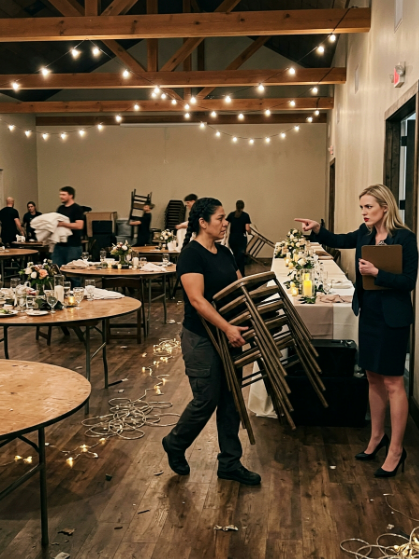
She stood up when she saw me. It took her a second — she’d only ever seen me in cargo pants, hauling chairs at one in the morning while a woman in stilettos screamed at me to move faster. Out of context, in a blazer, I was a stranger.
“Reyna Castillo,” I said. “Castillo Investigations. We met at your wedding. You just didn’t know it was me.”
I set the drive on the center of her desk.
“Your instinct was right,” I said. “From the very beginning. I’m sorry to tell you that.”
She didn’t touch it right away. She looked at it the way you look at a test result you asked for and now wish you hadn’t.
“What’s on it,” she said. Not really a question.
“A shadow cap table,” I said. “Todd has been forging dilution documents for eight months. Issuing himself shares through a class your operating agreement doesn’t actually authorize, backdating the paperwork, and routing the legal review through a firm his cousin works at. As of the documents on that drive, Todd Raines controls sixty percent of the company you built. On paper, he could remove you from your own startup by Friday.”
Addison sat down slowly.
I told her how I found it. The breakdown crew. Three weeks of being invisible at her own venue and at his every meeting, because the truth never hides in an office — it hides at the parties, in the unguarded moments, in the things people tape under tables when they’re sure the whole night is a blur of champagne and no one is watching the woman folding chairs.
I’d watched Todd slip the drive to an investor during the toasts. I’d watched the handoff. And when the crew tore down the head table at one a.m., I’d run my hand along the underside and found what he’d hidden there, while a wedding planner named Corinne pointed at me from the doorway and called me “you people.”
Addison was quiet for a long time.
Then she asked the question I’d been waiting three weeks to hear, because the answer would tell me exactly who she was.
“What are my options?”
“Legally? He committed fraud. Forgery, securities violations, breach of fiduciary duty. You have him cold — the documents, the timestamps, the witness. If you want, I can have this in front of a prosecutor by end of day. He could face criminal charges. He could lose everything. Some people, in your position, would enjoy watching that.”
She nodded slowly. “And the other option?”
“The other option is quieter, and it’s entirely yours. You confront him with counsel present. You unwind the forged shares — they were never legal, so they unwind clean. And you decide how much of the rest you want to set on fire.”
I watched her think.
I’ve done this work eight years, and I’ve learned you find out who a person really is in the ten seconds after they’re handed power over someone who wronged them. Most people reach for the match. I don’t blame them. The world teaches you that mercy is weakness, that the only safe enemy is a destroyed one.
I have seen it go the other way more times than I can count. A betrayed business partner who didn’t just want their money back, they wanted the other person ruined, salted, unable to ever work again. A spouse who turned a clean case into a decade of scorched earth because winning wasn’t enough; the other person also had to lose everything. I understand the impulse. When someone makes you feel small, the most natural thing in the world is to spend your new power making them smaller.
I expected Addison to reach for the match. She’d earned the right to.
She didn’t.
The confrontation happened two days later, in a conference room, with her attorney on one side and the unwound paperwork on the table. Todd came in smiling, called her “Addy,” asked what the “emergency meeting” was about.
She slid the printouts across to him. The shadow cap table. The forged dilution docs. His cousin’s signature on the review.
I watched his smile do what guilty smiles do.
He started to talk. They always start to talk. Explanations, then justifications, then the long ugly part where the friend you trusted explains why it was really your fault.
Addison let him finish. Then she said something I have not forgotten.
“At my wedding,” she said, “there was a woman on the breakdown crew. A planner screamed at her half the night. Called her ‘you people.’ Treated her like she wasn’t a person, because she’d decided that woman didn’t matter.” She nodded at me. “That woman was the one who caught you, Todd. Funny how that works.”
She slid one more piece of paper across the table.
“This is a resignation letter. You sign it, you walk away from the company, and you take six months of severance you absolutely do not deserve. The forged shares are already gone — they were never real. I’m not pressing charges.”
Todd blinked. “You’re… not —”
“I could,” Addison said. “I have everything I’d need. My lawyer thinks I’m insane not to.” She glanced at the attorney, who very clearly did think exactly that. “But I watched what cruelty looks like when someone finally has power over someone else. I watched it at my own wedding, in a doorway, in a pair of stilettos. And I decided I never want to be that. Not even to you. Especially not to you.”
She stood up.
“You don’t get my forgiveness,” she said. “That’s not what this is. You get my distance. Now sign, and get out of my company.”
He signed.
After, in the hallway, Addison thanked me and paid my fee. Then she asked me something almost shy.
“The woman the planner screamed at. The crew. Are they — did they get treated all right? In the end?”
So I told her the last thing I’d done before I changed out of the crew shirt for good.
The breakdown crew had been stiffed on their gratuity that night — Corinne had “forgotten” it, the way she forgot everything that involved paying people. So before I walked out of Magnolia Ridge at three in the morning, I’d left every one of them double what they were owed. Out of my own pocket. Cash.
They never knew it came from the woman hauling chairs beside them.
I think about that a lot, actually — that the kindest thing I did on that whole job was the one thing nobody would ever credit me for. The crew thought maybe the venue had finally come through. Corinne probably took the credit if anyone asked. And that’s fine. The point of a thing like that was never to be seen doing it. That’s the whole difference between me and the woman in the doorway: she needed an audience to feel big, and I’d learned to do the work whether anyone was watching or not.
Addison smiled when I told her. The first real smile I’d seen from her.
“Send me their names,” she said. “I’ll triple it. And I’m done using that venue until they fire the planner.”
People think my job is catching liars. It is, mostly.
But the part I actually do it for is the ten seconds after — when I hand an ordinary person proof and power, and I get to watch which one they become.
Most reach for the match.
Addison Hale handed it back.
And that, more than any case I’ve ever closed, is the one I tell people about.