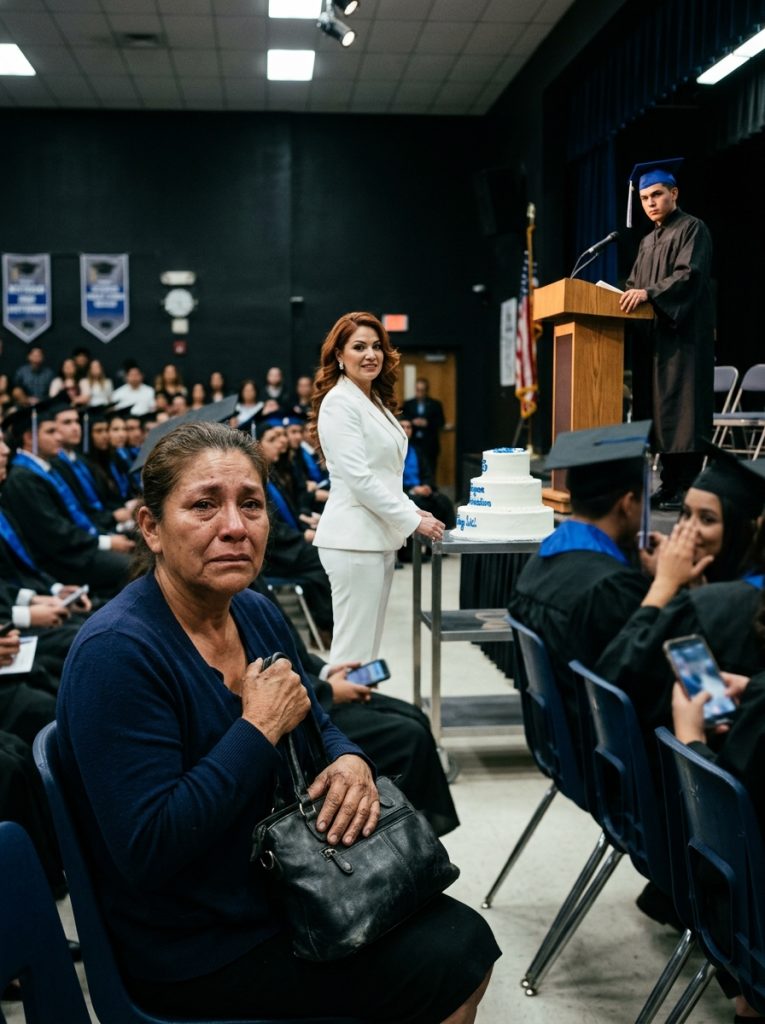
The auditorium didn’t just go quiet. It stopped existing.
Marcus gripped the podium like he was bracing against a current only he could feel. Two hundred graduates behind him. Four hundred parents and family members in front of him. A cake that said “Real Mom” growing stale on a silver cart. And me — his aunt Delia — sitting in the third row with nineteen years of exhaustion pressed into the seams of my faded black purse.
“My name is Marcus Reyes,” he said into the microphone. “And I am the valedictorian of Westbrook High School’s graduating class. I have a four-point-three GPA. A full scholarship to the University of Texas at Austin. And for the last nineteen years, I have been raised by a woman who is not my biological mother.”
Sabrina’s smile finally flickered. The phone in her hand dropped another inch.
“That woman,” Marcus continued, “is sitting in the third row. Her name is Delia Navarro. She is my aunt. And she is the reason I am standing here today.”
I wanted to tell him to stop. I wanted to wave my hands and say it didn’t matter — that I didn’t need this. But my throat had closed completely. I couldn’t have spoken if I tried.
“When I was eighteen months old,” Marcus said, his voice steady and clear, “I had a fever of one hundred and four degrees. My biological mother was in Miami. On vacation. My aunt Delia sat with me in the emergency room for fourteen hours. She didn’t leave my side once.”
Sabrina’s perfectly painted lips parted slightly.
“When I was six, I broke my arm falling off a bike. My biological mother had forgotten my birthday. Again. My aunt Delia bought me that bike — used, from a garage sale, because it was all she could afford. She worked double shifts. She cut hair until her wrists cramped. She washed towels at midnight in a South San Antonio beauty salon. And every single night, she made sure I had dinner.”
Someone in the audience started crying. I don’t know who. I couldn’t look away from Marcus.
“She signed every permission slip. She attended every parent-teacher conference. She sat in this exact auditorium for every band concert, every awards ceremony, every school play I was ever in. When my college acceptance letter arrived, she cried in the bathroom because she didn’t know how she would pay for it — and then she found a way anyway.”
Marcus paused. He looked down at the podium for a moment, collecting himself.
“My biological mother,” he said, “sent me a birthday card once. When I was twelve. It was three months late. She spelled my middle name wrong.”
A collective inhale swept through the auditorium.
Sabrina’s phone was now at her side. Her face had hardened into something ugly — the expression of a woman who had expected applause and was getting truth instead.
“I don’t say these things to hurt anyone,” Marcus continued. “I say them because for nineteen years, the woman who actually raised me has been invisible. She has never complained. She has never asked for credit. She has never once reminded me of everything she sacrificed. And she was about to walk out of this auditorium tonight without anyone knowing her name.”
He looked directly at me.
“Tía Delia,” he said, and his voice cracked for the first time. “Please stay in that seat.”
I pressed my purse harder against my lap. I was crying openly now — not the pretty kind of crying, but the kind where you can’t catch your breath and everything you’ve held inside for nineteen years comes rushing out at once.
Marcus turned back to the audience. “There’s one more thing.”
He reached into his gown and pulled out a stack of papers.
“These are receipts. Nineteen years of receipts. Every tuition payment. Every textbook. Every school lunch. Every pair of sneakers. My aunt kept every single one. She told me once it was for taxes. I think she kept them because no one else would ever believe what she did.”
He set the stack on the podium.
“This is what love looks like. Not a cake. Not a white pantsuit. Not showing up at graduation with a camera crew and pretending you were there all along. Love is rice and beans for dinner so your kid can have new shoes. Love is washing towels at midnight so there’s enough for tuition. Love is telling a crying boy ‘Next paycheck, mijo’ when you’ve been saying that for years and somehow it always works out.”
Sabrina stood up. “This is ridiculous,” she announced. “I’m his mother.”
“No,” Marcus said. “You’re my biological parent. There’s a difference.”
The words hit her like a physical blow. She opened her mouth, closed it, then turned and walked out of the auditorium — her white pantsuit disappearing through the double doors, her heels clicking on the tile floor until the sound faded into nothing.
Our parents — my parents — followed her without a word. They didn’t look at me. They didn’t look at Marcus. They just walked out, the way they’d walked out of both our lives years ago.
The cake sat untouched on its silver cart.
Marcus finished his speech. He talked about his future. About mechanical engineering. About building bridges. About a world where the people who sacrifice the most don’t have to stay invisible. When he finished, the applause was so loud the lights seemed to vibrate.
He walked off the stage and straight to me.
I stood up. My black purse dropped to the floor. I didn’t care.
“You didn’t have to do that,” I whispered.
“Yes, I did,” he said. “You’ve been telling the truth for nineteen years with your actions. I just put it into words.”
He hugged me. My nephew — my son in every way that mattered — wrapped his arms around me in front of everyone. And for the first time in nineteen years, I let myself believe that I had done enough.
The custodian wheeled the cake away an hour later. Untouched. Unwanted. I heard later that someone threw it in the dumpster behind the gym.
I didn’t see Sabrina again for three years. She sent a text once — something about family forgiveness and moving forward. I didn’t respond.
Marcus graduated from UT Austin with honors. He’s a structural engineer now. He designs buildings that don’t fall down. I still cut hair at the same salon — but now I only work four days a week instead of seven. Marcus insisted. He said I’d earned the rest.
Last month, he bought me a new purse. Not faded black — red leather. Bright red. The kind of purse you carry when you’re not afraid of being seen.
I cried in the store when he gave it to me.
Some things take nineteen years to heal. But they do heal.