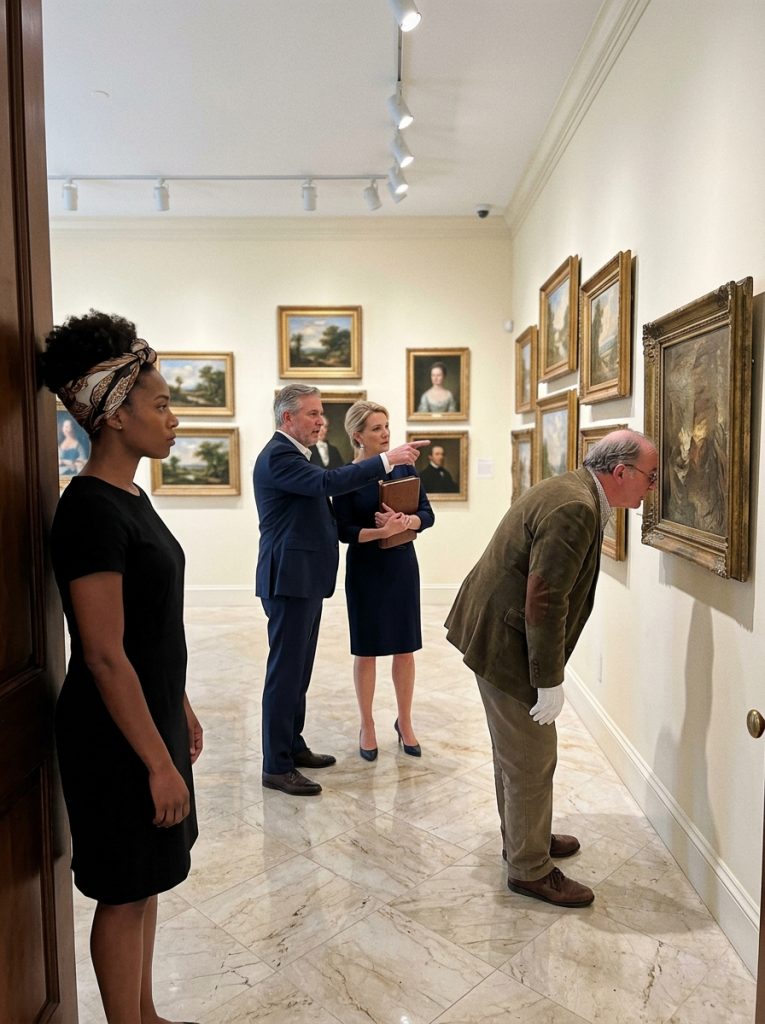
Hugo Brantley stayed on hold with London for forty minutes.
I stayed with him. In the gallery room. While my uncle Richard and my aunt Celeste moved to the dining room to keep arguing about the wine cellar and the lake house, neither of them noticing that the appraiser they’d hired hadn’t moved from a single mid-size canvas in a tarnished gilt frame.
“Tell me what you see,” I said.
Hugo didn’t look away from the painting.
“Do you know what your grandfather told the estate agency when he insured this collection?” he said. “He listed eleven of these twelve paintings at their honest value. A few thousand each. Nice regional work. Decorative.”
“And the twelfth?”
Hugo finally turned to me.
“He listed it at one dollar.”
I blinked. “One dollar?”
“One dollar. As if it were worthless. As if it were a thrift-store find.” Hugo took off his half-moon glasses and cleaned them with a cloth that shook slightly in his hands. “I’ve been doing this for thirty-eight years, Miss Ashford. A man does not insure eleven paintings honestly and undervalue the twelfth by accident. He does it on purpose. He does it to hide something.”
The voice on the phone came back. Hugo turned away and spoke in low tones — reference numbers, provenance codes, words I didn’t understand.
When he hung up, his face had changed.
“The International Foundation for Art Research has a registry,” he said. “Of stolen and missing works. There is a painting that disappeared from a private collection in Antwerp in 1931. A landscape. Earth tones. Heavy impasto brushwork. It was never recovered. It was presumed destroyed in the war.”
He pointed at the canvas in the tarnished frame.
“Until now.”
My legs felt strange.
“You’re saying—”
“I’m saying I need to bring in a conservator and a forensic specialist before I say anything with certainty. But the canvas weave, the pigment oxidation, the brushwork — Miss Ashford, if I’m right, this painting is worth somewhere between twelve and sixteen million dollars.”
The room tilted.
Twelve to sixteen million dollars.
More than the house. More than the stocks. More than the lake property and the wine cellar and everything my family had been clawing at each other over for three months.
Hanging on a cream wall in a tarnished frame that nobody wanted.
“Does anyone else know?” I asked.
“No.”
“Then we keep it that way. Until you’re certain.”
Hugo studied me. “Your family is preparing to liquidate this collection for pennies. Your aunt has a dealer arriving Thursday. If that painting leaves this house before it’s authenticated—”
“It won’t,” I said.
That night, I read my grandfather’s will. Again. The clause I’d skimmed past a dozen times.
“My art collection shall pass in its entirety to whichever heir valued what I loved.”
Valued. Not “wanted.” Not “claimed.” Valued.
The estate attorney had interpreted it as ambiguous — a sentimental flourish with no legal teeth. Richard’s lawyers had argued it should default to equal division like everything else.
But my grandfather had been precise about everything his whole life. He didn’t write sentimental flourishes. He wrote instructions.
The next morning, I called the estate attorney and requested a formal reading of the art clause with all heirs present. I asked him to bring my grandfather’s personal papers — the ones held in the law office safe.
Richard laughed when he heard. “You want the paintings? Take them. They’re worthless. Just don’t expect a share of anything that actually matters.”
Celeste smiled her tight smile. “Sentimental to the end, Noelle.”
I let them think that.
Thursday, we gathered in the gallery room. The estate attorney. Richard. Celeste. Two cousins. And me. Hugo stood quietly in the corner with a folder.
The attorney opened my grandfather’s personal papers.
And inside was a letter.
Handwritten. Dated three years before his death. Addressed to “whichever of my heirs is reading this in the gallery.”
The attorney read it aloud.
“If you are standing in this room, then I am gone, and the lawyers are dividing what I spent a lifetime building. Let them. Money is easy to divide because money has no soul.
But the paintings have souls. And only one of you ever saw them.
Noelle sat with me in this room when she was seven years old and asked me why the light in the corner painting looked like it was breathing. None of the others ever asked me anything. They walked past my life’s true treasure for thirty years and saw only old frames.
The painting in the tarnished frame is not worthless. I bought it from a dying man in Brussels in 1962 who told me its history and swore me to discretion. I have protected it for sixty years. I insured it for one dollar so that no thief — and no greedy heir — would ever know what it was.
To whichever of you valued what I loved: it is yours. All of it.
I think we both know who that is.”
The room was silent.
Richard’s face was white. Celeste’s ledger slipped from her hands and hit the marble floor.
Hugo stepped forward.
“I’ve completed preliminary authentication,” he said. “Pending final forensic confirmation, this painting is a lost work missing since 1931. Conservative auction estimate: fourteen million dollars.”
Celeste made a sound like a kettle.
“That’s — that belongs to the estate—”
“It belongs to Noelle,” the attorney said, reading the will. “The art collection passes in its entirety to the heir who valued it. The decedent named her explicitly. This is unambiguous.”
Richard stood up so fast his chair scraped.
“I’ll contest it.”
“You can try,” the attorney said. “The letter is notarized. The clause is clear. And frankly, Mr. Ashford, you stood in this room two days ago and called these paintings worthless on the record, in front of witnesses. That recording exists in the estate file. It rather undermines a claim that you valued them.”
Richard sat back down.
I didn’t gloat. I’m not built that way. My grandfather wasn’t either.
I had the painting authenticated over the following two months. It was real. A lost Belgian landscape, missing for ninety-three years, valued at $14.2 million.
Advertisement
I did not sell it.
I loaned it — permanently — to a museum in Brussels, in my grandfather’s name, with a plaque that tells the story of the dying man who entrusted it to him in 1962.
The other eleven paintings I kept. They hang in my home now. Not because of their value. Because of the stories. Because when I look at the one in the corner, the light still looks like it’s breathing.
Hugo Brantley came to the museum unveiling in Brussels. He wore the same corduroy blazer. He cried when the curtain dropped and the painting hung in proper light for the first time in ninety-three years.
“Your grandfather protected this for sixty years,” he told me afterward. “And he trusted the right person to finish the job.”
I asked him how he’d known — that first day in the gallery — to look at the one painting nobody else saw.
He smiled.
“Because it was the only one in a cheap frame,” he said. “A man who can afford gilt frames for landscapes worth a few thousand dollars does not put his most precious possession in a tarnished one. Unless he’s hiding it. The frame told me everything before I ever looked at the canvas.”
I think about that a lot now. How the thing of greatest value was disguised as the thing of least. How my grandfather hid a masterpiece in plain sight for sixty years, trusting that only the person who truly looked would ever find it.
Richard and Celeste split the house, the stocks, the lake property, and the wine cellar. They got exactly what they fought for.
I got what my grandfather loved.
And I think we both know who got the better inheritance.