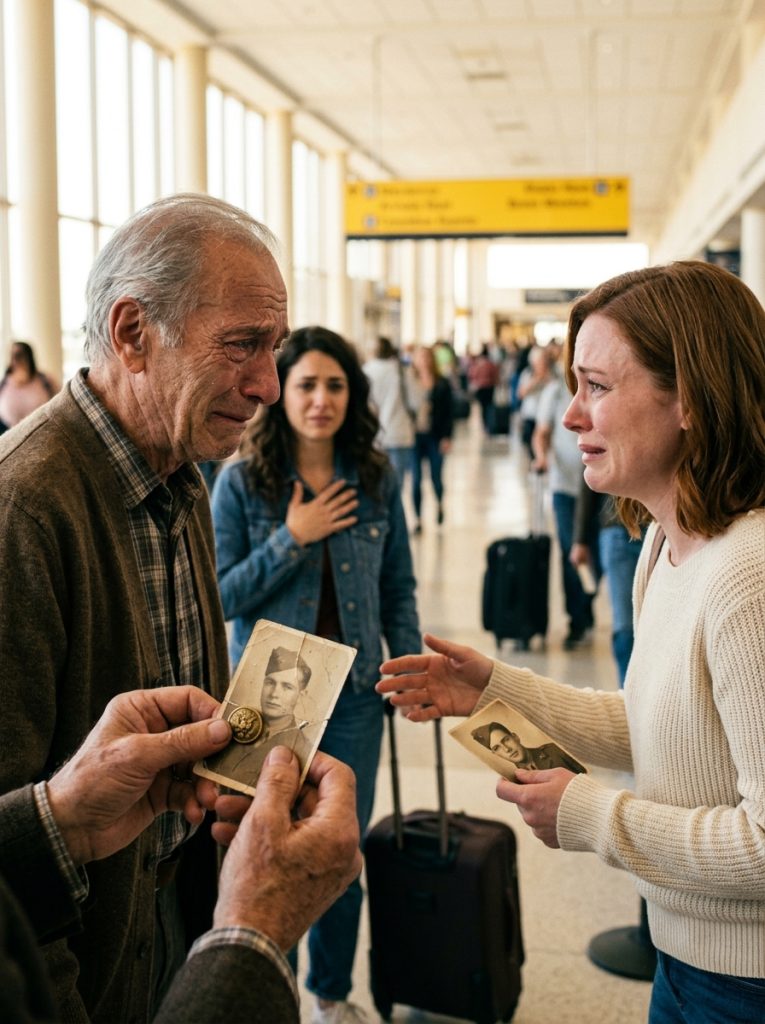
I waited until the second day to tell him. I wanted him to have one day that was only joy.
We spent that first afternoon at my kitchen table, the whole family talking over each other in two languages, Giulia translating until her voice gave out. Lorenzo held the blown-up photo of my grandfather in his lap the entire time and would not put it down, not even to eat.
But the next morning, while the house was quiet, I brought down the box.
It was an old footlocker, army green, the paint worn to metal at the corners. My grandfather kept it in his closet my whole life. After he died, I’d carried it home and not been able to open it. Grief has a way of sealing things.
I’d finally opened it the week the DNA match came. And what I found inside was the reason I’d been a wreck on the phone with Giulia, the reason I couldn’t quite explain over a translated call why this reunion meant more than even Lorenzo knew.
I set the footlocker on the table in front of him.
“Lorenzo,” I said. Giulia leaned in to translate. “Your mother told you your father never came back. That he forgot. That the letters never came because there were no letters.”
His face closed a little. Eighty years of that belief. You don’t undo it with a sentence.
I opened the locker.
On top was a photograph. A young woman, dark-eyed, laughing, standing in front of a stone wall with cypress trees behind her. On the back, in my grandfather’s hand: Assunta. Pisa. 1944.
Lorenzo made a sound I have never heard a person make before. He picked it up with both hands.
“Mamma,” he whispered.
It was his mother. Sixty years younger than he had ever been able to remember her. My grandfather had carried her picture for the rest of his life.
Underneath were the letters.
Dozens of them. Decades of them. All addressed in my grandfather’s handwriting to an address in a village near Pisa. And every single one stamped, in fading official ink, with the same words in three languages.
Return to sender. Address unknown.
He had written. For years, he had written. The village had been half-rebuilt after the war, the streets renumbered, Assunta’s family scattered or gone. The letters went out and the letters came back, and he kept every one, unopened the second time, in the order they returned.
He never abandoned them. The mail abandoned him.
I watched Lorenzo understand this in real time, the foundation of his whole life shifting under him at eighty-one years old. He pressed a stack of returned envelopes to his chest and rocked, and Giulia put her arms around him, and we all cried in my small Ohio kitchen for a man who had been dead eight months and a woman who had been dead for thirty years and a love letter that took eighty years to be delivered.
There was one more thing.
At the very bottom, separate from the rest, was an envelope that had never been mailed. The paper was newer. The hand was shakier — my grandfather in his last years, the same trembling letters I’d seen on the cards he wrote near the end.
It was addressed: To my child, if you exist.
I had read it once, alone, and not been able to read it again. So I gave it to Giulia, and I asked her to read it to Lorenzo in Italian, slowly, so he could have it in the language his mother sang to him in.
I don’t have all of it memorized. But I have the parts that matter.
“I have wondered my whole life,” my grandfather wrote, “whether the summer in Pisa left more than a hole in my heart. I have wondered if there is a person walking the earth who is half of me and half of the bravest girl I ever knew. If you exist, know this: I did not leave because I stopped loving her. I left because they put me on a truck and pointed it north, and by the time I could write, the world had moved the streets and swallowed my letters. I looked. God knows I looked. I am an old man now and I never stopped looking. If you are reading this, then someone found a way I never could. Tell them I am sorry I was late. Tell them their father was a good man named Thomas, and that he loved their mother in a stone village in a terrible year, and that it was the truest thing he ever did.”
Lorenzo listened with his eyes closed.
When Giulia finished, he sat very still for a long moment.
Then he opened his eyes and said, in his careful practiced English, the second sentence he had prepared for this trip.
“He was not late,” Lorenzo said. “He is here. I am here. We are not late.”
We drove to the cemetery that afternoon.
It was a cold, bright Ohio day, the trees half-bare. Lorenzo walked to his father’s headstone on Giulia’s arm, slower than slow, and he stood over the grave of a man he had spent eighty years imagining.
He took the little brass button out of his pocket — the one he’d carried his whole life, the one thing of his father’s his mother had been given by a passing soldier who’d known Thomas’s unit.
He knelt, with great difficulty, and he pressed the button into the earth at the base of the stone.
“I bring it home,” he said. “It belongs with you now, Papà. I kept it safe. Eighty years, I kept it safe for you.”
Then he said something in Italian, low, just for the grave, and Giulia did not translate it, and I did not ask.
Lorenzo stayed three weeks.
We took him to the diner my grandfather loved and ordered the pie. We drove him past the high school, the church, the river. He wanted to see all of it — every ordinary place his father’s ordinary life had happened, the life he’d been locked out of by a renumbered street and a war.
On his last night, the whole family gathered at my house again. My uncle carried my grandfather’s old record player up from the basement, and we played the records Thomas used to play — the big-band sides, the slow ones.
Lorenzo knew some of them. His mother had owned the same songs, he said, on a wind-up player in the village. The soldiers had left their music behind along with everything else.
He stood up, this frail man of eighty-one, and he held out his hand to my grandmother — Thomas’s widow, who had spent the whole week quietly absorbing the existence of a stepson older than her own children.
They danced. Slowly. Barely moving. Two women’s worth of grief and one man’s worth of love, swaying in an Ohio kitchen while a dead soldier’s records turned on the spindle.
There wasn’t a dry eye in the house. There wasn’t a dry eye for three states, I think.
He’s home in Tuscany now. We video-call on Sundays. Giulia props the phone up and the whole family crowds in, theirs and ours, two countries on one cracked screen, laughing in a language neither side fully speaks.
I’m flying to Pisa in the spring. Lorenzo wants to show me the stone wall where his mother laughed in a photograph in 1944. He wants me to stand where it started.
My grandfather looked for his son his whole life and died not knowing.
His son looked for his father his whole life and found him in a tin button and a returned letter and a granddaughter’s spit in a plastic tube.
Some mail takes eighty years.
It still arrives.