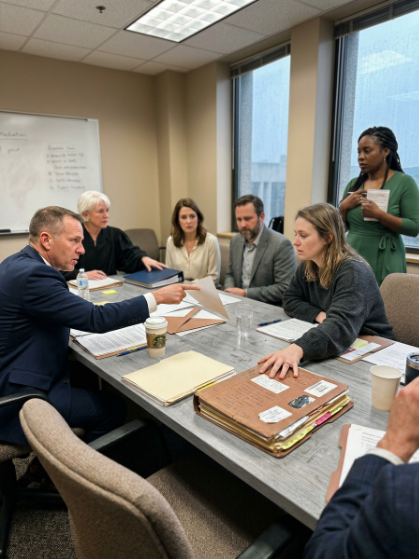
Judge Doyle did not read the clause quickly.
That was how I knew Paul was in trouble.
People skim paperwork when they already know what they want it to mean. Judge Doyle moved one line at a time, her finger steady on the page, her mouth set in a hard little line.
Paul Strick shifted in his chair.
It was the first honest thing his body had done all afternoon.
He reached for his pen, then stopped before touching it.
Noelle was looking at me now.
Not at the settlement packet.
Not at Paul.
At me.
Her face was pale in a way that made me realize she had not known what had been hidden any more than I had known why the agency suddenly wanted me quiet.
Bryce leaned toward the contract binder, but Judge Doyle lifted one hand.
Let me finish.
The room obeyed her.
Even the rain against the tall windows seemed quieter.
Aminah stood behind my chair with one hand on the back of it. She did not touch my shoulder. She knew better. I was already holding myself together with thread and stubbornness.
Judge Doyle read clause twenty-four aloud.
It said a surrogate retained standing to challenge agency conduct where alleged fraud affected medical consent, escrow compliance, or the legal safety of the pregnancy arrangement.
Standing.
The word Paul had used like a locked door.
The contract had a key built into it.
He had counted on me being too frightened to find it.
Paul said the clause was being taken out of context.
Judge Doyle looked at the escrow ledger.
Then at Aminah’s notes.
Then at the altered consent page in my folder.
Context appears to be the problem, Mr. Strick.
I had to look down because if I looked at Aminah, I would cry.
Not from victory.
From the sudden exhaustion of being believed.
Belief is not soft when it arrives late.
It hits the body like weather.
Noelle whispered, We were told escrow was current.
Paul turned toward her too fast.
Noelle, this is not the time.
She flinched.
Bryce saw it.
I saw it.
Judge Doyle saw everything.
She asked Paul whether the intended parents had received notice of the missed deposits.
He said agency finance handled those communications.
She asked whether the altered medical consent page had been sent to my clinic before or after the escrow lapse.
He said he would need to confirm.
She asked whether the settlement packet included a release of claims against the agency for events not disclosed to all parties.
Paul said standard language.
Judge Doyle closed the binder halfway.
Not fully.
Halfway, like she was done with his version but not done with the room.
She said the settlement would not be signed that day.
I felt my hand open on the folder.
I had not known I was gripping it so hard.
Paul objected.
He said delay could destabilize the arrangement.
Judge Doyle said concealed facts already had.
Noelle made a sound then.
Small.
Awful.
The sound of someone realizing the document she trusted had been moving beneath her feet.
She asked me if the consent page in my folder was the one I had been given at the clinic.
I slid it across the table.
Advertisement
Not to Paul.
To her.
The page faced down at first, because even after everything, I did not want my medical decisions turned into a spectacle.
Noelle took it with both hands.
She read the version number.
Then she looked at the copy in the agency packet.
Different.
Bryce cursed under his breath.
Paul told him to be careful.
Bryce said, No, you be careful.
That was when the alliance in the room shifted.
Not cleanly.
Noelle and Bryce were still intended parents with their own fears, their own interests, their own panic about losing control of a process that had already cost them years. I was still the person whose body had been used as the battleground for other people’s paperwork.
But the agency was no longer between us as a translator.
It was between us as a suspect.
Judge Doyle ordered the agency to produce the full escrow history, all consent-page versions, and communication logs with the clinic and intended parents within forty-eight hours. She also ordered that no medical decisions be changed without my direct written consent, my independent counsel’s review, and notice to all parties.
Independent counsel.
I did not have one.
Paul knew that.
He looked relieved for half a second.
Then Judge Doyle appointed a temporary legal advocate from the court’s approved emergency list for the limited purpose of reviewing consent and escrow issues.
His relief disappeared.
Aminah exhaled behind me.
I had not realized she was holding her breath.
The mediation ended without signatures.
That sounds simple.
It was not.
Walking out of that room unsigned felt like stepping away from a cliff with someone still trying to convince me the drop was a shortcut.
Paul packed his papers with clipped, angry movements.
He did not look bored anymore.
Noelle stood but did not leave.
She waited until Judge Doyle stepped out, until Paul was on the phone in the hallway, until Bryce had taken the agency packet and placed it under his own arm instead of Paul’s.
Then she walked to my end of the table.
Aminah straightened behind me.
Noelle saw it.
She stopped a careful distance away.
I am sorry, she said.
I did not answer at first.
Sorry is difficult in a room where harm is still happening.
She looked at my folder.
We should have asked you directly.
That was better.
Not enough.
Better.
I said, Yes.
Her eyes filled.
Bryce came up beside her and said they would join any complaint about the agency’s escrow handling.
I wanted to trust that.
I also knew panic makes people generous for fifteen minutes.
So I told them to put it in writing.
Aminah made a small sound that might have been approval.
By the next morning, the emergency advocate had called me.
Her name was Laila Chen, and she began the conversation by saying, I represent your consent, not anyone’s dream of a baby.
I cried after I hung up.
Not during.
After.
There are sentences you do not know you have needed until they arrive with a letterhead.
The forty-eight-hour production order did what pleading had not.
Emails appeared.
Ledger entries appeared.
A chain of messages showed the agency knew escrow funding had lapsed before they pressured me to sign a release. Another showed a coordinator asking whether the consent-page language could be simplified before I saw the change. Simplified meant removing the paragraph that said I could pause procedures until funding and consent were verified.
The clinic had not approved the altered version.
Noelle and Bryce had not been told payments were late.
I had been told everyone was waiting on me.
That lie had carried the weight of all of us.
Paul tried to blame a staff error.
Judge Doyle did not accept that.
The agency’s control over the mediation was suspended pending review. The court ordered all future communications to include my advocate, the intended parents’ counsel, and a clinic representative. Escrow was moved to a monitored account. Medical consent forms were reset to the clinic-approved version, with every change logged.
For the first time in weeks, my phone stopped filling with private pressure.
No urgent voicemails from coordinators.
No soft threats about cooperation.
No one telling me to think about everyone except myself.
Silence can be frightening when you are used to being chased.
Then it becomes medicine.
Noelle and Bryce did join the complaint.
Not perfectly.
There were hard conversations.
Noelle wanted reassurance I could not give her. Bryce wanted timelines that my body and my lawyer refused to promise. I wanted them to understand that my consent was not an obstacle to their family. It was the only ethical path left.
We did not become friends.
We became honest.
That was more useful.
Aminah stayed through all of it.
Appointment notes.
Court calls.
Clinic meetings where people suddenly spoke carefully because a doula with a folder had proven she knew dates better than their system did.
One afternoon, after a review meeting, I asked why she had not left when the agency started implying her involvement made me difficult.
She looked at me like the answer was obvious.
Because difficult is what they call a woman right before they take something.
I wrote that sentence down.
Not for court.
For myself.
Months later, when the agency settlement finally came, it did not look like revenge.
It looked like monitoring requirements, refunded fees, corrected consent procedures, and a ban on private settlement releases before full disclosure. It looked like Paul no longer representing surrogacy clients through that agency. It looked like Noelle and Bryce signing the complaint addendum beside me instead of across from me.
It looked boring, in the way real protection often does.
I learned to love boring.
The last time I saw Judge Doyle, she was not on the bench. She was in the courthouse hallway, walking fast with a file under one arm.
She recognized me and nodded.
I thanked her for reading the clause.
She said, Ms. Morgan, clauses are written to be read.
I thought of Paul saying I had no standing.
I thought of the settlement packet waiting for my signature like a trap in a neat folder.
I thought of Aminah’s notes beside my shaking hand.
Then I went home and put my copy of clause twenty-four in a drawer where I could find it whenever silence started to feel safer than truth.
The paper was plain.
The door it opened was not.