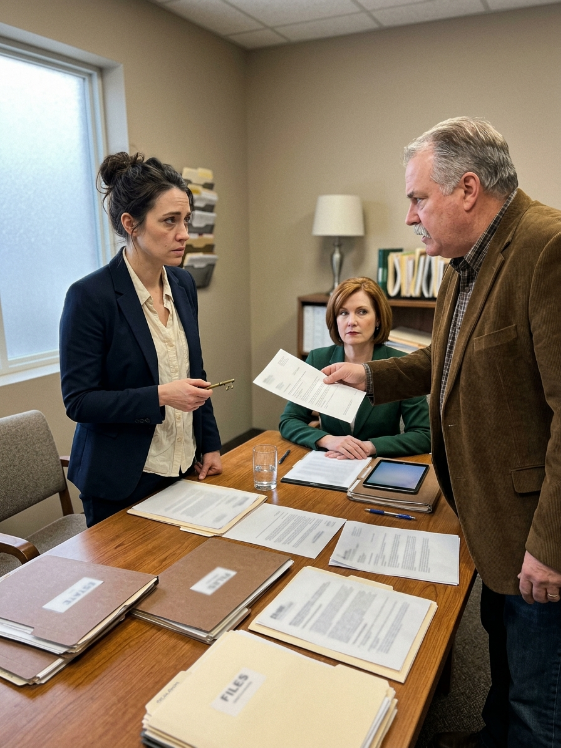
Elise did not pick up the tablet.
She placed one hand flat on the table between Ron and me and said, “No one touches that until Ms. Donovan decides how to proceed.”
Ms. Donovan.
Not Claire.
Not the accused daughter.
Not the niece everyone had been staring at like a suspect.
For the first time that morning, someone gave me my name back.
The tablet kept glowing.
Ron’s hand hovered above it, then dropped to his side.
“This is absurd,” he said. “We are discussing estate assets. Whatever call she has arranged can wait.”
Elise looked at me.
“Do you want to answer it here?”
Every part of me wanted to run into the hallway and take the call alone. I wanted to protect my father from the room’s hunger. I wanted to protect myself from what would happen if he could not speak clearly enough and Ron used that too.
Then the brass cabin key shifted in my fist.
My father had put it in my hand three weeks earlier at the rehab facility. His fingers had been weak. His mouth had fought every word.
But he had said one sentence clearly.
When I can talk, you let them hear me.
So I nodded.
“Yes. On speaker.”
Ron laughed.
It was too loud for the room.
Elise turned the tablet over and accepted the call before he could fill the silence.
At first, all we saw was ceiling tile.
Then a nurse adjusted the screen, and my father’s face appeared.
Thinner than anyone remembered.
One side of his mouth still heavy from the stroke.
White rehab blanket pulled up to his chest.
But alive.
Very alive.
My aunt made a sound I had never heard from her before.
My cousin whispered, “Oh my God.”
Ron took one step back.
The color left his face so quickly it looked like someone had opened a drain beneath him.
“Martin,” Elise said, voice careful. “This is Elise Morton. Can you hear us?”
My father’s eyes moved slowly across whatever he could see on his screen.
Then they found me.
“Claire,” he said.
One word.
Rough.
Uneven.
Mine.
I pressed my free hand over my mouth.
I had heard his voice in rehab, of course. I had sat through every difficult syllable. But hearing it in that room, after they had spent an hour speaking of him like an account problem, broke something open in me.
Elise asked if he understood he was joining a probate meeting concerning his estate.
My father blinked once, then said, “Not dead.”
No one laughed.
No one moved.
The nurse beside him said softly, “Mr. Donovan has a prepared statement. He practiced it this morning.”
Ron found his voice.
“This is manipulation. He is clearly not competent.”
My father turned his eyes toward the sound.
It took effort.
Everything took effort.
Then he said, “Ron. Stop.”
Two words.
The whole family obeyed them faster than they had obeyed any legal notice.
The nurse held a paper near the screen. My father did not read it perfectly. He did not need to. Every sentence came slowly, but each one landed.
He said he had suffered a stroke while traveling back from the cabin.
He said I was the one who found the rehab placement when the hospital discharge plan became confusing.
He said he asked me to keep his location private until he could speak without strangers deciding he was gone.
Advertisement
Then he looked at Elise.
“Claire protected me.”
Ron shook his head.
“Martin, she froze us out. She would not answer basic questions.”
My father closed his eyes for a second.
When he opened them, he looked older, but not weaker.
“You filed death papers.”
Elise’s pen stopped.
“Mr. Donovan, can you repeat that?”
The nurse adjusted the tablet closer.
My father spoke one word at a time.
“Ron. Filed. Death. Before. Doctor. Letter.”
Ron exploded then.
Not with grief.
With panic dressed as outrage.
He said the paperwork was preliminary. He said the family needed access. He said the cabin insurance, the taxes, the maintenance, the burden of leadership had fallen on him because I had made everything secret.
Elise let him talk for exactly fifteen seconds.
Then she raised one hand.
“Mr. Donovan, did you authorize your brother to pursue sale of the lake cabin?”
My father’s eyes moved to me.
I placed the brass key on the table where he could see it through the camera.
His face changed.
Not much.
But enough.
“No,” he said.
Ron gripped the back of a chair.
Elise asked if he wanted the estate freeze lifted.
“Yes.”
She asked if he wanted me removed from access.
“No.”
She asked if he wanted his location shared with the family after the meeting.
He paused.
That pause was the only mercy Ron received.
“With Claire present.”
My aunt began crying harder.
Not performative now.
Real.
The kind that comes when a person realizes they joined the wrong side because the loudest person gave them a script.
Elise stood and walked to the printer behind her desk. She printed three documents while the tablet stayed connected.
A notice to correct the death filing.
A motion to lift the emergency account freeze.
A hold on any sale, transfer, or encumbrance involving the lake cabin until Martin Donovan could appear through counsel or certified medical capacity review.
Ron said she could not do that so quickly.
Elise said, “Watch me.”
It was the only unprofessional sentence she said all morning.
I loved her for it.
The next week was paperwork, not drama.
That is what people forget. The truth can arrive in one video call, but undoing a lie takes forms, signatures, certified letters, and a lot of hold music.
The accounts were unfrozen after the correction filing reached the court.
The cabin sale Ron had been quietly preparing was blocked before any listing agreement could become active.
His attorney withdrew when Elise sent the timeline of the mistaken death filing, the rehab intake records, and the email where Ron asked about “accelerating cabin disposition” before any doctor confirmed my father’s status.
The family did visit the rehab facility.
Not all at once.
My father refused that.
He said he was recovering, not hosting Thanksgiving.
My aunt came first. She apologized to him, then to me, then to him again because she was not sure which apology carried more weight.
My cousin brought old photos and sat quietly while Dad pointed to the ones he wanted copied.
Ron came last.
I was present because Dad requested it.
Ron brought flowers from a grocery store and an apology that sounded like a legal draft.
My father listened.
Then he pointed to the chair by the window and made Ron sit while he said, slowly, that wanting the cabin was not the same as caring for the family.
Ron cried.
Maybe from shame.
Maybe from losing.
Maybe both.
I did not need to know.
A month later, Dad was well enough to ride with me to the lake cabin for an afternoon. Snow still sat in the shaded parts of the road. The cabin smelled closed-up and dusty, but the green shutters were still there.
I unlocked the door with the brass key.
Dad stood on the porch longer than he needed to.
His cane tapped once against the boards.
“Thought I lost this,” he said.
“The cabin?”
He shook his head.
Then he looked at me.
“You.”
I had defended strangers for years, but no verdict ever felt like that sentence.
Inside, we found the old coffee can full of keys exactly where he said it would be, on the pantry shelf behind the flour tin. He laughed when I opened it because none of the keys had labels.
“What do these open?” I asked.
He smiled crookedly.
“Stories.”
That became our project during rehab weekends. One key at a time. Shed. Dock box. Old desk drawer. Rusted padlock on the boathouse.
The last key did not open anything important.
It opened a little metal tackle box full of faded fishing lures and a photo of me at eight years old holding a bluegill like it was a trophy.
Dad had written on the back: Claire, keeper of the cabin.
I cried then.
Not in the probate office.
Not when the accounts unfroze.
There, with dust on my hands and my father alive beside me.
The brass key hangs by my door now.
Not because I own the cabin.
Because I learned what it means to be trusted with the truth before anyone else is ready to hear it.