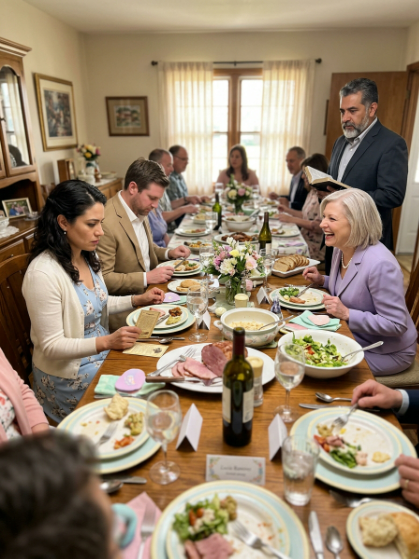
Pastor Mateo did not ask me to repeat the blessing.
He said it himself.
Quietly.
In the exact same old phrasing my mother had used at our kitchen table when I was a child.
The room did not understand the words, but I did. Every syllable moved through me like a door opening in a house I thought had burned down.
Gloria shifted in her chair.
“Pastor, I am sure Lucia does not need to be interrogated over dinner.”
She said my name correctly that time.
That was how I knew she was afraid.
Ben finally lifted his head.
His face was pale, but he still did not speak.
Pastor Mateo looked from my mother’s prayer card to me.
“May I see it?”
I did not want to hand it over.
That little card was one of the last things I had that still felt like my mother’s hand. The edges were soft because she had touched them. Because I had touched them after she died. Because sometimes I carried it when hospitals got too loud and families cried into my scrubs.
But his voice was careful.
Not hungry.
Not entitled.
So I placed the card in his palm.
He turned it over.
On the back, in my mother’s slanted handwriting, was her maiden name.
Alvarez.
Pastor Mateo’s hand trembled.
Not much.
Enough.
Gloria saw it too.
“How lovely,” she said. “A common name. Now can we please eat before everything gets cold?”
No one reached for the ham.
Pastor Mateo sat down slowly in the empty chair at the end of the table.
He was not performing anymore. He looked older, suddenly, like the years had caught up all at once.
“What was your mother’s name?” he asked.
My throat closed.
“Isabel.”
His eyes filled before I finished the second syllable.
“Isabel Alvarez Ramirez?”
The fork in Gloria’s hand clicked against her plate.
Ben whispered, “Lucia?”
I could not look at him.
I was staring at Pastor Mateo.
No one outside my mother’s old papers knew her full name that way. Not in that order. Not with Alvarez held like it mattered.
“Yes,” I said.
Pastor Mateo pressed the prayer card to his chest.
“She was my sister.”
The room disappeared.
That is the only way I can explain it.
The pastel plates, the serving dishes, Gloria’s pearls, Ben’s silent shame, all of it faded until there was only that sentence and the little card between us.
She was my sister.
My mother had told me about a brother once. Not in detail. Only when I was very young, on a night when rain hit the apartment window and she thought I was asleep. She said families could be split by borders, pride, fear, and paperwork, but blood remembered even when addresses did not.
I had thought it was one of her sad sayings.
I did not know it was a map.
Gloria recovered first because cruelty has fast reflexes.
“That seems like quite a coincidence,” she said. “Maybe this is not appropriate for the table.”
Pastor Mateo turned to her.
For the first time all afternoon, his kindness had a spine.
“What was not appropriate,” he said, “was mocking a guest in a language you assumed could not answer you.”
Gloria’s mouth opened.
He continued, still calm.
“You said her name wrong. You joked that your son would spend his life translating feelings. You asked where she learned English as if language were permission you had given her.”
Every face at the table turned toward Gloria.
She looked at Ben.
Advertisement
Waiting.
That was the moment that mattered for us.
Not the reveal.
Not the prayer card.
Ben had been quiet through my humiliation. Now his mother needed him to be quiet through hers.
He pushed his chair back.
The sound was small, but it felt like a decision.
“Mom,” he said, “stop.”
Two words.
Late.
But real.
Gloria stared at him like he had slapped the table.
“Excuse me?”
Ben’s voice shook.
“You embarrassed her. And I let you.”
He turned to me then.
I did not know what I wanted from him. An apology could not undo the silence. But silence had been the wound, so words were at least a beginning.
“Lucia,” he said, “I am sorry. I should have said something the first time.”
The first time.
He knew.
That hurt and helped at the same time.
Pastor Mateo handed me back the prayer card.
“Your mother and I were separated when she left Texas with your grandmother after a family dispute,” he said. “I wrote. Letters came back. Then nothing. I searched church records for years. I did not know she had a daughter.”
I held the card with both hands.
“She died when I was twenty-two.”
He closed his eyes.
There are griefs that arrive late and still arrive full-sized.
No one at the table spoke while he breathed through that one.
Then he asked if she sang when she cooked.
I laughed once, broken and surprised.
“Badly.”
He laughed too.
“Yes. Very badly.”
And just like that, my mother was in the room in a way Gloria could not control.
Not as an accent.
Not as a background.
As a sister.
As someone remembered by another living person.
Dinner did get cold.
Nobody cared except Gloria, and even she stopped saying it after Pastor Mateo asked me whether my mother still made lentils with too much garlic.
She had.
He told me about the village phrasing in the blessing, how their grandmother used it because she mixed two old prayers together and refused to be corrected. He told me Isabel once hid his church shoes in a flour sack because he teased her hair. He told me she had wanted to become a nurse before life pushed her into cleaning offices at night.
I told him she raised one anyway.
That was when he cried.
Ben drove me home later, but we did not talk for the first ten minutes. The prayer card sat on my lap. My phone had three new messages from Pastor Mateo already: a photo of my mother at sixteen, a picture of their parents, and a voice memo of him saying the blessing slowly so I could keep the older cadence.
At a red light, Ben said, “I failed you today.”
I looked out the window.
Tulsa was quiet, the kind of Easter evening where porches glow and families look simpler from the street than they are.
“Yes,” I said.
He gripped the steering wheel.
“Can I fix it?”
I thought about Gloria’s laughter. His silence. Pastor Mateo’s trembling hands. My mother’s name coming back to me across a table that had tried to shrink me.
“Not quickly,” I said.
He nodded.
That was the first right thing he did. He did not ask for quick forgiveness.
The next Sunday, Ben came with me to Pastor Mateo’s church. Not as a performance. Gloria was not invited. We sat in the third row while Mateo introduced me to cousins I did not know I had, people with my mother’s eyes and my grandmother’s hands and stories that made my childhood feel less like an island.
A month later, Gloria sent a note.
It was not good.
It said she was sorry if I had felt unwelcome.
I returned it in the same envelope with one sentence written underneath.
I did not feel unwelcome. I was made unwelcome.
Two weeks after that, she asked to meet me for coffee. I brought Ben. She apologized better that time. Not perfectly. Perfect was not on the table. But she said my name correctly before she said anything else.
That counted as a start, not a finish.
Pastor Mateo gave me a small box of my mother’s letters that summer. Most were returned unopened. One had a pressed flower inside. One mentioned me as a baby, though the letter had never reached him.
I read them slowly.
One per night.
I did not want to spend the inheritance too fast.
The prayer card is framed now on my dresser, but I still take it down sometimes before hard hospital shifts. The back shows my mother’s maiden name, and beside the frame is a photo of her at sixteen, laughing with the brother she thought she had lost.
For years, I thought that card was the last piece of where I came from.
It turned out to be the first address home.