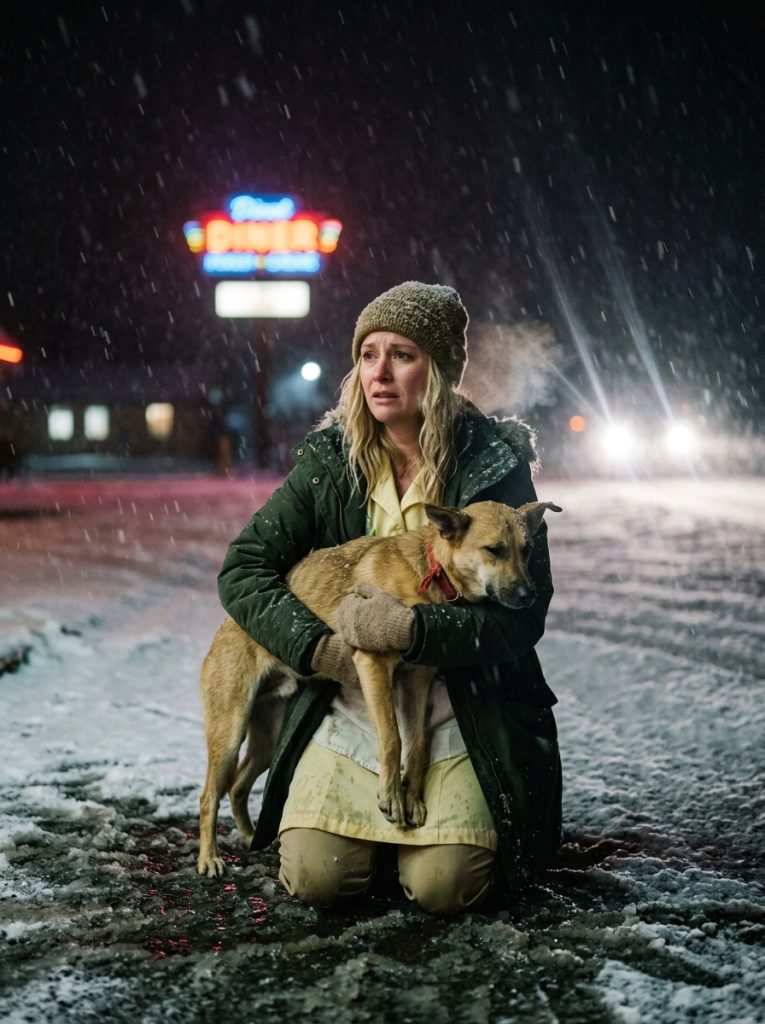
The vet tech held the phone away from her ear while the woman on the other end cried, and she looked at me like she needed help carrying it.
“Ma’am,” she said gently into the phone. “Ma’am, he’s alive. He’s here. We’ve got him warm. Can you tell me about him?”
So the woman told her, and the tech repeated the pieces out loud for me, because by then I had a hand on Biscuit’s flank and I wasn’t letting go.
His name wasn’t Biscuit.
It was Scout.
He belonged to a young man named Danny Mercer. And Danny Mercer had died two winters ago, in a wreck on the interstate eleven miles east of my diner.
Black ice. A truck that couldn’t stop. Danny was twenty-three. His dog had been in the back seat.
They never found the dog.
The family assumed Scout had died in the crash or in the cold after. They’d searched for a week, put up flyers, then surrendered to the second grief on top of the first.
For two years, Scout had been living rough along that stretch of highway. Drifting west a few miles at a time. Until he found a back door where a waitress left out scraps.
I’d been feeding Danny Mercer’s dog for four months and calling him a name that wasn’t his.
The Mercers drove through the storm that night. Five hours from across the state, headlights crawling through the snow, because the tech told them the truth: Scout was old now, and sick, and this might be the only window.
He held on.
I don’t have another word for it. The vet got fluids in him, got his temperature up, got his breathing even. But she told me quietly, while we waited, that his heart was tired and his years were mostly spent. “He was running on something stronger than his body,” she said. “Dogs do that. They wait.”
When the Mercers came through the clinic door, snow on their shoulders, Tom Mercer in a canvas jacket and Carol with her hands already pressed to her mouth, Scout lifted his head off the towel.
He was too weak to stand.
But his tail moved. Slow, then faster. And he made a sound I’d never heard him make in four months — a high, broken, joyful sound, aimed at two people he hadn’t seen in two years.
Carol Mercer went down on her knees on the clinic floor and put her face against his and said her son’s dog’s name over and over.
“He waited,” Tom kept saying. “He waited for us. Oh, buddy. You waited.”
I stood against the wall and cried into my parka sleeve and tried to make myself small, because this was theirs, not mine.
But Carol reached back without looking and caught my hand.
“You fed him,” she said. “Two years on his own and somebody fed him. That was you.”
“I didn’t know,” I said. “I didn’t know whose he was. I’m so sorry.”
“Don’t.” She squeezed my hand hard. “Don’t be sorry. You kept a piece of my son alive without ever knowing it was his. Do you understand what you gave us?”
I didn’t, then. I think I’m only starting to.
Scout stayed at the clinic two more days. The Mercers got a room in town and didn’t leave his side. I brought them coffee and the good pie from the diner and sat with them on my breaks.
They told me about Danny. How he’d found Scout as a puppy in a feed-store parking lot. How the two of them were never apart. How Danny used to say that dog would follow him to the end of the world.
He nearly did. He just took the long way, and the world turned out to be a diner off Route 66.
Scout went home with them. He lived four more months — good months, Carol wrote me, warm by their fire, on the rug that had been Danny’s. He passed in his sleep in the spring, an old dog finally allowed to stop waiting.
They buried him next to Danny.
Carol sent me a photograph of the two markers, the big one and the small one, side by side under a desert sky. On the back she’d written: Both of them home now. Thank you for the years you kept him for us, even when you didn’t know you were keeping him.
I keep that photo by the diner’s back door.
I still leave a bowl out on cold nights. For whatever lost thing the highway sends my way next.
Because I learned something standing in that snow with a dying stray in my arms: you almost never know what you’re carrying for someone else.
You just keep the light on, and you feed what shows up hungry, and sometimes — too late for one heart, just in time for two others — it turns out you were keeping a family’s whole world alive.