I did not say anything to Gaspar Rios in the first meeting.
I sat at my dad’s right elbow with a yellow legal pad and I took notes the way a second-summer law clerk takes notes. The cap on the wall behind me did not move. The man in the chair across the conference table did not look up at it.
He had no reason to.
The conference table was a beat-up oak we had inherited from the firm we’d absorbed in 2019. The window behind Gaspar looked out at midtown Sacramento on a Tuesday afternoon in October. The light was already thinning toward the early dusk that comes when the harvest is ending.
He was in the same kind of plaid Western shirt he had been wearing on I-15.
The cap he was wearing now was a newer one. Faded, but newer than the one on my wall.
My dad said, “Mr. Rios. Thank you for driving up. Walk me through the property.”
Gaspar walked us through it.
Forty-three acres of almonds outside Hilmar in Merced County. Original family well. Drilled in 1958 by his grandfather Joaquín. Three generations of Rios brothers had run the orchard. His brother Beto had passed in 2021. Gaspar had taken over the operation. The orchard had not turned a profit since the drought, but it was holding on.
Then Vesper Aggregate Farms, a private-equity ag-rollup, had bought every neighboring parcel.
Then Vesper had filed, with the county, a claim that an unrecorded 1962 easement gave Vesper the right to draw 38 acre-feet of water per year through the Rios well, on the grounds that the well sat “appurtenant” to a parcel Vesper now owned and had been used by both parcels under a handshake agreement.
The 1962 easement was on a single sheet of grayed photocopy paper, with a notary stamp half-faded into the margin.
Gaspar had hired a small-town lawyer who had read it once and told him to settle.
Gaspar had not settled.
Gaspar had walked into our office because his Stockton parish priest had handed him a yellow Post-it note with my dad’s name on it.
My dad sat with the photocopy in front of him for a long time.
He said, “Mr. Rios. May I keep this?”
Gaspar said, “Yes, sir.”
My dad looked at me.
“Theo. Take Mr. Rios down to records. Then call John in Davis.”
I said, “Yes, sir.”
I walked Gaspar to the file room on the second floor. I did not, on the elevator down, look at his face longer than I had to. I did not, when he handed me a manila folder of every document he had on the well, let my hand shake more than once.
He said, on the way out, “Son, you’re a quiet one.”
I said, “Yes, sir.”
He said, “That’s a good thing. Most lawyers I’ve met do too much talking.”
He laughed.
I did not laugh. I did not, yet, trust myself to.
I did not say one word to my dad either.
I did not, in the way I am about to describe, hold this back to make it dramatic. I held it back because I needed to know we could win the case before I allowed any of us to know that the man in the chair was the man on the wall.
We worked it for ten weeks.
John from Davis turned out to be Dr. John Erskine, a paleographer at UC Davis my dad had worked with since 1998. He took the easement under a stereo microscope on a Wednesday and called us back on a Friday. The notary stamp was a forgery. The notary commission number on the stamp was a number that had not been issued until 1969. The easement was dated September 1962. The notary’s actual logbook for September 1962 was on file with the California Secretary of State and contained no such entry. The stamp had been lifted, almost certainly, from a 1971 notarization on a separate property and re-applied to a backdated document.
We had Vesper Aggregate Farms on a forged historical instrument.
I drove down to the Hilmar parcel myself in early November. I sat with Gaspar at his kitchen table with his wife Esperanza, who fed me pan dulce and asked me how my mother was, and I went over the strategy with them in plain English. We were going to file a quiet-title action and a claim for damages. We were going to subpoena Vesper’s chain-of-custody records on the easement. We were going to depose the title officer who had certified the document.
Gaspar did not understand all of it.
He nodded.
He said, “Theo. Tell your father that whatever happens, my family will not forget him.”
I said, “Yes, sir.”
I drove the four hours back to Sacramento with my hands on the wheel of my dad’s old loaner sedan and the cap on the seat next to me and a knot in my chest the size of a softball.
Vesper folded.
It took until late February. They folded the way private equity folds — not at the deposition, but the morning after, at a settlement table in a downtown hotel with their general counsel making a face. They withdrew the easement. They paid the Rios family one hundred and twelve thousand dollars in damages. They signed a recorded covenant disclaiming any interest in the Rios well in perpetuity.
The title was quieted on March 14.
The well still pumps.
The almonds are flowering as I write this, in a small office over the milking parlor of nobody’s milking parlor — a borrowed phrase, my dad’s, from a different client; please excuse me — at our office in Sacramento, with the window cracked open and the spring smell of California’s Central Valley three hours away.
I went down to Hilmar with my dad on the Saturday after we recorded the disclaimer.
Esperanza had set up a long table in the orchard.
There were forty people there. Cousins, neighbors, the parish priest, two of the cousins’ kids, a man named Pablo who had run the well’s pump house for thirty-one years and was not going to be replaced by a Vesper-installed monitoring valve.
Gaspar embraced my dad. He embraced him hard, the way men embrace each other after something heavy has been carried for two seasons.
Then he turned to me.
He said, “Son. You are quiet, but I have been around long enough to know quiet is not the same as nothing. You worked this case. I want to thank you.”
I had been waiting for that moment for eleven years, in a way I had not let myself name.
I had brought the cap.
I took it out of my courier bag.
I set it down on the long orchard table between the platters of carnitas and the bowl of frijoles.
The faded “Rios” stitched across the brim caught the late-afternoon sun.
Gaspar looked at it.
He looked at it for a long time.
He looked up at my dad.
My dad shook his head once, very slowly. He did not know either.
Gaspar looked at me.
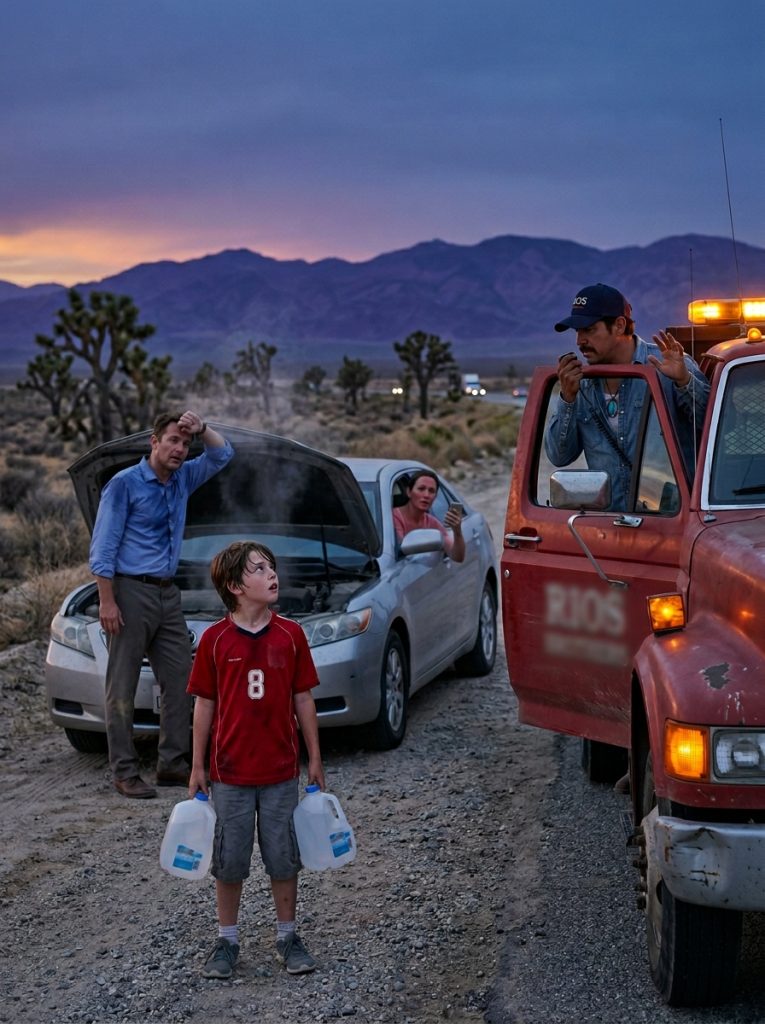
I said, “Sir. I-15 between Baker and the state line. August 2014. You gave my mom and my dad two warm gallons of water. You called Big Sam on the CB. You let me use the mic to call my abuela. You handed my dad your cap.”
Advertisement
His eyes went.
My dad’s eyes went.
Esperanza, who had been the woman on the phone that night when my abuela called her crying, started to laugh-cry into a dishtowel.
Gaspar stepped around the table.
He took the cap off the wood.
He held it in both hands.
He said, “Buddy.”
He used the same word he had used on the desert shoulder.
He said, “Buddy. You’re the kid in the red jersey.”
I said, “Yes, sir.”
He said, “You grew up to be a lawyer.”
I said, “Yes, sir. My dad’s lawyer.”
He said, “Pay it on. Hermano. Pay it on.”
He pressed the cap back onto my head with both hands the way a parent presses a graduation cap.
He pressed too hard, the way men of his generation press anything that matters.
The cap sat crooked on my hair. I did not straighten it.
My dad looked at his shoes for a long moment so I would not see his face. Esperanza laugh-cried harder. The parish priest crossed himself once, softly.
Pablo from the pump house started clapping, and forty people in an orchard outside Hilmar in March followed him, and for a second the entire Central Valley felt like the same valley as a desert pull-out off I-15 at blue hour eleven years before.
That is the test in disguise.
The test was the desert.
The water was the water table.
Pay it on, hermano. Pay it on.
I drove home with my dad that night up I-5, in the same loaner sedan, with the cap on the dashboard against the windshield where the steam had once come up from a busted radiator.
He did not say much.
I did not, either.
About forty miles out of Modesto he reached over and patted the brim of the cap on the dashboard with his thumb, the way he used to pat the steering wheel in the desert when he was thinking.
He said, “Son. Good work.”
I said, “Yes, sir.”
The cap is on the wall above my desk now.
It is no longer alone.
There is a small framed Polaroid beside it of an eleven-year-old boy in a red jersey holding two warm gallon jugs of water, and a man in a sunburned ball cap reaching for a CB radio mic, and a sky bleeding indigo over the Clark Mountains.
Pay it on, hermano.
I am.