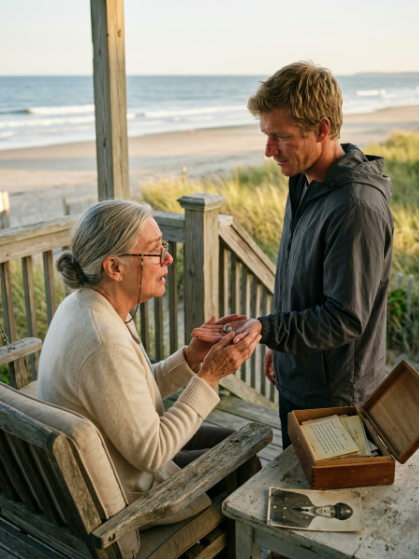
“Sit down, Margaret. Please.”
I’m seventy-one years old, and a stranger had just told me to sit on my own porch. But my knees had already decided the matter. I lowered myself back onto the swing.
Eli sat on the top step, turning his cap over in his hands.
“I almost didn’t come,” he admitted. “I find rings all the time. Most of them I can’t trace. But this one had initials inside the band, and a year, and a high school crest stamped on it. T.C. Class of 1974. Wells High.”
“Thomas Calder,” I said.
“I know,” he said softly. “I found him.”
For one impossible second, my heart leapt fifty years.
Then I saw Eli’s face — and I understood the way you understand weather, before a single word is spoken.
“He passed last spring,” Eli said. “I’m so sorry. I found his son first. Michael. He’s the one who told me the rest.”
I held very still and let the tide of it move over me.
Here is what Tommy did with his life. The parts I never got to know.
He came home from the service in 1976 and went straight back to this beach looking for me. But my family had moved inland by then, and the girl working the clam shack told him I’d married. Which I had. So he didn’t knock. He thought a knock would only make my life harder.
He married too, eventually. A kind woman named Ruth. He had Michael. He built boats, the way he always swore he would, in a shop two coves north of here.
And every year — every single year — on the last weekend of August, he drove down to this stretch of sand.
He brought a metal detector.
He was looking for his ring.
Michael sent a shoebox along with Eli for me. Eli set it on the swing beside me with both hands, the way you’d set down something holy.
Inside were letters.
Dozens of them. Written to me. Never once mailed.
Fifty years of them.
One a year, mostly. Written in August. A man telling a girl he’d known for a single summer about his boats, his boy, his Ruth, the weather, the way the evening light came off the water and reminded him of me every time without fail.
The last letter was dated two summers ago. His handwriting had gone shaky by then.
It said he thought he had finally found me. A Margaret Ellison, one town over, the right age. He wrote that he was going to drive down and knock on my door come spring.
He didn’t make it to spring.
I have spent four years believing the great love of my life was the good man I married and buried.
And he was. Don’t mistake me on that.
But this week I learned that a boy I knew for one August had carried me down the whole length of his life like a smooth stone in his pocket. That he gave away his ring on purpose, then spent fifty years searching one beach to find it again.
That he was a single block away at the end, and ran out of time by one season.
That is grief. But it is not nothing. It is the very opposite of nothing.
There was one letter Michael asked me to read before any of the others.
It was written the spring Tommy turned forty — the year his Ruth passed. He wrote that he’d told his wife about me once, near the end, and that Ruth, kind and steady to the last, had held his hand and said, “If you ever find that beach girl’s ring, you go and give it back to her yourself. Don’t you dare put it in the mail.”
He wrote that he had promised her he would.
He just never knew it would be a sandy-haired stranger with a metal detector keeping that promise for him — fifty years and a single season too late.
I folded that letter back along its soft, worn creases and held it against my chest for a long time.
Eli is coming back next Saturday. He’s bringing his detector. The two of us are going to walk the beach together, slowly, the way Tommy did all those Augusts.
Michael is coming too. He says his father would have liked that. He says I should keep the ring.
So this morning I slid it onto a thin chain and put it around my neck.
It’s far too big for my finger now. We were so young when he pressed it into my hand.
Tonight I’ll sit out here where I can hear the water, and I’ll read just one of his letters. Only one. I want to make them last.
After fifty years, I am finally writing him back.