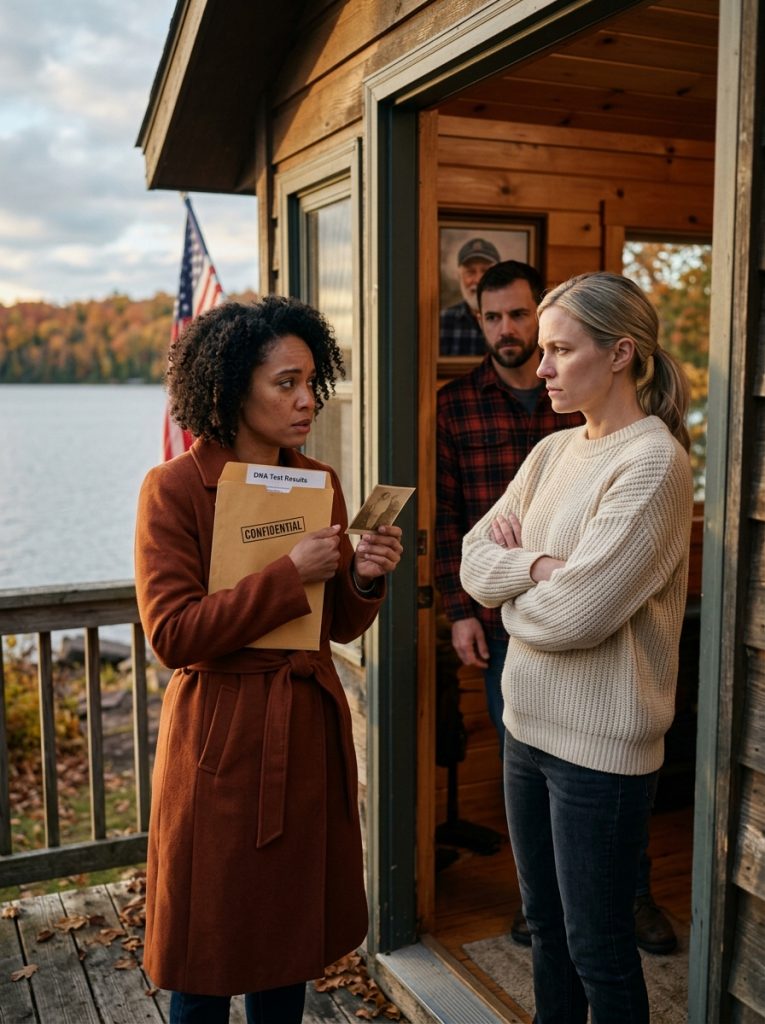
Two weeks after we buried my father, a woman I’d never seen knocked on the door of his lake house.
She had his eyes. The exact gray, with the same slight downturn at the corners. And in her hands she held a manila envelope with a DNA report inside.
My name is Brynn Lindqvist, and I blocked that doorway like my whole grief depended on it.
We were barely upright. My brother Cole and I had just put our dad, Gus, in the ground beside our mother, up the hill from the lake he loved. The casseroles hadn’t stopped coming. The cabin still smelled like his coffee and his pipe tobacco. And here was a stranger on the porch, in the gold October light off Lake Superior, saying the words that turn grieving families into courtrooms.
“I think Gus was my father too.”
I almost laughed. Almost slammed the door. We’d heard the warnings — people read an obituary, smell an estate, and show up with a tragic story and an open hand.
“Whatever you’re selling,” I started.
She held the envelope up between us like a shield. “I’m not selling anything. I just need you to look.”
So I looked.
The report showed a half-sibling match. The same 25 percent shared centimorgans with me. The same with Cole. The kind of number a lab doesn’t get wrong and a stranger can’t fake.
Cole called our family lawyer right there on the porch, certain he’d say she had no standing.
He said the opposite. “If that report’s legitimate,” he said carefully, “and she’s biologically your father’s child, then under state intestacy law she’s an heir. She’d have a claim to a share of the estate.”
A share of the cabin. A share of Dad’s accounts. A quarter of the only things we had left of him.
I felt sick. I was sure I was looking at the most patient kind of thief — one who’d waited for the funeral notice.
“You came two weeks after he died,” I said, my voice shaking. “How convenient.”
And that’s when her face crumpled. Not the way liars crumple when they’re caught. The way bone-tired people do when they’ve used up the last of their strength getting to your door.
“I didn’t even know his name until last month,” she said. “Can I — please, can I just explain, and then I’ll leave, and you’ll never see me again if that’s what you want.”
I let her in. Cole stood with his arms crossed by the woodstove. I stayed by the door.
Her name was Simone. She was thirty-six, a nurse from Milwaukee. She’d been adopted as an infant, closed adoption, and had never gone looking for her birth family. She’d made her peace with not knowing.
Then her daughter got sick.
“Maya’s eight,” she said, and pulled a photo from her coat pocket. A little girl, bald from treatment, grinning at the camera with a gap where her front teeth should be. “Leukemia. She needs a bone marrow transplant. The best matches come from biological family, and I’m only a half-match, and her father’s not a match at all. So the doctors told me to test. To find blood relatives I’d never met. Not for me. For her.”
She’d done the cheek swab to expand the donor search. The database had returned a half-sibling hit, and through it, a family tree, and a name. Gus Lindqvist. Duluth. A man who, the timeline showed, had a brief relationship decades ago, long before he met my mother — and who never knew a child had come of it.
“I wasn’t looking for a father,” Simone said. “I found a grave. I’m two weeks too late to even meet him.” Her voice broke. “I don’t want his money. I’ll sign anything you put in front of me tonight — I’ll renounce the whole estate in writing, every cent, I mean it. I came because you and your brother might be the closest thing to a match my daughter has left in this world. You’d be her family. I had to ask. Wouldn’t you?”
The cabin was very quiet. Outside, the lake had gone the color of pewter.
I looked at the photo of that little girl, and then at the gray eyes I’d buried two weeks ago looking back at me out of a stranger’s face, and every wall I’d built that afternoon came down at once.
“Of course we’ll test,” I said. My voice didn’t sound like mine. “Both of us. Today, if there’s a lab open.”
Cole uncrossed his arms. He’d gone quiet the whole time. Then he said, gruff, the way Dad used to get when he was moved and didn’t want to show it, “Dad would’ve already had his sleeve rolled up. Sit down. You look like you haven’t eaten.”
We tested that week. The waiting was its own kind of agony — Cole and I had spent it angry, then ashamed of being angry, then just hoping.
Cole was the match.
A near-perfect one. The transplant coordinator said the odds of a half-niece-and-uncle line working out that cleanly were small, and here it was. My brother — who’d stood by the woodstove ready to call security — donated marrow for the daughter of a sister he hadn’t known existed forty days earlier.
Maya’s in remission now. It’s early, and remission isn’t the same as cured, and I’ve learned not to get ahead of the doctors. But she has hair again, fine and dark, and a new gap-toothed grin in the photos Simone sends.
We never did fight about the estate. Simone signed the renunciation she’d promised before we ever asked her not to — and then we tore it up, the three of us, at the kitchen table, because by then it felt obscene to be talking about the cabin like it was the thing that mattered.
She comes up to the lake now, with Maya, every fall. There are three DNA reports in a drawer in that kitchen, and a fourth photo on the wall beside my father’s — a little girl who looks just enough like him to make Cole have to leave the room sometimes.
I spent one afternoon certain that a stranger had come to take what was left of my father.
She came to give him something instead: a granddaughter he never met, alive because of the family he didn’t know he had.
Comment “FAMILY” if blood was never really about the money. 🧬