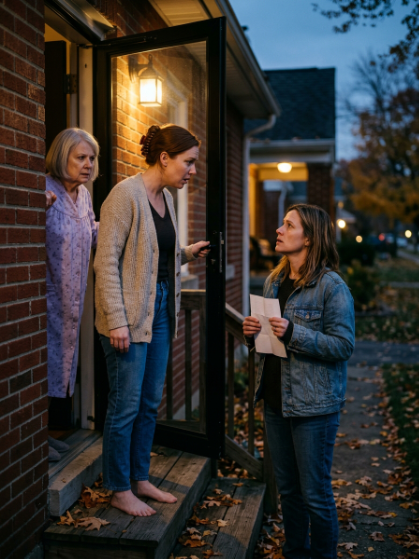
The name my mother whispered was Annie.
“Annie,” she said again, and her knees went. I caught her elbow and walked her to the porch step, and the three of us sat down in the cold like that was a normal thing for strangers to do.
“I named you Annie,” Carol said to Robin. “For eleven minutes, in a hospital in Dayton, you were Annie. Then they took you down the hall and I never saw you again.”
Robin made a sound I’ll never forget.
It came out in pieces, the way the worst stories do. My mother was eighteen in 1986. Pregnant by a boy whose family had money and a reputation and lawyers. Her own father told her she had two choices: give the baby up quietly, or leave and never come home.
She was eighteen. She had forty dollars and a part-time job at a pharmacy.
She signed the papers.
“They told me it was closed,” she said. “They told me you’d never be able to find me. I thought that was a kindness they were doing for you.” She pressed her hand flat to her mouth. “I have spent thirty-eight years hoping I was wrong about that.”
I sat there learning that my mother had been a different person before she was mine. That the woman who packed my lunches and clapped at my recitals had been carrying a hole in her the whole time, and had never once let me see the edges of it.
“Why didn’t you tell me?” I asked. “I’m thirty-four, Mom. You let me think I was an only child my entire life.”
She looked at me, and the answer was right there in her wet eyes.
“Because if I said it out loud,” she said, “I’d have to admit I let them take her. And I didn’t know how to be your mother and that woman in the same sentence.”
Robin reached into her bag. She took out a worn manila envelope and set it on the step.
Inside were her adoption records. A photo of her as a baby. And a single hospital bracelet, tiny, yellowed with age, with one word printed on it.
Annie.
My mother picked it up with two fingers like it was made of glass. She started to cry in a way I had never seen, the kind that comes from a place that’s been sealed so long it forgot how to open.
Then she said, “Wait here.”
She went inside. She came back with a shoebox I’d seen on the top shelf of her closet my whole life and never once asked about.
She opened it on the porch.
Birthday cards. Thirty-eight of them. One for every year. Bought, addressed to “my daughter,” and never sent, because she never had anywhere to send them.
“I didn’t know your name,” Carol whispered. “So I just wrote it to the girl. Every September fourth.”
Robin’s birthday is September fourth.
My grandfather — the man who handed my mother those two choices when she was eighteen — died when I was twelve. I remember him as stern and silent at the head of every holiday table. I never once suspected he was the reason my mother went quiet every September. He carried the secret to his grave and left her holding all of it alone.
I asked her, that night, if she hated him.
“No,” she said. “He thought he was protecting me. People did, back then. That’s the worst part. Everyone was so sure they were being kind.”
We sat on that porch until the cold drove us in, and then we sat at the kitchen table until two in the morning. Robin had grown up ninety minutes away, in Springfield, with good parents who’d passed a few years back. She had my mother’s hands. She had my exact laugh, which is a deeply strange thing to hear come out of a stranger’s mouth.
She had been afraid, she admitted, that we’d slam the door. That she’d be a problem to be managed, the way her birth had been.
“You’re not a problem,” my mother said. “You were never a problem. You were a secret somebody else made me keep.”
Here is what I have learned since that night.
A family is not a fixed thing. It is not a closed file. It can grow on a Tuesday, on a porch, in the cold, when a stranger holds up a piece of paper and is brave enough to ring the bell.
Robin and I do DNA test jokes now, the dark kind only sisters are allowed. She comes for September fourth. My mother bakes a cake and writes the card and actually hands it to her, and every year my mother cries, and every year it’s a little less from grief and a little more from something else.
The shoebox is empty now. All thirty-eight cards delivered, plus the new ones.
Mom keeps Annie’s hospital bracelet in it instead.
She says a box should always have something worth keeping.