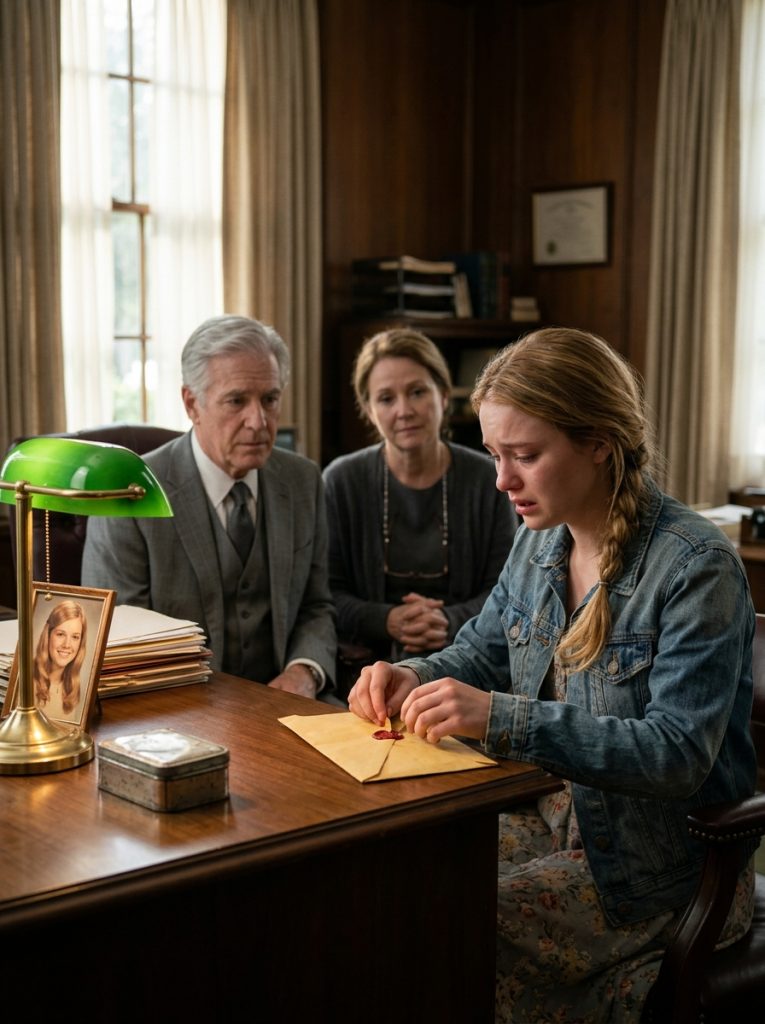
Harold Glass poured me a glass of water I didn’t drink, and waited while I made myself turn the page.
My mother’s handwriting filled both sides. She’d written it in the hospital, three weeks after I was born, when the doctors had already told her how little time was left.
“My Nora,” it began. “If you are reading this, you are eighteen, and I am a story Ruth has told you. Let me tell you the parts she never will.”
The first part was about Ruth.
My mother wrote that when she got sick, Ruth was twenty-two days into nursing school in Atlanta. A scholarship. The first person in our family to go.
She withdrew the week I was born.
“She told the school her sister was dying and her niece needed a mother more than the world needed one more nurse,” my mother wrote. “I begged her not to. She did it anyway. She has never once told you this, because she didn’t want you to grow up feeling like a debt.”
I looked up.
Ruth was staring at her folded hands.
“You quit school,” I said. My voice didn’t sound like mine. “For me.”
“There were other schools,” she said softly. “There was only one of you.”
I read the next page through a blur.
My mother wrote about the money. How she had nothing to leave but a small life insurance policy. How she’d made Ruth promise to use it for one thing only.
“She didn’t spend it,” my mother wrote, as if she could see the future. “Knowing her, she added to it. Quietly. For your school. Ask her.”
I looked at Harold. He slid a single sheet across the desk.
A trust account. Opened eighteen years ago. Forty dollars here, a hundred there. Hair-salon money. Double-shift money. Birthday money she told me she didn’t have.
The balance at the bottom had enough zeros to send me anywhere I wanted to go.
I had spent eighteen years thinking she resented me.
She had spent eighteen years saving for a future she never mentioned, in case I wanted it.
But the letter wasn’t done. And the last page was the one that broke me.
“There is a man named Daniel,” my mother wrote. “He is your father. He is not a bad man. He was a frightened one. My family told him he wasn’t good enough, and I let them, because I was proud and sick and stupid, and I sent him away before you were born. That was my mistake, not his, and not yours.”
I had never even heard his name.
“If he ever tries to find you,” she wrote, “let him. Promise me. Do not let my pride become your loneliness.”
I turned to Harold. “Did he? Ever try?”
Harold didn’t answer right away. He opened the dented tin box and turned it toward me.
It was full of envelopes. Dozens. One for every year of my life. All addressed to me in the same unfamiliar hand. All unopened.
“They came to this office,” Harold said quietly. “He didn’t have your address. Your mother’s instructions sealed everything until today. He wrote every year on your birthday. He asked me, each time, to keep them until you were old enough to choose.”
I picked up the most recent one. The postmark was from March.
Three months ago.
“Mr. Glass,” I said. “Where is he now?”
The look on his face told me before he did.
“Daniel passed in April,” he said gently. “A heart attack. He’s buried outside Macon. I’m sorry, Nora. He missed you by a season.”
The room went very quiet.
Eighteen years of letters. A father who wrote into the dark every single year, not knowing if I’d ever read a word.
And I’d walked in this morning ready to sign it all away and drive off with a boy who didn’t even get out of the truck.
I put my hand flat on the stack of envelopes.
“I’m not signing anything over,” I said. “And I’m going to college. The one Mom would’ve wanted Ruth to finish.”
Ruth made a sound I’d never heard her make.
I crossed the office and I hugged the woman who quit her whole life so I could have mine, and for the first time in eighteen years I said the word that had always belonged to her.
“Thank you, Mom.”
That afternoon, Ruth drove me to Macon.
We bought a single white lily at a gas station, and we found the new stone at the edge of the cemetery, and I read every one of those letters out loud to a father I never got to meet — one a year, in order, until the sun went down.
Some truths arrive too late to fix anything.
But they still tell you exactly who loved you, and how long, and how quietly.
I keep the tin on my desk at school now.
Forty acres of zeros got me through the door. Eighteen unopened envelopes taught me to walk through it without bitterness.
And every March, on the morning I was born, I drive out to a quiet stone in Macon and read him one more letter — the ones I write back.