“Your Honor,” I said, and my voice came out steadier than I felt. “I’m prepared to support this arrangement. I’ll sign.”
Every head in that courtroom turned. Marcus turned last, and the look on his face nearly undid me — not relief, not yet. Disbelief. Like he’d long ago stopped expecting an adult to stand up for him and had forgotten it was even a thing that could happen.
The judge studied me over her glasses. “And you are?”
“Diane Voss. I’ve been Marcus’s teacher for two years.” I walked to the front. My legs did not feel like my own. “I’m not family. But I’ve watched this young man do the work of three adults without complaint since before his mother passed. If the concern is whether there’s a responsible person standing behind these children, there is. There are, in fact, more of us than the paperwork knows about.”
That last part was a gamble. I’d made calls the night before, the kind you make when you finally stop telling yourself it isn’t your place.
The judge raised an eyebrow. “Explain.”
So I did.
I told her that the school counselor was prepared to coordinate after-care for Eli and Rosie at no cost. That the hardware store where Marcus worked had offered to make him a salaried assistant manager the day he turned twenty, with a schedule built around school pickup. That two families from the neighborhood had committed in writing to a meal rotation. That I would personally co-sign the lease and serve as the named adult guardian-of-record’s mentor, available to the court for check-ins as often as they wanted.
“It takes a village, Your Honor,” I said. “I’m aware that’s a cliché. I’m offering to be the village in writing.”
The caseworker, to her credit, did not fight me. She looked, if anything, relieved — like she’d wanted to find a way to yes the whole time and had finally been handed one.
The judge was quiet for a long moment. She looked at Marcus. Then at Eli, who had stopped staring at his shoes and was watching her with the wary focus of a kid who has learned that adults decide things. Then at Rosie, six years old, swinging her feet, holding her brother’s hand.
“Mr. Bell,” the judge said. “Stand up, please.”
Marcus stood.
“I’ve read your file. I’ve read your mother’s. I want to say something to you that I don’t get to say from this bench very often.” She folded her hands. “You did not have to do this. A nineteen-year-old, in your circumstances, would have been forgiven for letting the system take this weight. No one would have blamed you. You chose the harder thing. You chose them.”
Marcus’s jaw was working. He didn’t trust himself to speak. I knew the feeling.
“Guardianship is not a medal,” she went on. “It’s the hardest job there is, and it doesn’t end. There will be nights you regret this. There will be parent-teacher conferences and fevers and bills, and you are barely more than a child yourself.” She paused. “But this court does not exist to break up families that are fighting to stay together. It exists to protect children. And every piece of evidence in front of me says these three are safest, and most loved, with each other.”
She signed something. The sound of the pen was the loudest thing in the room.
“Petition granted. Mr. Bell, you are awarded guardianship of Eli and Rosie Bell, subject to the support plan as entered and supervised review at ninety days.” She looked at me. “Ms. Voss, the court accepts your offer to serve as mentor of record. I hope you understand you’ve just signed up for more than a signature.”
“I do,” I said. And I did.
What I remember most isn’t the gavel. It’s Rosie.
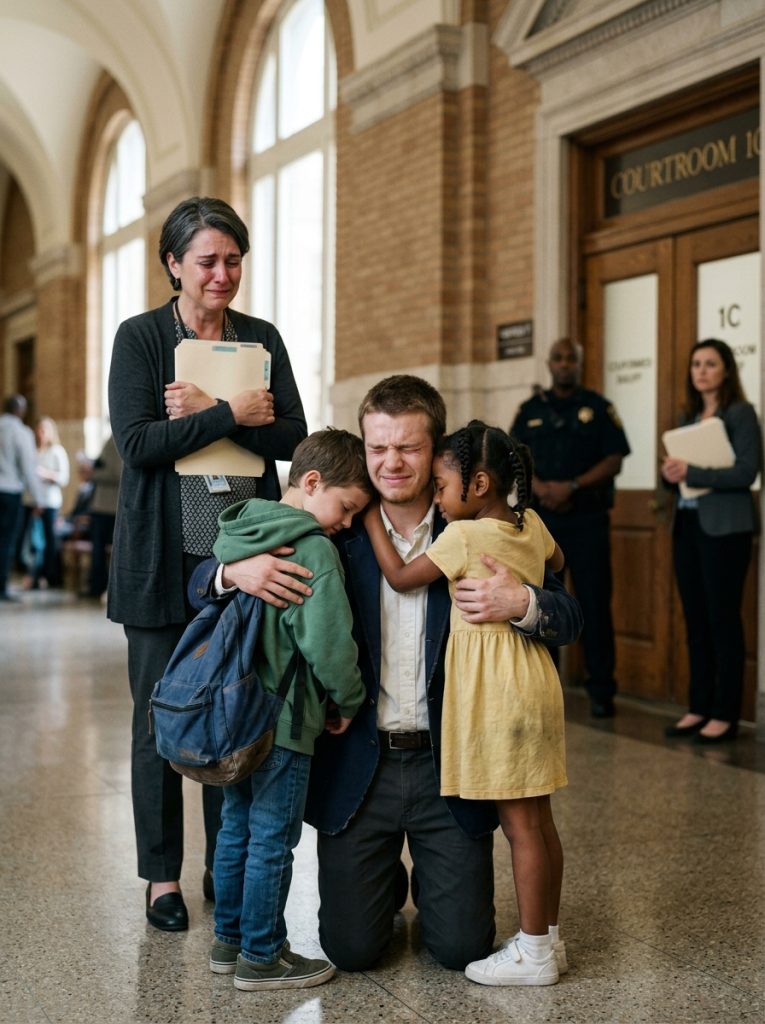
She didn’t understand the words. She understood the room. She understood that the scary part was over because her brother had dropped to his knees in the courthouse hallway afterward and pulled both of them into him so hard that Eli’s backpack slid off one shoulder.
I stood a few steps back, the manila folder against my chest, and I let myself cry where they couldn’t see.
Because here is the part that isn’t tidy. The part that makes this bittersweet instead of triumphant.
Their mother was still gone. No ruling brings that back. Rosie would grow up with only the foggiest memory of the woman who used to braid her hair, and she’d ask Marcus questions one day that would break him to answer.
And Marcus — Marcus had a scholarship. A real one. Engineering, a four-year ride, the kind of ticket out that a kid like him gets maybe once. I’d written one of his recommendation letters myself, a year ago, before any of this.
He deferred it.
He didn’t agonize in front of me. He just did it, quietly, the way he did everything. When I asked him later if he was sure, if he understood that “deferred” has a way of becoming “never,” he looked at me with those steady eyes and said something I’ve thought about every day since.
“I can be an engineer in five years, Ms. Voss. Rosie only gets to be six once. And she only gets one person who remembers Mom for her.”
I didn’t have an answer for that. I still don’t.
So I did the only thing I could. I kept my word.
I co-signed the lease. I showed up. I learned Eli’s basketball schedule and Rosie’s bedtime and the exact brand of cereal that prevented a Tuesday-morning meltdown. The neighborhood meal rotation held. The hardware store kept its promise. The counselor moved mountains.
It was not a fairy tale. There were hard months. There was a winter the heat went out and a spring Marcus nearly quit from exhaustion and a night he called me at eleven p.m. just to hear another adult say you’re doing it right, you’re not failing them, because no one had ever told him that and he’d started to believe the opposite.
But the three of them stayed together. That was the whole fight. That was the only thing that ever mattered to him, and we won it.
People ask me sometimes why I got involved. Why a chemistry teacher would co-sign a lease for a student’s family, put her name on documents, rearrange her life. They say it like it was a grand sacrifice.
It wasn’t. I want to be honest about that.
For three months I had watched a boy carry the unbearable, and I had done nothing but notice. I had told myself it wasn’t my place a hundred times. The truth is I was afraid — afraid of overstepping, afraid of the paperwork, afraid of caring that much about a kid I’d have to hand back to the world in June.
Standing up in that courtroom didn’t cost me anything I couldn’t afford. It cost me a personal day and a signature and the comfortable distance teachers are taught to keep.
What I got back was a front-row seat to the bravest thing I’ve ever seen a person do.
Marcus graduated that spring. He walked across the stage in the same secondhand blazer, the sleeves still an inch too short, and when they called his name, two kids in the third row stood up on their chairs and screamed so loud the principal laughed into the microphone.
He starts college this fall. Five years later than planned. Eli is in middle school now and Rosie’s braids are still crooked because Marcus has never once gotten the part straight, and she won’t let anyone else do it.
I’m still the village. I signed up for more than a signature, and I’d sign again.
I just wish I hadn’t waited three months to do it. That’s the only thing I’d change. Not the standing up — the waiting.
If you’re ever in that hallway, watching someone drown, deciding whether it’s your place: it is. It always was.
Stand up sooner than I did.